 revset
Ask home-service leads what work they need, where the property is, when they need help, who can coordinate the work, and how they want to take the next step. Ask only for missing information that changes routing. Add trade-specific questions when useful, and keep unknown answers visible. A qualified lead meets your documented service criteria; it is not automatically a booked appointment or a sale.
Why this matters in a real business
A name and phone number tell a caller how to reach someone, but not why that person needs help. The purpose of qualification is to make the next conversation useful without turning a simple inquiry into an interrogation. This guide provides original scripts and suggested operating rules. Adapt them with your service manager before using them in a form, chat agent, or call script.
Five questions that make the next conversation useful
This is a question bank, not a mandatory five-message sequence. Skip questions already answered, and respond to the customer’s own question before continuing the intake.
- “What would you like help with?” Store the service and the customer’s description. Distinguish a repair request from a replacement estimate when the routing differs.
- “What ZIP code is the property in?” Check an approved coverage list. Ask for a full address only when needed for the next action; a ZIP code may not resolve every coverage boundary.
- “When would you like the work considered?” Separate urgency, preferred timing, and an actual deadline. None proves that a crew is available.
- “Who will coordinate access and approval for the work?” Ask when relevant to the service. A property manager, tenant, owner, and contractor may each have a legitimate role.
- “Would you prefer a callback or the next available consultation?” Offer only supported options. Confirm the channel, time zone, and chosen slot before committing.
For an after-hours request, explain what can happen now and what needs the next staffed period. See after-hours lead response and missed-call reply templates.
Lead qualification questions by trade
Select the smallest useful subset for your offer. These questions gather customer-reported context; they do not replace a technician’s assessment.
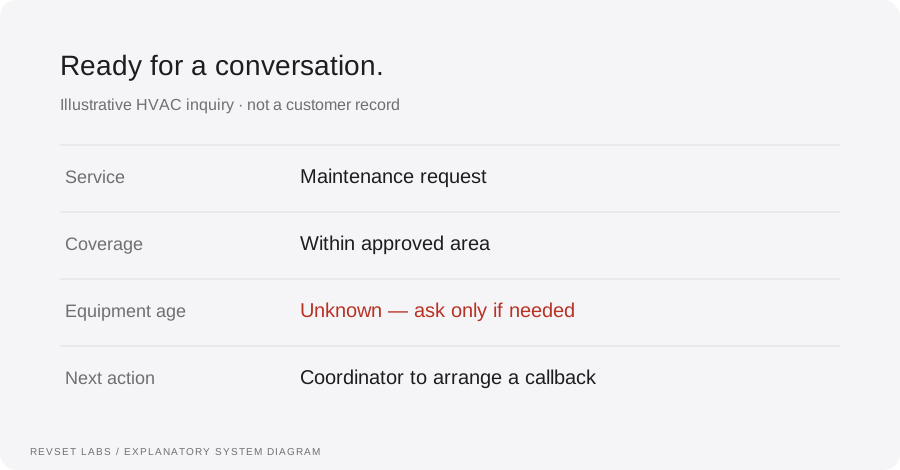
HVAC lead qualification questions
- Is this a repair, replacement, or maintenance request?
- What is the system doing, in your own words?
- Do you know the equipment type or approximate age? It is fine if not.
- Which times can you speak with the service coordinator?
Record unanswered items as unknown. Ask a follow-up only when it changes the next step.
Plumbing lead qualification questions
- Which fixture or part of the property needs attention?
- Is this an active problem or work you are planning?
- Has your building manager or another contractor already arranged a visit?
- What access details should the coordinator know before arranging service?
Record unanswered items as unknown. Ask a follow-up only when it changes the next step.
Roofing lead qualification questions
- Are you asking about a leak, visible damage, inspection, or replacement?
- When did you first notice the issue?
- Do you have existing inspection notes or photos you can safely share?
- Who should discuss access and the inspection appointment with us?
Record unanswered items as unknown. Ask a follow-up only when it changes the next step.
Remodeling lead qualification questions
- Which space do you want to change, and what would you like it to do better?
- Are you exploring options, working from plans, or ready for an estimate?
- Is there a target period or a date the project depends on?
- Do you have a planning budget, or would an initial scope conversation help establish one?
Record unanswered items as unknown. Ask a follow-up only when it changes the next step.
Cleaning lead qualification questions
- Is this recurring cleaning, a one-time visit, or a move-related clean?
- What type and approximate size of property is it?
- Are there particular rooms or tasks you want included?
- Are there access arrangements or pets the scheduling team should account for?
Record unanswered items as unknown. Ask a follow-up only when it changes the next step.
When should you ask about budget?
Ask when scope and investment affect the appointment you should offer, especially for planned remodeling. Explain why: “That helps us decide whether a planning call or a detailed estimate is the useful next step.” If there is a genuine published minimum, state it accurately. Do not require a budget answer before responding to a straightforward service request, and do not infer spending capacity from a name or neighborhood.
What a natural qualification conversation looks like
Fictional cleaning inquiry received on October 2, 2026. This example assumes service coverage and callback availability have been checked against the business’s own records.
EXAMPLE · CUSTOMER CONVERSATION
CustomerCan you do a move-out clean in 27609 next week? Two bedrooms.
Business assistantWe cover that ZIP code. Is the property going to be empty for the clean?
CustomerYes. I also need the inside of the oven done. Can someone call tomorrow after 2?
Business assistantI’ll include the oven request for the coordinator to confirm scope and pricing. There is a callback slot tomorrow at 2:30 PM Eastern. Would that work?
CustomerYes.
AFTER THE CALLBACK RESERVATION SUCCEEDS
Your callback is confirmed for Saturday, October 3, at 2:30 PM Eastern. The coordinator will confirm the cleaning availability and oven-cleaning details with you.
The assistant never asks again for the ZIP code or bedroom count. It also does not turn a booked phone call into a promised cleaning visit. Include the calendar date in the confirmation, not just “tomorrow.”
How to use the answers: four routing decisions
Ready for the next step
The request matches your service and coverage, and enough information exists to offer the correct appointment. Record which criteria were met. An unknown roof age may be acceptable for an inspection; the wrong service area may not be.
Needs a person
The scope, authorization, location, or request needs judgment. Assign a named queue or owner with the original answers and an explicit open question. Do not silently mark these leads unqualified.
Planning for later
The request is supported but the person is researching a future project. Provide the information they requested and agree an appropriate next contact where permitted. Keep that timing in the record so they do not receive an immediate-booking sequence.
Outside the supported service
Explain the specific mismatch politely. “We do full roof replacements, but do not currently offer gutter cleaning” is clearer than “You do not qualify.” Have someone review ambiguous cases before closing them.
Our AI qualification guide explains how explicit criteria and human review fit together. CallRail’s home-services prompt examples provide product-specific examples of configuring intake questions; your service rules still need to come from your business.
Download and adapt the question bank
Download the questions, routing worksheet, and test cases ↓. Start with one service, define which answers are essential, and review ten real conversations with personal details removed before expanding the script.
What RevSet’s client work demonstrates
In the Auspak International implementation, contextual qualification and assigned callbacks replaced a process that began with exported contact details. The published account reports about 1,100 agent-handled leads and 780 qualified leads receiving chosen-time callbacks. These are first-party reported results in education consulting, not a home-services benchmark; downstream sales were not measured after handover.
Can AI ask these questions?
Yes, as an implementation pattern: an agent can use existing answers, ask for missing context, and propose a route. Validate its interpretation, approved knowledge, action permissions, and handoff behavior. A fluent conversation alone does not prove correct qualification.
How many questions should a lead answer?
There is no universal count. Stop when you have enough information for the agreed next action. If a customer requests a human, make the handoff rather than forcing completion of the script.
Book a consultation to review your lead qualification process. Bring your current form, a redacted conversation, and the criteria your team actually uses to accept a job.
Inspect the technical workflow
How the workflow works
- 01
Define fit before writing the script
Document supported services, coverage, appointment types, staffing, and exceptions. Name the person who approves changes. A question earns its place only if its answer changes a real next action.
- 02
Read the context you already have
Use the form, ad offer, and earlier messages. If the customer has already named the service and ZIP code, confirm coverage from your approved rules and ask the next missing question. Do not make them repeat the whole request.
- 03
Ask, record, and preserve uncertainty
Ask one clear question at a time. Store both the original response and any normalized field used for routing. Use unknown when the person cannot answer. An AI summary must not turn “maybe next month” into a confirmed deadline.
- 04
Choose the next action with an owner
Route a supported request to booking or a coordinator. Give incomplete or conflicting requests a review owner. Keep longer-term projects separate from immediate appointments without treating them as worthless.
- 05
Confirm the handoff
Reserve a valid slot before confirming a callback. Deliver the answers and outstanding questions to the assigned person. Keep scheduling, attempted calls, connected calls, and sales outcomes as distinct states.
WORKED EXAMPLE / ILLUSTRATIVE
A roofing inquiry with enough context to call
Walk through the situation, the design decision, and the checks that belong in a real implementation.
A roofing inquiry with enough context to call
Fictional example: Morgan asks for a roof inspection in an approved service area. They report a stain after rain, do not know the roof age, and can speak tomorrow afternoon. No technical diagnosis or visit has been confirmed.
Read the example against your own process. The same event can require a different action when your business rules differ.
Store the reported symptom and unknown age. Check the company’s triage rules, then assign the inspection coordinator. Ask for a specific callback time from current availability rather than promising a technician tomorrow.
- Context: identify the starting event
- Authority: define permitted actions
- Ownership: name the responsible person
The coordinator receives the request, location, original answers, unknown roof age, and a confirmed callback event if a slot is successfully reserved. The record does not claim a diagnosed leak, booked inspection, or won job.
Budget becomes a premature rejection
A homeowner who does not know the cost may still have a suitable project. For complex work, distinguish an unknown budget from a stated limit below a published minimum. Explain actual minimums and offer human review when scope is unclear.
A workflow is incomplete until the team knows how to recognize and recover from an exception.
Some tenants coordinate approved repairs; some property managers arrange work for owners. Ask who can authorize the proposed work when that matters. Apply the business’s authorization process instead of equating tenancy with a bad lead.
- Inspect: the latest customer state
- Preserve: the original event and history
- Escalate: unresolved exceptions
Test complete answers, an unknown equipment age, a customer who already supplied the ZIP code, an unsupported service, conflicting locations, a tenant with authorization, a budget not yet decided, an urgent request, a request for a person, and an unavailable callback time. Check that the script uses known facts, leaves unknowns intact, creates the appropriate next action, and does not promise unsupported prices or availability.
Test the behavior. Keep the evidence.
Test complete answers, an unknown equipment age, a customer who already supplied the ZIP code, an unsupported service, conflicting locations, a tenant with authorization, a budget not yet decided, an urgent request, a request for a person, and an unavailable callback time. Check that the script uses known facts, leaves unknowns intact, creates the appropriate next action, and does not promise unsupported prices or availability.
An example explains an intended design. Acceptance evidence shows whether your particular implementation behaves that way.
The coordinator receives the request, location, original answers, unknown roof age, and a confirmed callback event if a slot is successfully reserved. The record does not claim a diagnosed leak, booked inspection, or won job.
- Expected: the agreed behavior
- Observed: the actual record and response
- Reviewed: a named acceptance owner
Track a defined cohort of unique inquiries: replied, information sufficient to route, human review required, callback scheduled, and callback connected. Record the question after which conversations stop, but inspect examples before assuming that question caused the drop-off. Illustrative calculation: 30 of 50 inquiries contain enough information for routing, so routing completeness is 60%. If 18 of those 30 schedule a callback, that stage rate is 60%; it is not a sales conversion rate. Audit a sample of rejected and unknown records for missed opportunities.
Example 1 of 3
Illustrative examples. No messages are sent, records changed, or appointments booked.
Where it can go wrong
Budget becomes a premature rejection
A homeowner who does not know the cost may still have a suitable project. For complex work, distinguish an unknown budget from a stated limit below a published minimum. Explain actual minimums and offer human review when scope is unclear.
A tenant is rejected automatically
Some tenants coordinate approved repairs; some property managers arrange work for owners. Ask who can authorize the proposed work when that matters. Apply the business’s authorization process instead of equating tenancy with a bad lead.
Urgency becomes an invented dispatch promise
A request for today is a preference until availability is checked. Potential safety concerns need the company’s approved escalation path. An AI intake conversation should not diagnose a hazard or imply that it provides emergency dispatch.
A score hides the reason
“82 out of 100” is not useful if nobody can explain it. Show the supported service, coverage decision, timing, missing facts, and routing reason. Review incorrect rejections as well as successful bookings.
What to measure
Track a defined cohort of unique inquiries: replied, information sufficient to route, human review required, callback scheduled, and callback connected. Record the question after which conversations stop, but inspect examples before assuming that question caused the drop-off. Illustrative calculation: 30 of 50 inquiries contain enough information for routing, so routing completeness is 60%. If 18 of those 30 schedule a callback, that stage rate is 60%; it is not a sales conversion rate. Audit a sample of rejected and unknown records for missed opportunities.
How to test the implementation
Test complete answers, an unknown equipment age, a customer who already supplied the ZIP code, an unsupported service, conflicting locations, a tenant with authorization, a budget not yet decided, an urgent request, a request for a person, and an unavailable callback time. Check that the script uses known facts, leaves unknowns intact, creates the appropriate next action, and does not promise unsupported prices or availability.
For each sample journey, record the expected response, CRM state, next action, and accountable owner. Inspect what actually happened before calling the workflow complete.
Which answers actually change your next action?
Prepare these decisions
- Choose one service and its coverage rules.
- Mark essential, optional, and already-known answers.
- Assign ambiguous requests to a review owner.
A useful test to walk through
Run one complete inquiry and one with an unknown answer. Confirm that uncertainty stays visible and each request receives an appropriate next action.
See what RevSet implements ↗Platform documentation
This guide describes RevSet’s design approach. Check the vendor’s current documentation for platform-specific behavior and availability.
CallRail: custom prompts and questions for home-service businesses ↗