 revset
AI lead qualification uses a conversational system to gather and interpret information relevant to business fit. It should operate against explicit criteria and hand off cases that are ambiguous or outside its approved scope.
Why this matters in a real business
Qualification is more useful when the sales team can see the underlying answers. A label such as “high intent” is a summary, not a substitute for the service request, area, timing, and questions that produced it.
Inspect the technical workflow
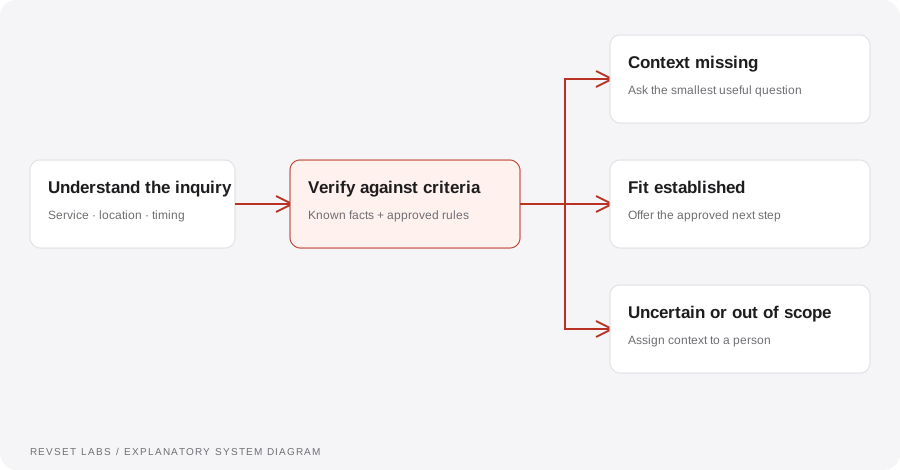
How the workflow works
- 01
Define fit
Write the criteria your team already uses. Distinguish hard requirements, useful preferences, and information that can wait until a human conversation.
- 02
Limit the question set
Ask only what is needed for the next decision. Reuse known details after confirming them when appropriate. A conversational system should not collect extra data simply because it can.
- 03
Ground the response
Provide approved business information, allowed actions, and a route for unsupported questions. Keep qualifications about pricing, scope, and availability attached to the answer.
- 04
Record evidence
Store the supplied answers and the reason for routing. If a field is inferred rather than explicitly provided, preserve that distinction for review.
- 05
Route or escalate
Offer a suitable next step when the criteria are met. Send uncertain, sensitive, or out-of-scope cases to an owner with a concise summary and conversation history.
WORKED EXAMPLE / ILLUSTRATIVE
A prospect fits the area but asks for an exception
Walk through the situation, the design decision, and the checks that belong in a real implementation.
A prospect fits the area but asks for an exception
The prospect supplies an eligible postcode and service type, then asks whether a custom job can be completed tomorrow.
Read the example against your own process. The same event can require a different action when your business rules differ.
The illustrative agent can confirm the known coverage. It cannot approve the unusual scope or commit an unavailable team. It collects the request and creates a human-review handoff.
- Context: identify the starting event
- Authority: define permitted actions
- Ownership: name the responsible person
The team receives the qualifying facts and the unresolved exception. The prospect receives an accurate explanation of the next step.
Invented certainty
A model can produce a fluent answer without a supported business fact. Approved information and review paths matter.
A workflow is incomplete until the team knows how to recognize and recover from an exception.
A qualification score becomes hard to audit when the original answers and decision criteria are missing.
- Inspect: the latest customer state
- Preserve: the original event and history
- Escalate: unresolved exceptions
Test a good-fit inquiry, an uncertain area, contradictory answers, an unsupported pricing request, and a direct request for a person. Inspect both the response and the stored evidence.
Test the behavior. Keep the evidence.
Test a good-fit inquiry, an uncertain area, contradictory answers, an unsupported pricing request, and a direct request for a person. Inspect both the response and the stored evidence.
An example explains an intended design. Acceptance evidence shows whether your particular implementation behaves that way.
The team receives the qualifying facts and the unresolved exception. The prospect receives an accurate explanation of the next step.
- Expected: the agreed behavior
- Observed: the actual record and response
- Reviewed: a named acceptance owner
Review qualification completion, routing accuracy on sampled conversations, unresolved questions, handoff completion, and progression to suitable appointments.
Example 1 of 3
Illustrative examples. No messages are sent, records changed, or appointments booked.
Where it can go wrong
Invented certainty
A model can produce a fluent answer without a supported business fact. Approved information and review paths matter.
A score without evidence
A qualification score becomes hard to audit when the original answers and decision criteria are missing.
An interrogation before value
Long question sequences can prevent people from asking the question they came to resolve.
What to measure
Review qualification completion, routing accuracy on sampled conversations, unresolved questions, handoff completion, and progression to suitable appointments.
How to test the implementation
Test a good-fit inquiry, an uncertain area, contradictory answers, an unsupported pricing request, and a direct request for a person. Inspect both the response and the stored evidence.
For each sample journey, record the expected response, CRM state, next action, and accountable owner. Inspect what actually happened before calling the workflow complete.
What evidence is enough to route an inquiry?
Prepare these decisions
- Name each qualification criterion and whether it is required or optional.
- Define what missing, contradictory, and unsupported answers mean.
- Choose the questions a person must answer before booking or disqualifying.
A useful test to walk through
Create three sample conversations: clearly suitable, clearly outside the service scope, and missing a required fact. A useful qualification design preserves uncertainty in the third case instead of guessing.
See what RevSet implements ↗