 revset
Missed-call text back sends an SMS after an unanswered inbound call when the recipient is eligible to receive it. For a home service business, it gives the caller another way to explain the job while the team is unavailable. A complete process also assigns the reply, records the next action, and tracks whether a callback or appointment actually happens.
Why this matters in a real business
A roofing estimate, an existing customer asking about an invoice, and an urgent repair request can all arrive as missed calls. Treating them as identical new sales leads creates extra work. Start by deciding who reads replies and what they can promise. Then configure the message. This guide describes a proposed workflow for US service teams; its sample business, messages, times, and results are illustrative.
Five missed-call text templates to adapt
Replace bracketed fields before use. These original examples assume your messaging eligibility checks have passed. Keep the first question easy to answer and add further qualification only when it helps route the request.
1. A new estimate inquiry
“[Business]: we couldn’t answer your call. Is this about a new estimate or an existing job? You can reply here. Reply STOP to unsubscribe.”
This separates sales from service without requesting the caller’s full project history.
2. A roofing or remodeling request
“[Business]: thanks for calling about your project. What work are you considering? Reply here and our office can help with the next step. Reply STOP to unsubscribe.”
Use the project reference only when the inquiry context supports it. Ask for the ZIP code next if the service area is unknown.
3. After hours
“[Business]: our office is closed and returns [day, time, timezone]. What do you need help with? This inbox is reviewed during office hours. Reply STOP to unsubscribe.”
Calculate the next opening from the actual holiday schedule. This is unsuitable for an emergency-dispatch promise. See the after-hours response guide for shift handoff examples.
4. An existing customer
“[Business]: we missed your call. Is your question about the scheduled work, a completed job, or billing? Reply here so we can send it to the right person. Reply STOP to unsubscribe.”
Only use this version when the record reliably identifies an existing customer. Do not reveal private job details in an unsolicited opening.
5. A confirmed callback
“Your callback with [team member] is confirmed for [day] at [time, timezone]. We’ll discuss [request]. This is a phone consultation, not a scheduled site visit.”
Send confirmation only after the slot and owner are reserved. If the customer requests a different time, update the reservation before confirming the change.
What happens after the customer replies?
Here is the middle of the Cedar Roof Care example. It shows the difference between collecting details and making a commitment. All messages are illustrative.
- Customer
“A quote to replace my garage roof. ZIP 27609.”
- Business
“We cover that ZIP code. Our estimating team has a callback available today at 3:30 PM Eastern. Would that work?”
- Customer
“Yes, please.”
- After the calendar confirms
“You’re booked for a phone callback with Maya at 3:30 PM Eastern today. She’ll discuss the roof and the next step for an estimate.”
The owner’s task should contain the request, coverage check, agreed time, callback number, and conversation history. If the calendar rejects the slot, keep the request open and offer a verified alternative. Do not send a confirmation optimistically.
How to set up missed-call text back in HighLevel
HighLevel’s current documentation places the feature under Settings → Phone System → Voice → Voicemail & Missed Call Text Back. Enable it, customize the opening, and use the test action. Its documentation also states that the built-in feature can send a text for each missed call, including repeated attempts. Use workflow controls when you need a different repeat-call policy. Read HighLevel’s current setup instructions ↗
Before turning on a custom workflow, check whether the built-in feature is already active. Two independent responders can send two messages for one call. Test forwarding and voicemail on the actual business number, not only a software preview. RevSet’s proposed ownership and callback controls extend beyond simply switching on the vendor feature.
Messaging permissions and opt-outs belong in the setup
Check your provider’s requirements before activating automatic SMS. Twilio’s policy requires consent, clear sender identification, and an accessible opt-out. It distinguishes a reply to an inbound text from permission for recurring messages. Do not treat an unanswered voice call as blanket permission for a marketing sequence. Read Twilio’s messaging policy ↗
Record the applicable permission, honor suppression across connected workflows, and review the specific use case and jurisdiction before launch. The examples here are message drafts, not a determination that any particular contact may be texted.
Questions to settle before buying a system
Do I need AI for missed-call text back?
No. A fixed rule can send an approved acknowledgement. AI may help interpret open-ended replies, collect missing details, and prepare a handoff. Use it only where the business rules and escalation path are clear.
How much should I budget?
Request separate figures for setup, software, the phone number, messaging usage, registration where applicable, integrations, and ongoing support. Ask how messages are billed and what happens to failed deliveries. “Price per text” alone does not describe the operating cost.
Can I keep my existing business number?
That depends on the carrier, routing, and messaging setup. Have the implementer verify the number customers call, the sender customers will see, and where replies arrive. Do not assume that call forwarding alone establishes SMS capability.
Will this recover every missed job?
No. Some callers cannot receive texts, do not reply, are outside your service area, or have already chosen another provider. Measure actual conversations and completed work rather than assigning a job value to every missed call.
Start with one number and one accountable team
Download the missed-call launch checklist ↓. It includes the routing decisions, record fields, test cases, and weekly review measures for a first implementation.
RevSet’s Auspak International case study describes related work connecting qualification, lead records, and chosen-time callbacks. It is an education-consultancy project, not a home-service missed-call benchmark.
If your callers already reach voicemail but their replies still lack an owner, book a consultation about your missed-call process. Bring your call routing, business hours, CRM, and an anonymized example of a missed handoff.
For an additional editorial perspective on message wording, see Boost Local Biz’s missed-call text examples. The templates and worked example on this page were written for this guide.
Inspect the technical workflow
How the workflow works
- 01
Connect the actual call path
Identify the number customers dial, where calls ring, and where the final call status is recorded. Test a live answer, busy line, unanswered call, and voicemail using your own test number. A phone system may report voicemail or a forwarded leg differently from a human answer. Define which final states should trigger recovery before enabling messages.
- 02
Check whether a text should be sent
Check SMS capability, messaging eligibility, suppression preferences, and whether a person has already responded. Preserve the call identifier so a retried event cannot trigger another message. If the caller cannot receive SMS, create a callback task instead of repeatedly retrying the same delivery.
- 03
Match the caller to the current conversation
Look for an existing customer record and an open request. Keep each call in the history, but avoid opening several opportunities for the same job. A repeat call during an active conversation should update the assigned owner rather than restart the greeting.
- 04
Send a short, accurate opening
Identify the business and ask one useful question. Do not say the crew is on a job unless you know that, or promise a callback time without coverage. Record the attempted send and delivery status separately. The templates below are starting points to adapt after reviewing your messaging setup.
- 05
Route the reply and agree the next step
Use service type, location, and the customer’s request to choose the owner. An existing invoice question belongs with support or accounts, not a new-estimate sequence. Offer a callback only against actual team availability. Store the agreed time and timezone; notify the person who must make the call.
- 06
Close the loop on the human action
Keep scheduled, attempted, connected, and completed callbacks as distinct outcomes. Pause generic follow-up when a person takes over or the request closes. If the owner misses the due time, raise an overdue task for the backup owner. A sent text or scheduled callback does not establish that a job was won.
WORKED EXAMPLE / ILLUSTRATIVE
A missed roofing inquiry becomes an assigned callback
Walk through the situation, the design decision, and the checks that belong in a real implementation.
A missed roofing inquiry becomes an assigned callback
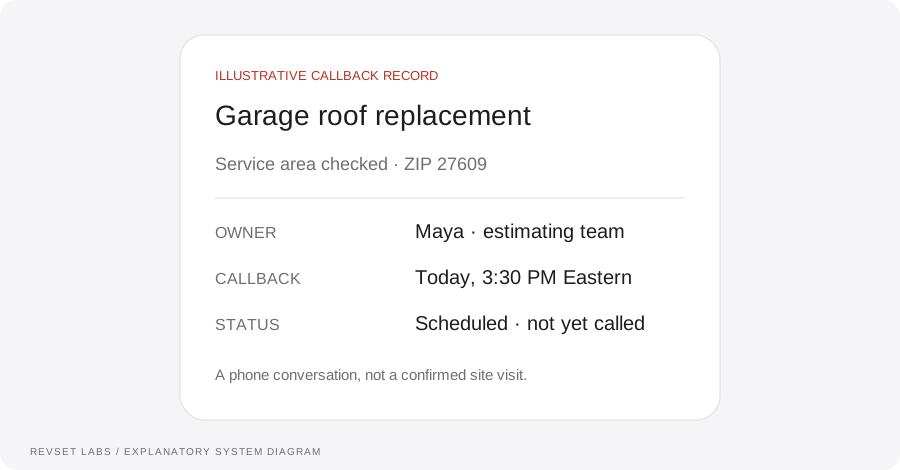
Illustrative example: Cedar Roof Care misses a call at 2:10 PM. The caller has an eligible SMS record, no active conversation, and asks about replacing a garage roof. The office can accept estimate callbacks that afternoon.
Read the example against your own process. The same event can require a different action when your business rules differ.
Collect the ZIP code and project type, check the approved coverage area, then offer a callback slot from the office calendar. When the caller chooses 3:30 PM Eastern and the system confirms the reservation, assign it to Maya with the conversation summary.
- Context: identify the starting event
- Authority: define permitted actions
- Ownership: name the responsible person
The record shows “callback scheduled,” owner Maya, 3:30 PM Eastern, garage roof replacement, and the confirmed service area. It changes to “connected” only after the callback outcome is recorded. No price, installation date, or completed sale has been promised.
A second call restarts the entire sequence
Choose a repeat-call policy for the same active inquiry. For example, preserve the new call in the history and notify the owner while suppressing another opening text. Do not silently discard repeated calls: they may signal urgency or a failed prior handoff.
A workflow is incomplete until the team knows how to recognize and recover from an exception.
Name a primary owner and a backup for each shift. Make unassigned replies and overdue callbacks visible in a daily queue. An automatic acknowledgement without anyone responsible for the answer only moves the delay to another channel.
- Inspect: the latest customer state
- Preserve: the original event and history
- Escalate: unresolved exceptions
Before release, test an answered call, missed call, voicemail, repeated event, repeat caller, existing customer, after-hours request, opt-out, unsupported number, failed delivery, and a human takeover. For each case, inspect the message, contact record, task owner, due time, and stop condition. Use consenting test numbers. Launch with a monitored scope and review every exception before expanding coverage.
Test the behavior. Keep the evidence.
Before release, test an answered call, missed call, voicemail, repeated event, repeat caller, existing customer, after-hours request, opt-out, unsupported number, failed delivery, and a human takeover. For each case, inspect the message, contact record, task owner, due time, and stop condition. Use consenting test numbers. Launch with a monitored scope and review every exception before expanding coverage.
An example explains an intended design. Acceptance evidence shows whether your particular implementation behaves that way.
The record shows “callback scheduled,” owner Maya, 3:30 PM Eastern, garage roof replacement, and the confirmed service area. It changes to “connected” only after the callback outcome is recorded. No price, installation date, or completed sale has been promised.
- Expected: the agreed behavior
- Observed: the actual record and response
- Reviewed: a named acceptance owner
Use a defined cohort of unique missed-call inquiries, keeping repeat calls separately. Track eligible inquiries, delivered opening texts, replies, assigned callbacks, connected callbacks, booked visits, and completed jobs. Illustrative example: 40 eligible inquiries, 36 delivered texts, 12 replies, 8 scheduled callbacks, and 6 connected callbacks means delivery coverage is 36/40 = 90%, reply rate among delivered texts is 12/36 = 33.3%, and callback completion is 6/8 = 75%. These are examples, not RevSet benchmarks. They do not prove six additional sales. Inspect unanswered inquiries as well as averages, and compare like-for-like periods before attributing improvement to the workflow.
Example 1 of 3
Illustrative examples. No messages are sent, records changed, or appointments booked.
Where it can go wrong
A second call restarts the entire sequence
Choose a repeat-call policy for the same active inquiry. For example, preserve the new call in the history and notify the owner while suppressing another opening text. Do not silently discard repeated calls: they may signal urgency or a failed prior handoff.
The reply goes into an unmonitored inbox
Name a primary owner and a backup for each shift. Make unassigned replies and overdue callbacks visible in a daily queue. An automatic acknowledgement without anyone responsible for the answer only moves the delay to another channel.
A booking link implies the wrong service
An estimate callback is different from a technician visit. State the appointment type explicitly and use the correct calendar. If coverage, job scope, or capacity is uncertain, ask for human review before allowing self-booking.
The message fails but the workflow says complete
Inspect delivery failures and record the next action. Do not mark the customer contacted simply because an API accepted a send request. Stop automatic retries when the number is unsuitable or the recipient is suppressed.
What to measure
Use a defined cohort of unique missed-call inquiries, keeping repeat calls separately. Track eligible inquiries, delivered opening texts, replies, assigned callbacks, connected callbacks, booked visits, and completed jobs. Illustrative example: 40 eligible inquiries, 36 delivered texts, 12 replies, 8 scheduled callbacks, and 6 connected callbacks means delivery coverage is 36/40 = 90%, reply rate among delivered texts is 12/36 = 33.3%, and callback completion is 6/8 = 75%. These are examples, not RevSet benchmarks. They do not prove six additional sales. Inspect unanswered inquiries as well as averages, and compare like-for-like periods before attributing improvement to the workflow.
How to test the implementation
Before release, test an answered call, missed call, voicemail, repeated event, repeat caller, existing customer, after-hours request, opt-out, unsupported number, failed delivery, and a human takeover. For each case, inspect the message, contact record, task owner, due time, and stop condition. Use consenting test numbers. Launch with a monitored scope and review every exception before expanding coverage.
For each sample journey, record the expected response, CRM state, next action, and accountable owner. Inspect what actually happened before calling the workflow complete.
Who owns the reply after your missed-call text?
Prepare these decisions
- Map the actual phone routing and final call states.
- Approve messaging eligibility, repeat-call behavior, and staffed hours.
- Assign a callback owner and backup with a visible due time.
A useful test to walk through
Miss a test call, reply with a service request, then call again before the callback. Confirm one conversation, one current owner, and no duplicate opening message.
See what RevSet implements ↗Platform documentation
This guide describes RevSet’s design approach. Check the vendor’s current documentation for platform-specific behavior and availability.
HighLevel: missed-call text-back setup and repeat-call behavior ↗Twilio: messaging consent, sender identification, and opt-out policy ↗