 revset
An HVAC lead-to-booking problem occurs when a relevant inquiry does not reach a confirmed next appointment. That may reflect a broken contact path, delayed response, unclear ownership, unavailable appointment capacity, or an unresolved customer question. Count inquiries, appointments, completed jobs and collected payments separately before deciding what to change.
Why this matters in a real business
Buying more traffic will not repair a broken phone link or an unanswered callback task. Equally, automating follow-up cannot create demand where few suitable people find the business. Trace the customer’s actual journey to identify which problem you have. Repair, replacement and maintenance inquiries should be reviewed separately because their timing and next steps differ.
Five places HVAC inquiries lose their next step
1. Search result to working contact path
Open the exact page a prospect reaches from your profile or search result. Does it explain the requested service, real coverage and operating hours? On a phone, tap the phone number and test the form with a controlled address. Confirm the intended destination received the inquiry. A visually attractive button is not evidence of a functioning call path.
For discovery, review accurate business information and relevant service pages. Google describes relevance, distance and prominence as local-ranking factors. Posting more often alone does not guarantee more suitable inquiries.
2. Inquiry to useful response
A missed call needs an owner and an appropriate callback path. A permitted acknowledgement can ask for the service request, but should not claim that a technician is coming. Compare the inquiry time with the first useful response, and preserve any integration delay. See our missed-call message examples.
3. Conversation to qualified handoff
Ask enough to route the request: service, property location, desired timing and the next conversation. Reuse facts already supplied. Preserve uncertainty instead of guessing a diagnosis or rejecting a customer because they do not know the equipment model. The person receiving the handoff needs the original question, not just a score.
4. Qualified request to confirmed appointment
Check whether the calendar represents the right work and actual capacity. Record a successful reservation before confirming a time. A full schedule is a capacity decision for the business, not proof that marketing found the wrong customer. Route requests that cannot be booked to a visible owner with an honest next step.
5. Appointment or estimate to recorded decision
After the conversation, who answers the scope question? Which estimate version is current? When should the next check-in happen? Stop generic follow-up on replies and decisions. Your estimator approves options and commercial terms; the system helps keep the conversation from disappearing.
A worked audit: 40 inquiries, several different problems
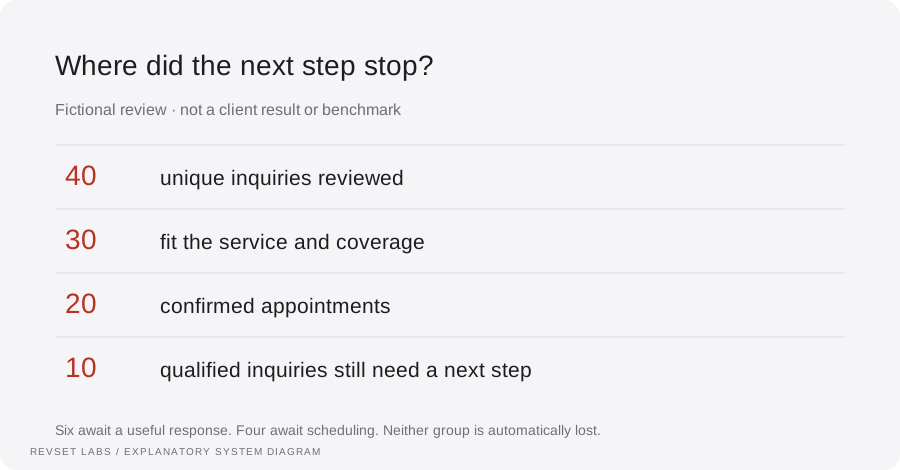
This is a fictional arithmetic example, not a RevSet result or an industry benchmark. A company reviews 40 unique inquiries from one source over a defined period. Ten are outside its supported service or coverage. Of the remaining 30, six have no useful response, four are awaiting a scheduling decision, and twenty have confirmed appointments.
- Qualified inquiry share: 30 ÷ 40 = 75%.
- Booking rate among qualified inquiries: 20 ÷ 30 = 66.7%.
- Qualified inquiries without a useful response: 6 ÷ 30 = 20%.
The first investigation is those six unanswered requests and four scheduling cases. It would be misleading to call all twenty unbooked inquiries “bad leads,” or to describe the twenty appointments as completed jobs. Check attendance and delivery records later.
What to investigate when calls fall
Validate the measurement before explaining the cause. Has the phone number or call-tracking configuration changed? Is the mobile link working? Did website traffic, relevant search visibility, staffing or service demand change? Check the actual interval of any outage and the affected pages.
Report what is known, what was fixed and what remains uncertain. A broken contact path is a real defect, but without suitable evidence you cannot attribute every missing call to it. Review a comparable period after repair, and do not hide the unresolved evidence behind a reassuring percentage.
The business needs both operational accountability and honest attribution. Use the revenue reporting guide to define stages before building a dashboard.
Questions HVAC owners ask
Should I increase the advertising budget?
First establish whether relevant inquiries can reliably reach a person and book the right next step. If that path is working but demand is insufficient, assess acquisition separately. Ad spend and implementation fees are different costs, and neither guarantees a particular number of jobs.
Will an AI receptionist solve this?
It can be part of a scoped response workflow, but it still needs approved answers, working integrations, escalation and a staffed owner. Voice, messaging and booking capabilities should be tested in the actual tools before making customer promises.
What if we already use field-service software?
Review native features and how the office actually uses them before adding another platform. The gap may be an approval rule, missing field, failed alert or unclear responsibility rather than missing software.
Can automation follow up on old customers?
Only through a reviewed process with a relevant reason, suitable contact eligibility and stop rules. A past job does not make every campaign appropriate. Maintenance history, renewal dates and customer preferences should shape the next message.
Review ten inquiries before rebuilding everything
Download the HVAC inquiry review worksheet ↓. Give each unresolved request a specific reason, responsible person and next action. Use that review to choose the first improvement.
RevSet’s HVAC marketing and sales implementation connects discovery, response, booking and follow-through around the agreed scope. Our Auspak account describes related qualification and callback work in education consulting; the case study explains the implementation and measured outcomes.
Inspect the technical workflow
How the workflow works
- 01
Choose a defined sample
Review consecutive inquiries from one source and time period. Separate repeat contacts about the same request from genuinely new projects. Keep failed and unresolved inquiries in the sample.
- 02
Trace the first contact attempt
Test mobile call links and forms yourself, then inspect the corresponding business record. Record original inquiry time, receipt, first useful response and whether a person actually connected.
- 03
Check fit and ownership
Was the service supported, location covered and customer request understood? Identify the current responsible person and the unresolved question. Unknown equipment age alone should not silently end the conversation.
- 04
Verify the next appointment
Look for a real calendar event with the correct type, owner and time zone. A callback is not a service visit. Record unavailable slots and cancellations rather than describing every unbooked inquiry as low quality.
- 05
Follow the recorded outcome
Inspect attendance, estimate, acceptance, completed work and payment when applicable. Change one repeated failure, test the fix, and observe the next comparable sample. Small samples diagnose examples; they do not establish a reliable uplift.
WORKED EXAMPLE / ILLUSTRATIVE
A replacement prospect is waiting for clarification
Walk through the situation, the design decision, and the checks that belong in a real implementation.
A replacement prospect is waiting for clarification
Fictional example: a homeowner requests replacement options. The team sends an estimate, but the prospect asks whether the two options include the same installation scope. The CRM still says “follow up.”
Read the example against your own process. The same event can require a different action when your business rules differ.
Pause generic reminders and give the estimator the question with the current estimate version. Let the estimator answer from approved scope and equipment information. Record the actual customer decision afterward.
- Context: identify the starting event
- Authority: define permitted actions
- Ownership: name the responsible person
The immediate fix is an owned answer, not another sales message or ad campaign. The inquiry may progress, remain undecided or close; none of those outcomes should be invented by the automation.
Calls and jobs become the same metric
A call may be a repeat question, supplier, existing customer or unsupported request. Define a qualified new inquiry and track it through the relevant appointment and job records.
A workflow is incomplete until the team knows how to recognize and recover from an exception.
An automatic response may arrive quickly while the estimator does not see the request until the next day. Measure useful response and accepted ownership separately.
- Inspect: the latest customer state
- Preserve: the original event and history
- Escalate: unresolved exceptions
Use controlled test records to check a mobile phone link, website form, missed call, missing ZIP, unsupported service, unavailable coordinator, full calendar, reschedule, scope-change reply and opt-out. Confirm the expected owner and next action, not just a successful-looking screen. Test notifications and downstream records as well as the public page.
Test the behavior. Keep the evidence.
Use controlled test records to check a mobile phone link, website form, missed call, missing ZIP, unsupported service, unavailable coordinator, full calendar, reschedule, scope-change reply and opt-out. Confirm the expected owner and next action, not just a successful-looking screen. Test notifications and downstream records as well as the public page.
An example explains an intended design. Acceptance evidence shows whether your particular implementation behaves that way.
The immediate fix is an owned answer, not another sales message or ad campaign. The inquiry may progress, remain undecided or close; none of those outcomes should be invented by the automation.
- Expected: the agreed behavior
- Observed: the actual record and response
- Reviewed: a named acceptance owner
Start with unique qualified inquiries, confirmed appointments and completed jobs. Add timestamps and source context to explain the handoffs. When comparing periods, use consistent definitions and observation windows. An open estimate needs time to reach a decision; a recently acquired inquiry should not be compared with one observed for months.
Example 1 of 3
Illustrative examples. No messages are sent, records changed, or appointments booked.
Where it can go wrong
Calls and jobs become the same metric
A call may be a repeat question, supplier, existing customer or unsupported request. Define a qualified new inquiry and track it through the relevant appointment and job records.
Fast acknowledgement hides a slow handoff
An automatic response may arrive quickly while the estimator does not see the request until the next day. Measure useful response and accepted ownership separately.
Every inquiry uses the same calendar
Repair triage, replacement consultations and maintenance visits require different duration, staffing and service rules. Do not offer a slot merely because a generic calendar looks empty.
A seasonal comparison becomes a causal claim
A different month may have different weather, service demand, capacity, promotions or source mix. Record those changes before attributing a fall or increase entirely to marketing.
What to measure
Start with unique qualified inquiries, confirmed appointments and completed jobs. Add timestamps and source context to explain the handoffs. When comparing periods, use consistent definitions and observation windows. An open estimate needs time to reach a decision; a recently acquired inquiry should not be compared with one observed for months.
How to test the implementation
Use controlled test records to check a mobile phone link, website form, missed call, missing ZIP, unsupported service, unavailable coordinator, full calendar, reschedule, scope-change reply and opt-out. Confirm the expected owner and next action, not just a successful-looking screen. Test notifications and downstream records as well as the public page.
For each sample journey, record the expected response, CRM state, next action, and accountable owner. Inspect what actually happened before calling the workflow complete.
Which handoff stops a suitable inquiry from progressing?
Prepare these decisions
- Choose a consecutive inquiry sample.
- Separate qualification, response and availability failures.
- Assign the next action and test the contact path.
A useful test to walk through
Submit a controlled HVAC inquiry and trace the record, owner, response and confirmed next appointment. Record failures rather than inferring a booking from an acknowledgement.
See what RevSet implements ↗Platform documentation
This guide describes RevSet’s design approach. Check the vendor’s current documentation for platform-specific behavior and availability.
Google: local ranking factors and accurate Business Profile information ↗