 revset
Revenue-system reporting measures how inquiries progress through defined stages and where they stop. It connects operational events to commercial outcomes while keeping attribution assumptions visible.
Why this matters in a real business
Sent messages and created tasks show activity. They do not establish whether a workflow generated a customer. A useful reporting model separates system execution, prospect progression, and business outcomes.
Inspect the technical workflow
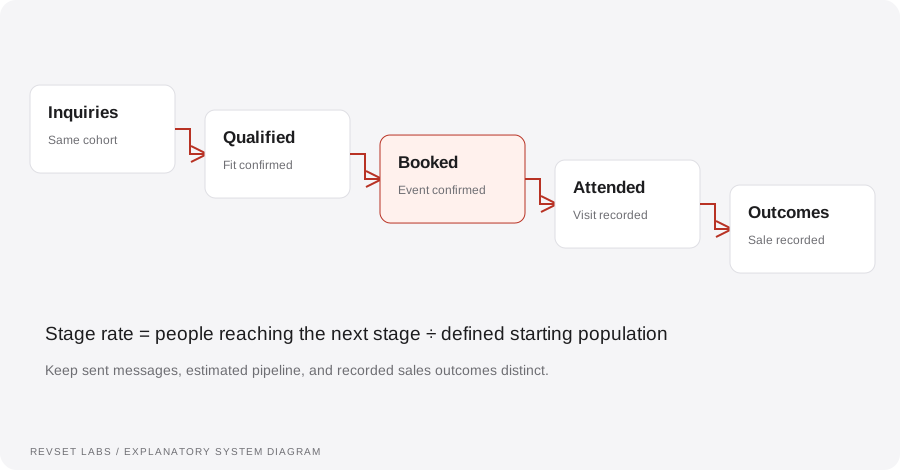
How the workflow works
- 01
Define the events
Agree on received inquiry, meaningful response, qualified inquiry, booked appointment, attended appointment, and closed outcome. Include timestamps and stable identifiers.
- 02
Choose the population
Decide whether a report groups inquiries by arrival date or counts events that happened in a period. These views answer different questions and can produce different rates.
- 03
Connect the records
Link the contact, opportunity, appointment, and outcome. Review missing joins rather than silently dropping incomplete records from the denominator.
- 04
State attribution
Describe how source credit is assigned. A first-touch view and a latest-touch view can both be useful, but neither proves that a single touch caused the sale.
- 05
Review exceptions
Inspect delayed events, duplicated opportunities, cancellations, and missing outcomes. Pair a dashboard with a process for correcting the underlying data.
WORKED EXAMPLE / ILLUSTRATIVE
Bookings rise while attendance falls
Walk through the situation, the design decision, and the checks that belong in a real implementation.
Bookings rise while attendance falls
A sample report shows more bookings in one period but a lower share of attended appointments.
Read the example against your own process. The same event can require a different action when your business rules differ.
Look at the same inquiry cohort, appointment types, cancellation behavior, lead mix, and reminder delivery. Check whether the booking definition changed.
- Context: identify the starting event
- Authority: define permitted actions
- Ownership: name the responsible person
The team investigates the full journey rather than declaring success from booking volume alone.
Mixed denominators
Bookings from older inquiries divided by this month’s new inquiries can produce a misleading conversion rate.
A workflow is incomplete until the team knows how to recognize and recover from an exception.
An appointment is not a completed sale. Keep pipeline estimates separate from recorded outcomes.
- Inspect: the latest customer state
- Preserve: the original event and history
- Escalate: unresolved exceptions
Reconcile a small cohort manually from original inquiry to final outcome. Confirm that the dashboard counts agree and that missing outcomes are visible.
Test the behavior. Keep the evidence.
Reconcile a small cohort manually from original inquiry to final outcome. Confirm that the dashboard counts agree and that missing outcomes are visible.
An example explains an intended design. Acceptance evidence shows whether your particular implementation behaves that way.
The team investigates the full journey rather than declaring success from booking volume alone.
- Expected: the agreed behavior
- Observed: the actual record and response
- Reviewed: a named acceptance owner
Use a small operational set: response coverage, qualification completion, qualified-to-booked conversion, attendance, recorded sales outcomes, and unresolved system failures.
Example 1 of 3
Illustrative examples. No messages are sent, records changed, or appointments booked.
Where it can go wrong
Mixed denominators
Bookings from older inquiries divided by this month’s new inquiries can produce a misleading conversion rate.
Revenue inferred from appointments
An appointment is not a completed sale. Keep pipeline estimates separate from recorded outcomes.
A before-and-after result called causation
Seasonality, spend, staffing, lead quality, and pricing may also change during an implementation.
What to measure
Use a small operational set: response coverage, qualification completion, qualified-to-booked conversion, attendance, recorded sales outcomes, and unresolved system failures.
How to test the implementation
Reconcile a small cohort manually from original inquiry to final outcome. Confirm that the dashboard counts agree and that missing outcomes are visible.
For each sample journey, record the expected response, CRM state, next action, and accountable owner. Inspect what actually happened before calling the workflow complete.
What exactly is the denominator?
Prepare these decisions
- Choose one metric, cohort definition, observation period, and source.
- Separate activity counts from customer outcomes and confirmed sales.
- Record changes in lead source, offer, pricing, and sales team alongside results.
A useful test to walk through
Compare a source producing many low-fit inquiries with one producing fewer qualified inquiries. Inspect both raw counts and stage conversion before deciding which workflow needs attention.
See what RevSet implements ↗