 revset
An autonomous revenue architecture is the arrangement of systems that receive customer events, maintain business records, select permitted next actions, execute those actions, and report what happened.
Why this matters in a real business
Buying several capable tools does not automatically connect a journey. The architecture needs a clear authority for each fact and a deliberate way to move information between components.
Inspect the technical workflow
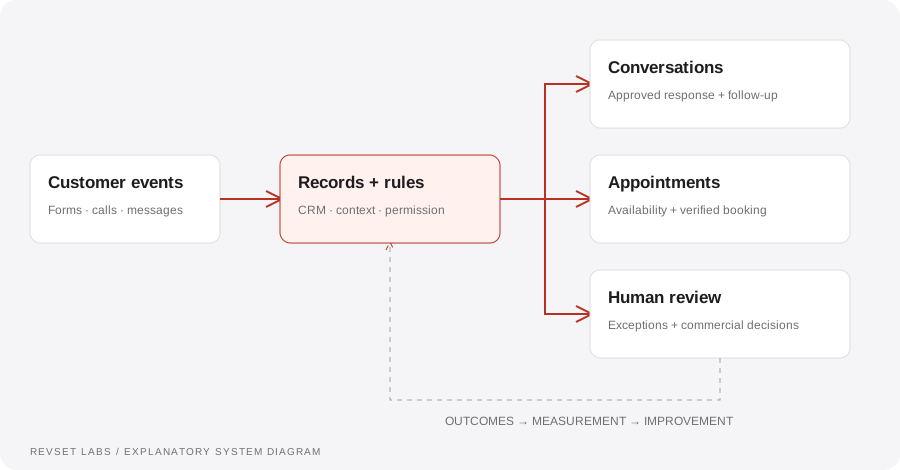
How the workflow works
- 01
Sources
Website forms, calls, messaging, referrals, and campaigns produce events. Preserve the source and the original context.
- 02
System of record
The CRM maintains contacts, opportunities, ownership, and stage history. Other systems can remain authoritative for their own facts, such as calendar availability.
- 03
Decision layer
Rules and AI interpret the event within approved boundaries. They choose a next action, ask for a missing detail, or escalate.
- 04
Action layer
Messaging, calendars, tasks, and record updates execute the selected operation. Capture success and failure separately.
- 05
Feedback layer
Reporting, operational review, and customer responses inform the next iteration. Changes should have an owner and a way to validate their effects.
WORKED EXAMPLE / ILLUSTRATIVE
A form becomes an appointment
Walk through the situation, the design decision, and the checks that belong in a real implementation.
A form becomes an appointment
An illustrative prospect submits a service request with a location and preferred time.
Read the example against your own process. The same event can require a different action when your business rules differ.
Capture the event, match the contact, check the service rules, obtain actual calendar availability, create the booking, and update the opportunity after confirmation.
- Context: identify the starting event
- Authority: define permitted actions
- Ownership: name the responsible person
Each component contributes a specific fact or action. The architecture records the chain and can identify the point that needs attention if it fails.
Two sources of truth for one fact
If a spreadsheet and a calendar both claim final authority over availability, conflicts are inevitable.
A workflow is incomplete until the team knows how to recognize and recover from an exception.
Important decisions need an explicit specification and observable behavior.
- Inspect: the latest customer state
- Preserve: the original event and history
- Escalate: unresolved exceptions
Trace an event through every component. Identify the authority, identifier, output, failure mode, and responsible owner at each boundary.
Test the behavior. Keep the evidence.
Trace an event through every component. Identify the authority, identifier, output, failure mode, and responsible owner at each boundary.
An example explains an intended design. Acceptance evidence shows whether your particular implementation behaves that way.
Each component contributes a specific fact or action. The architecture records the chain and can identify the point that needs attention if it fails.
- Expected: the agreed behavior
- Observed: the actual record and response
- Reviewed: a named acceptance owner
Assess end-to-end journey completion, record consistency, failure recovery, handoff quality, and whether the team can explain what the system will do next.
Example 1 of 3
Illustrative examples. No messages are sent, records changed, or appointments booked.
Where it can go wrong
Two sources of truth for one fact
If a spreadsheet and a calendar both claim final authority over availability, conflicts are inevitable.
Business rules hidden inside prompts
Important decisions need an explicit specification and observable behavior.
A diagram without recovery paths
Exception handling, ownership, and observability belong in the design alongside the normal journey.
What to measure
Assess end-to-end journey completion, record consistency, failure recovery, handoff quality, and whether the team can explain what the system will do next.
How to test the implementation
Trace an event through every component. Identify the authority, identifier, output, failure mode, and responsible owner at each boundary.
For each sample journey, record the expected response, CRM state, next action, and accountable owner. Inspect what actually happened before calling the workflow complete.
Where does each important fact live?
Prepare these decisions
- Map the inquiry, conversation, opportunity, calendar, and decision records.
- Assign an authoritative system for each field that drives a workflow.
- Define how events move between tools and where exceptions are inspected.
A useful test to walk through
Trace a single appointment from customer intent to confirmed calendar entry and pipeline update. For each handoff, identify the input, permitted action, confirmation, and failure owner.
See what RevSet implements ↗