 revset
A revenue-system implementation plan specifies the customer journey to be changed, the work required, the dependencies, the acceptance criteria, and who operates the system after launch.
Why this matters in a real business
“We will automate your sales” does not define a deliverable. An implementation is reviewable when both parties can identify the exact trigger, expected behavior, exception path, and proof that the workflow operates as agreed.
Inspect the technical workflow
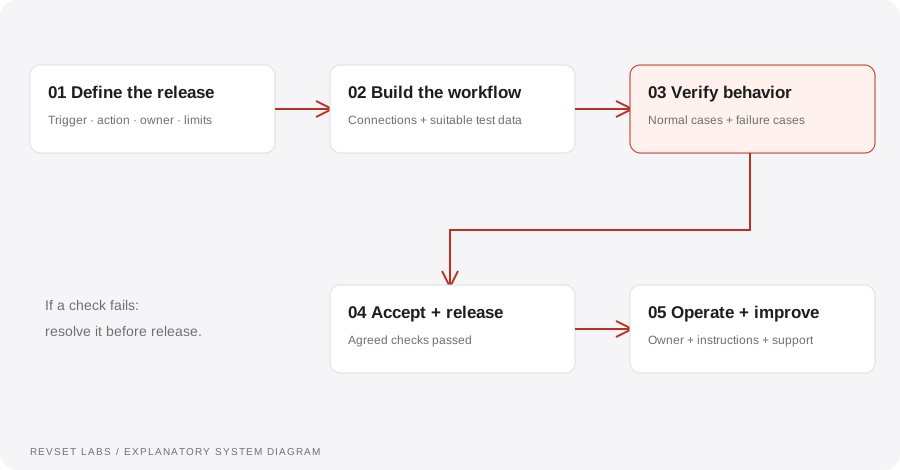
How the workflow works
- 01
Discovery and baseline
Map the current journey and identify one measurable problem. Record the tools, owners, current data quality, and observed performance.
- 02
Design and scope
Document the proposed workflow, allowed actions, integrations, field mapping, and handoff rules. State what belongs in the first release.
- 03
Build and test
Configure the components and test representative journeys. Include replies, opt-outs, missing information, integration failures, and conflicts.
- 04
Launch and ownership
Agree on access, approvals, rollout sequence, rollback options, training, and the owner for day-to-day exceptions.
- 05
Review and support
Define monitoring, support scope, change requests, documentation updates, and the metrics used to evaluate the implementation.
WORKED EXAMPLE / ILLUSTRATIVE
Start with unanswered inquiries
Walk through the situation, the design decision, and the checks that belong in a real implementation.
Start with unanswered inquiries
A service business has a functioning CRM but new inquiries sometimes remain unassigned.
Read the example against your own process. The same event can require a different action when your business rules differ.
The first scope covers inquiry capture, ownership, acknowledgement, and an exception queue. Reactivation and advanced reporting remain separately defined work.
- Context: identify the starting event
- Authority: define permitted actions
- Ownership: name the responsible person
The buyer can review a concrete first implementation and its acceptance criteria before adding more workflows.
A fixed date without dependencies
Access, data cleanup, internal approvals, and platform limits can change what is feasible.
A workflow is incomplete until the team knows how to recognize and recover from an exception.
Separate implementation fees from platform subscriptions, messaging usage, and ongoing support.
- Inspect: the latest customer state
- Preserve: the original event and history
- Escalate: unresolved exceptions
Request the current-state map, proposed architecture, field and trigger specification, acceptance test results, operating guide, cost assumptions, and support responsibilities.
Test the behavior. Keep the evidence.
Request the current-state map, proposed architecture, field and trigger specification, acceptance test results, operating guide, cost assumptions, and support responsibilities.
An example explains an intended design. Acceptance evidence shows whether your particular implementation behaves that way.
The buyer can review a concrete first implementation and its acceptance criteria before adding more workflows.
- Expected: the agreed behavior
- Observed: the actual record and response
- Reviewed: a named acceptance owner
Track agreed acceptance criteria, unresolved issues, operational ownership, and the original problem metric. Avoid changing the success measure after seeing the result.
Example 1 of 3
Illustrative examples. No messages are sent, records changed, or appointments booked.
Where it can go wrong
A fixed date without dependencies
Access, data cleanup, internal approvals, and platform limits can change what is feasible.
Software costs hidden inside the service
Separate implementation fees from platform subscriptions, messaging usage, and ongoing support.
No definition of done
A visual automation canvas is not an acceptance test. Evaluate actual sample journeys and failure cases.
What to measure
Track agreed acceptance criteria, unresolved issues, operational ownership, and the original problem metric. Avoid changing the success measure after seeing the result.
How to test the implementation
Request the current-state map, proposed architecture, field and trigger specification, acceptance test results, operating guide, cost assumptions, and support responsibilities.
For each sample journey, record the expected response, CRM state, next action, and accountable owner. Inspect what actually happened before calling the workflow complete.
What must be demonstrated before you accept the build?
Prepare these decisions
- Define one release with explicit deliverables and exclusions.
- List access, data preparation, approvals, and vendor-plan dependencies.
- Agree sample acceptance journeys and operating responsibilities before configuration starts.
A useful test to walk through
Write one acceptance case with the starting event, expected message, resulting record, next action, and owner. Then add a stop condition and a tool failure. Use those cases to clarify the scope discussion.
See what RevSet implements ↗