 revset
Rule-based automation executes specified actions when defined conditions are met. A chatbot is a conversational interface. An AI agent can interpret context and select or use permitted tools. A revenue system may combine all three.
Why this matters in a real business
These categories overlap. A chatbot can use simple rules or an AI model, and an agent still needs deterministic controls around important business actions. The useful question is what behavior the workflow requires.
Inspect the technical workflow
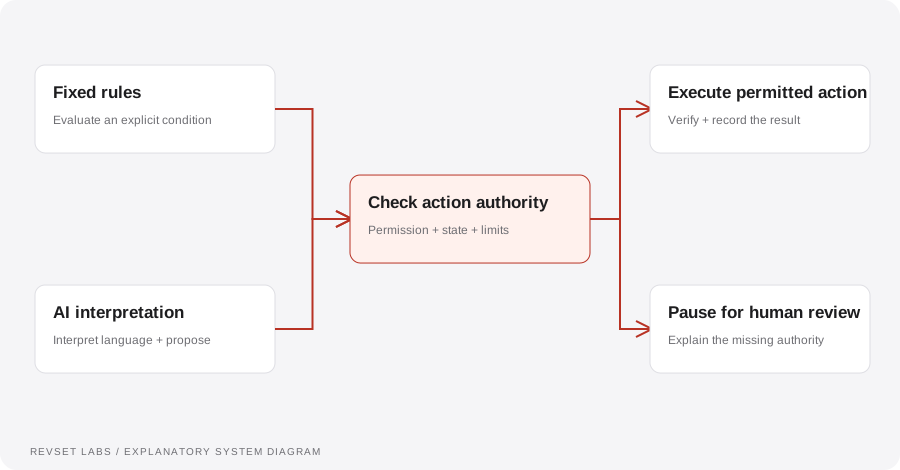
How the workflow works
- 01
Use rules for known decisions
When the criteria are explicit, such as a confirmed appointment changing a pipeline stage, a deterministic rule can be straightforward to test.
- 02
Use conversation for missing context
A conversational interface can ask questions and explain next steps. It should not require a complex agent when a short form would serve the visitor better.
- 03
Use AI where interpretation helps
An AI component can interpret varied wording or summarize an interaction. Specify approved knowledge and verify outputs needed for later actions.
- 04
Constrain tool use
Permitted actions, required fields, access, and exception routes remain part of the system specification. A model should not independently invent commercial authority.
- 05
Evaluate the combination
Test the complete journey. A good model response does not guarantee a correct calendar event or an accurate CRM record.
WORKED EXAMPLE / ILLUSTRATIVE
A natural question with a deterministic outcome
Walk through the situation, the design decision, and the checks that belong in a real implementation.
A natural question with a deterministic outcome
A prospect writes, “Could someone come out next week? We’re just outside your usual area.”
Read the example against your own process. The same event can require a different action when your business rules differ.
An AI component can interpret the request and collect the location. A defined service-area rule determines whether automatic booking is permitted. An exception is routed to a person.
- Context: identify the starting event
- Authority: define permitted actions
- Ownership: name the responsible person
Flexible language handling and predictable business controls serve different parts of the same interaction.
Adding AI to a settled rule
More complexity can make a simple event-to-action workflow harder to inspect.
A workflow is incomplete until the team knows how to recognize and recover from an exception.
A chat interface may not update records, coordinate follow-up, or recover from failures.
- Inspect: the latest customer state
- Preserve: the original event and history
- Escalate: unresolved exceptions
Write a small set of typical and difficult requests. Evaluate both the response and every downstream change against explicit expected behavior.
Test the behavior. Keep the evidence.
Write a small set of typical and difficult requests. Evaluate both the response and every downstream change against explicit expected behavior.
An example explains an intended design. Acceptance evidence shows whether your particular implementation behaves that way.
Flexible language handling and predictable business controls serve different parts of the same interaction.
- Expected: the agreed behavior
- Observed: the actual record and response
- Reviewed: a named acceptance owner
Compare task completion, accuracy of resulting actions, exception quality, maintenance effort, and operating cost under representative workloads.
Example 1 of 3
Illustrative examples. No messages are sent, records changed, or appointments booked.
Where it can go wrong
Adding AI to a settled rule
More complexity can make a simple event-to-action workflow harder to inspect.
Calling any chatbot an autonomous system
A chat interface may not update records, coordinate follow-up, or recover from failures.
Evaluating only the conversation
Judge the resulting actions, permissions, record updates, and handoffs as well as the words.
What to measure
Compare task completion, accuracy of resulting actions, exception quality, maintenance effort, and operating cost under representative workloads.
How to test the implementation
Write a small set of typical and difficult requests. Evaluate both the response and every downstream change against explicit expected behavior.
For each sample journey, record the expected response, CRM state, next action, and accountable owner. Inspect what actually happened before calling the workflow complete.
Does this step need a fixed rule or language interpretation?
Prepare these decisions
- Separate deterministic business rules from open-ended language tasks.
- Define the information the model can use and the actions it may request.
- Keep permission, eligibility, and commercial approval checks explicit.
A useful test to walk through
Compare a fixed booking confirmation with a customer asking an ambiguous service question. Use the simplest reliable mechanism for each, and test the boundary when the question cannot be answered from approved information.
See what RevSet implements ↗