
Best Follow-Up Timing by Lead Source
Title Tag: Best Time to Follow Up Leads: 7 Proven Timing Benchmarks Meta Description: Learn the best time to follow up leads by source — referral, paid, organic, missed-call, and more — with practical timing benchmarks. URL Slug: /best-time-to-follow-up-leads/
Not every lead has the same degree of urgency, intent, or trust.
A consumer who calls after being suggested by a friend is not the same as someone who clicks on a Google Ad and fills out a form. While a repeat client might already know exactly who they want to talk to, a missed-call lead has already made an effort to get in touch with you.
However, a lot of companies follow up with them all at the same time.
This leads to a straightforward but costly issue: where a lead originated, what they did, and what they are likely to do next all play a major role in determining when it is best to follow up with them.
Lead follow-up is viewed by RevSet Labs as a revenue operations issue rather than just a sales task. “How quickly can we contact this person?” is not the sole question. “What does this specific lead source tell us about intent, urgency, trust, and the next appropriate action?” is another question.
The similar idea behind the quote-follow-up framework: rather than delivering the same messages only because a certain period of time has elapsed, client behavior should dictate the next course of action.
This distinction is crucial because, although speed to lead is significant, relevant speed is far more beneficial.
Why Follow-Up Timing Should Change by Lead Source
There is no universal answer to the question, “When should I follow up with leads?”
A useful starting point is to separate leads into three broad categories:
- High-intent inbound leads: Paid search, website forms, missed calls
- Warm relationship-based leads: Referrals and repeat customers
- Lower-intent or outbound leads: Cold prospects and less engaged contacts
The risk of delay increases with the speed at which the prospect has shown intent.
Contact efforts made within five minutes of an online query had much higher probabilities of success than those made later, according to research from InsideSales/XANT. The report also highlights that the time interval between a web query and the initial effort at contact is referred to as reaction time.
That does not imply that every company has to contact every lead in precisely five minutes. This means that the buyer’s expressed desire should be reflected in the first-response window.
For example, five minutes could seem like a long time when someone calls for emergency plumbing services.
Five minutes might not be needed if someone downloads an instructional guide.
An automated email might not be the best course of action if an existing client calls because their present service is no longer functioning.
Therefore, the appropriate lead response time depends on the circumstance.
Best Time to Follow Up Leads by Source
A RevSet Labs practical framework looks like this:
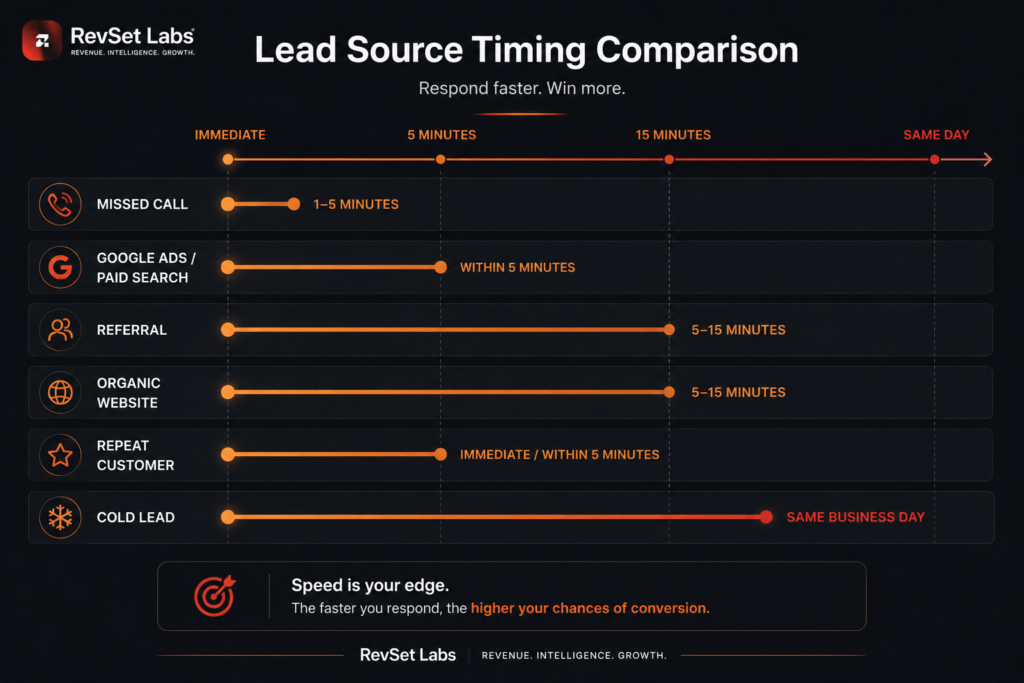
| Lead Source | First Response | Follow-Up Approach |
|---|---|---|
| Missed call | Within 1–5 minutes | Call back immediately, then SMS |
| Google Ads / Paid Search | Within 5 minutes | Call + SMS/email |
| Referral | Within 5–15 minutes | Personal call or direct message |
| Organic Website Lead | Within 5–15 minutes | Personalized call/email |
| Repeat Customer | Immediate or within 5 minutes | Human-first response |
| Cold Lead | Same business day | Multi-touch cadence |
| Outbound Lead | Planned outreach window | Research-led sequence |
The actual SLA should be influenced by urgency, industry, business hours, service type, lead quality, and staffing capacity.
Making every lead move at the same speed is not the goal.
It is to ensure that each lead gets a suitable response before the buying momentum fades.
Best Follow-Up Timing by Lead Source
Paid Leads: Respond While Intent Is Fresh
Paid leads, particularly those from Google Ads, frequently merit one of the quickest response times.
A need is openly expressed when someone searches for “emergency HVAC repair,” “roof replacement quote,” or “dentist near me.” Additionally, they can be comparing many suppliers concurrently.
Because of this, it’s typically better to follow up with Google Ads leads as soon as the query gets to the CRM.
RevSet Labs targets the following for high-intent paid leads:
- 0–5 minutes: First meaningful response
- 5–15 minutes: Second contact attempt if appropriate
- Same business day: Additional personalized follow-up
- Next business day: Continued cadence if there is no response
Instead of just saying, “Thank you for contacting us,” the initial response should address the specific question.
For example:
“Hello Sarah, your request to replace your air conditioning system has been received. I can assist you in verifying your availability and discussing the next course of action. Could we have a brief phone conversation?”
This response attests to the company’s comprehension of the reason for the contact.
The more general idea that prompt follow-up is important is also supported by Gong’s study. According to its data, sellers saw higher win rates and shorter contract durations when they finished follow-up activities within one business day.
Best day and time to call paid leads
For inbound paid leads, when the lead arrives is frequently more crucial than waiting for a supposedly perfect day or hour.
If the lead arrives Tuesday at 2:10 PM, responding Tuesday at 2:12 PM is typically more logical than waiting until Wednesday AM since a benchmark suggests Wednesday is a strong calling day.
That is the gap between speed to lead and general sales-call timing.
Organic Leads: Fast, But More Contextual
Organic leads can come from SEO pages, blog posts, contact forms, Google Business Profile searches, or other unpaid channels.
Their intentions might differ greatly.
A person looking up “how much does a new roof cost?” might still be doing some research.
A buyer is much closer to making a purchase when they visit a roofing service website and request a quote.
For this reason, the timing of follow-ups for paid and organic leads shouldn’t be the same.
For an organic form with high intent: 5–15 minutes is a strong operational target.
For a content inquiry with a lower intent: It might be better to do so within the same working day.
The message should also reflect the page or action that generated the lead.
If someone submitted a form on a “Kitchen Remodeling” page, the sales representative should know that before calling.
This is where CRM tracking becomes valuable.
The representative should ideally see:
- Lead source
- Landing page
- Service requested
- Form submission time
- Previous interactions
- Lead score
- Assigned salesperson
Without that context, fast follow-up can still feel generic.
Referral Leads: Speed Builds on Existing Trust
Because some confidence has already been exchanged, referral leads are distinct.
A friend, coworker, partner, or current client may introduce a referred prospect.
The ideal time to follow up with referral leads is thus somewhat quickly, but the tone should be more intimate than that of a response to a purchased lead.
A suitable objective is: 5 to 15 minutes, if at all feasible, or on the same working day.
It’s not a given that referral leads will vanish after five minutes.
The reason is that although the introduction is still new, the reference establishes social context that has to be recognized.
Instead of:
“Hello, just checking in regarding your question.”
Try:
“Hello Mark, you could need assistance with your business HVAC system, Sarah said. While the introduction was still new, I wanted to get in touch with you to see what you needed.”
That doesn’t feel like a chilly sales encounter; rather, it feels like an extension of an already-existing communication.
Additionally, the CRM should monitor referral leads in a distinct way.
Along with the date of referral and pertinent relationship background, the referring customer or partner should be included.
Both the first answer and the subsequent follow-up cadence may be impacted by that information.
Missed-Call Leads: The Follow-Up Should Be Immediate
One of the most obvious indicators of purpose is a missed call.
The potential customer has already made a proactive move.
They tried to get in touch by picking up their phone, looking up the company, or using a number they were provided.
The follow-up shouldn’t wait till tomorrow if the company doesn’t respond.
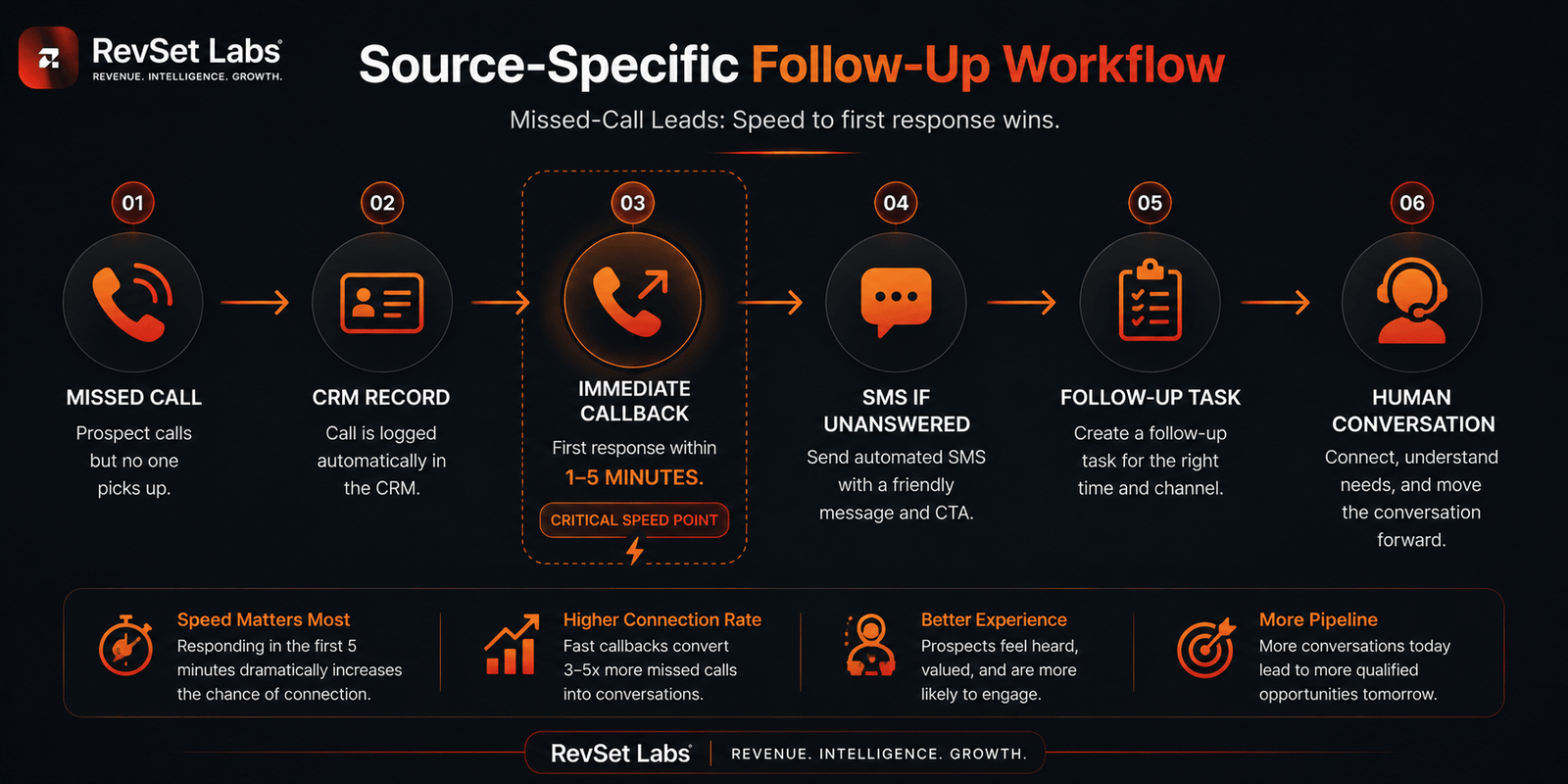
During business hours, it’s typically advisable to follow up on leads from missed calls right away or within five minutes.
A simple workflow can be:
Missed call → CRM record → immediate callback → SMS if unanswered → task for additional follow-up
For example:
“Hello James, this is ABC Plumbing’s Mike. We apologize for missing your call. If you would want to let me know what you need help with, I am accessible right now.”
Because the message acknowledges the customer’s behavior, it functions.
The reason you are contacting the customer does not need to be explained.
They are already aware.
Missed-call automation can be particularly useful for urgent service companies since, in the event that no one answers, the client might contact the next rival.
Repeat Customers: Prioritize the Relationship
It is not necessary to put recurring clients in the same automatic queue as fresh leads.
They have a past already.
They could be familiar with the business, the agent, the service procedure, and even the cost.
Therefore, it’s usually ideal to follow up on a lead from an existing client as soon as it’s practically feasible.
When a recurring client requests a different service, their current account owner should be contacted right away.
CRM data should tell the representative:
- What services the customer previously purchased
- Who handled the account
- Previous communication
- Existing contracts
- Service history
- Open issues
- Previous preferences
CRM tracking transcends record keeping at this point.
It turns into a means of maintaining the framework of relationships.
Every time a consumer contacts the business, they shouldn’t have to justify their past.
Cold Leads Need a Different Clock
Inbound inquiries are not the same as cold leads.
They haven’t necessarily tried to get in touch with your business, asked for information, or asked for a price.
This implies that “immediately” is not always the optimum time to follow up with cold leads.
There must be a purpose for cold outreach.
It can be preferable to arrange the initial contact according to the prospect’s job, industry, business hours, and probable availability.
While Gong’s cold-calling research has traditionally shown Wednesday and Thursday to be excellent days for cold calls, its current sales-engagement recommendation indicates that Tuesday and Wednesday mornings have strong connect rates for calls in its dataset.
It’s crucial to avoid making these figures into strict guidelines.
Eventually, you should learn more from your own contact rate.
Track:
Lead source → Day → Time → Channel → Contact rate → Response rate → Meeting rate
Over time, this gives you a source-specific timing model.
The Best Time of Day to Follow Up With Leads
Businesses often ask for one universal answer: morning, afternoon, or evening?
There isn’t one.
According to Gong’s sales-engagement standards, Tuesday and Wednesday mornings have high call connect rates in its dataset, while afternoon emails often result in greater reply rates than morning emails.
According to another Gong study, afternoon sales calls might have lower no-show rates than morning calls; in the particular dataset examined, 4 PM outperformed 8 AM.
These results show that the optimal time and day to call a lead should be considered an optimization issue rather than a general guideline.
- React right away to incoming leads.
- Use the buyer’s chosen time for scheduled sales calls.
- Test certain days and hours for chilly outreach.
- Give urgency and relationships a priority for loyal consumers.
- Call back right away if you missed a call.
The clock is altered by the source.
When to Follow Up With Inbound vs Outbound Leads
Treating incoming and outgoing prospects as though they had the same expectations is one of the greatest mistakes companies make.
Inbound leads initiated the interaction. They could have sent a message, made an appointment, called, completed a form, or asked for a quote.
Outbound leads did not necessarily initiate the conversation. They may have been found through account research, LinkedIn, prospecting, a database, or recommendations.
This means that two distinct operational models are needed to determine whether to follow up with inbound vs outbound leads.
Inbound — Prioritize:
- Fast first response
- Context
- Immediate routing
- Multiple channels when appropriate
- Clear next step
Outbound — Prioritize:
- Relevance
- Timing
- Personalization
- Persistence
- Multi-touch follow-up
The inbound model is primarily about preserving existing intent.
The outbound model is about creating interest.
Confusing the two can make inbound follow-up too slow and outbound outreach too aggressive.
Build a Lead Follow-Up Timing Matrix
RevSet Labs thinks of follow-up as a decision system.
The CRM should not simply say:
“Lead came in → send email.”
It should ask:
“What kind of lead is this, what did they do, and what should happen next?”
A RevSet Labs matrix looks like:
| Lead Signal | Priority | First Action | Next Step |
|---|---|---|---|
| Missed call | Very high | Immediate callback | SMS + task |
| Paid search form | Very high | Call within minutes | Email/SMS |
| Referral | High | Personal call | Relationship-based follow-up |
| High-intent organic form | High | Call/email | Value-based follow-up |
| Repeat customer | Very high | Existing owner contact | Personalized service |
| Cold prospect | Medium | Planned outreach | Multi-touch cadence |
This approach is much more useful than assigning every lead the same five-minute SLA.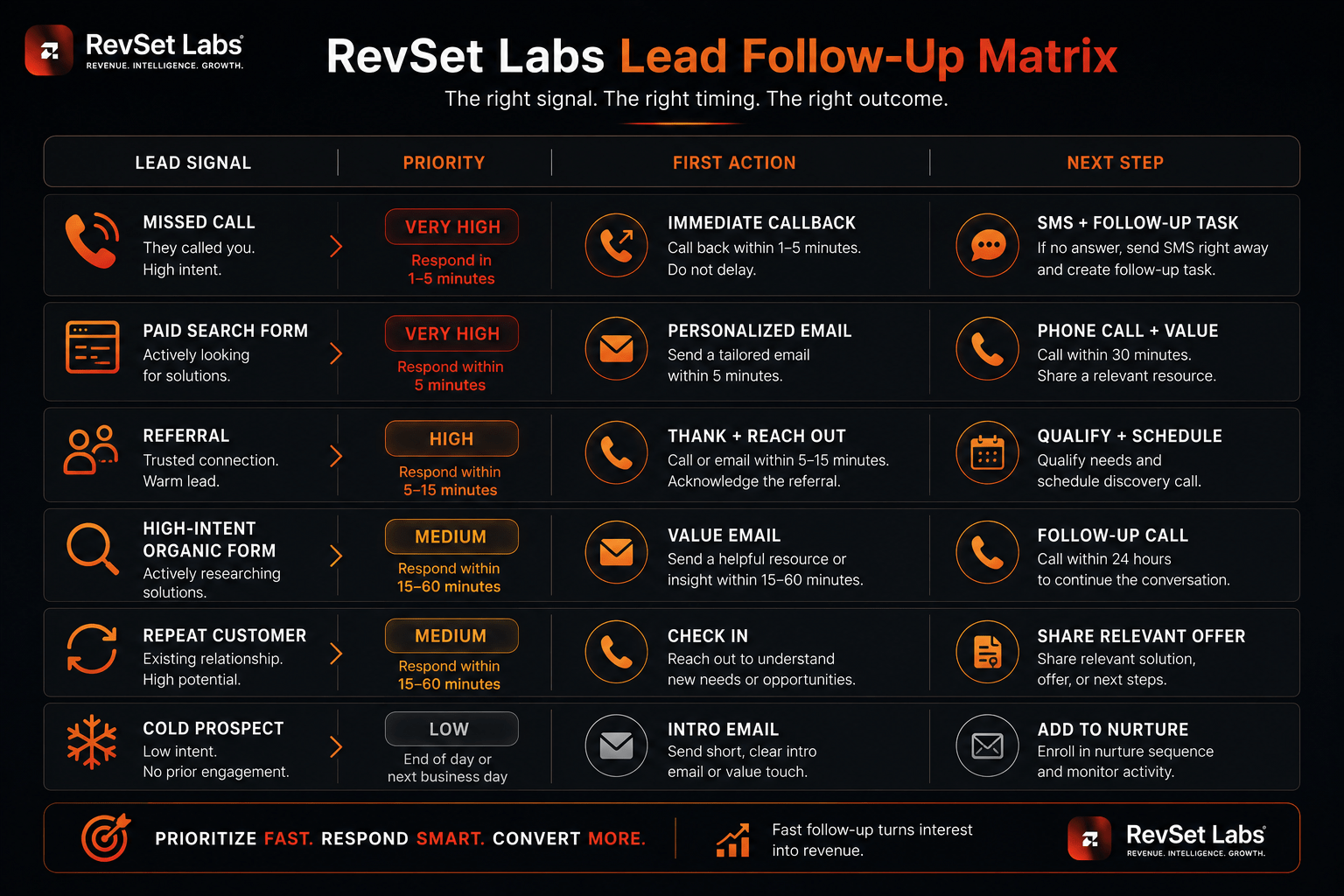
Why Faster Does Not Always Mean Better
Speed is important.
However, speed without significance might lead to other issues.
Imagine that thirty seconds after downloading a lengthy industry study, someone gets a call requesting a sales meeting.
Technically, the company’s reaction speed is outstanding.
It can be overly aggressive from an operational standpoint.
For this reason, RevSet Labs distinguishes between response quality and reaction speed.
Three questions should be addressed in a compelling initial response:
- Do we understand why the prospect contacted us?
- Are we responding within an appropriate window?
- Have we made the next step easy?
The quickest feasible communication is not the only objective.
The fastest practical contact is the aim.
Create a Multi-Touch Follow-Up Cadence
One response is rarely enough.
If the prospect does not respond, the business needs a defined follow-up cadence.
For high-intent inbound leads, a practical sequence could be:
- Day 0: Immediate call + personalized message
- Day 0: Second attempt if appropriate
- Day 1: Helpful follow-up
- Day 2–3: Value-based contact
- Day 5–7: Decision or timing check
- Later: Nurture based on lead quality
Each source should have a different precise cadence.
Missed-call lead needs many rapid efforts.
A referral requires a more intimate discussion.
Longer sequence could be necessary for a chilly lead.
Recurring client might just want an immediate response from their current contact.
According to Gong’s study, a more successful sales cycle may be achieved by altering the timing, channel, and goal of each contact rather than relying solely on “just checking in” communications.
This also holds for managing incoming leads.
Measure Response Rate by Hour and Source
The best timing strategy eventually comes from your own data.
Instead of asking only:
“What is the best time to follow up with leads?”
Ask:
- What is our hourly contact rate?
- What is our hourly response rate?
- Which source needs greater attention?
- What is the fastest converting source?
- Which day has the highest rate of reservations?
- What is the impact of initial response time on conversion?
- After the initial interaction, which leads turn into opportunities?
- Which lead sources provide the most income?
Lead scoring and CRM monitoring are crucial in this situation.
It is not appropriate to approach a lead who downloaded an article six weeks ago in the same way as one who replies promptly, examines price sites, answers emails, and asks for a quote.
The system ought to set priorities according to behavior.
As a result, the ideal lead reaction time is defined in a far more practical way.
The RevSet Labs Approach to Lead Follow-Up Timing
RevSet Labs’ objective is not to build a complicated automation system just because technology makes it possible.
The objective is to create a reliable process that connects:
Lead Source → Intent → CRM → Routing → Response → Follow-Up → Conversation → Revenue
The initial urgency is determined by the source.
What occurs next is determined by the conduct.
The context is maintained by the CRM.
Automation manages repetitive tasks, speed, routing, and reminders.
People deal with criticism, objections, difficult questions, and important discussions. (See our full breakdown of manual vs. automated lead response.)
This hybrid strategy avoids two typical mistakes.
The first is under-response: follow-ups rely on someone’s recollection, leads remain in inboxes, and calls are missed.
The second is over-automation: when all leads, regardless of relationship or purpose, get the identical messaging.
Controlled responsiveness is the superior model.
When to escalate, when to wait, when to act swiftly, and when a human should take control should all be recognized by the system.
A Simple Rule for Choosing Follow-Up Timing
If you need one practical framework, use this:
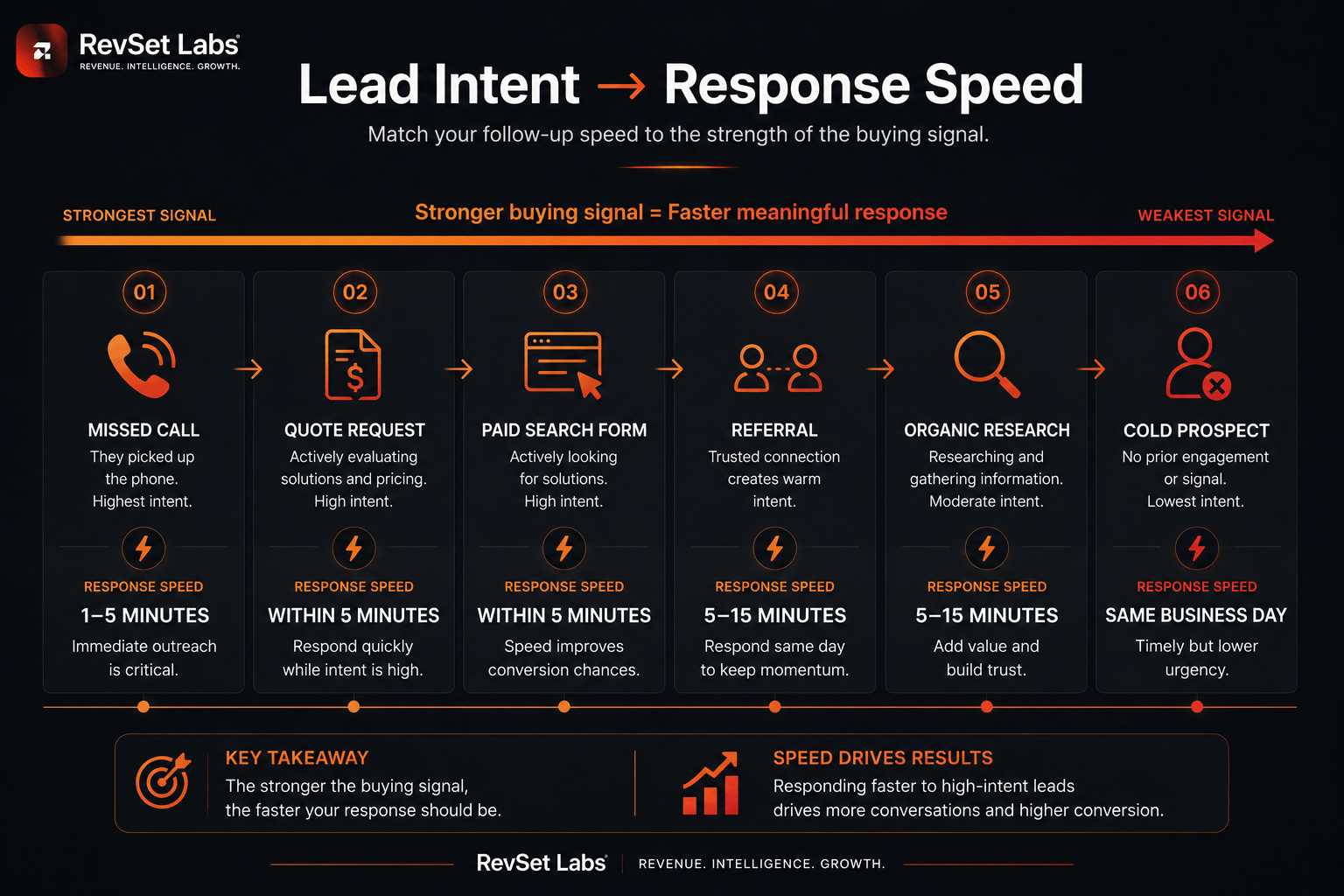
The stronger the buying signal, the faster the first meaningful response should be.
A missed call is more powerful than a downloaded piece of material.
Requesting a quotation is more powerful than simply seeing the website.
A cold prospect is weaker than a request from a returning consumer.
Because trust has already been conveyed, a referral is warmer.
This means that rather than following an arbitrary company-wide guideline, follow-up scheduling for various lead sources should be based on the intensity of the purchasing signal.
This is also the reason why two persons who submitted forms five minutes apart may have different optimal times for following up on leads.
One could be prepared to purchase.
Perhaps the other is still conducting a study.
Your staff should be able to distinguish between them with the aid of your CRM.
Final Thoughts
No single timepiece is suitable for all prospects.
The ideal time to follow up on a lead varies on a number of factors, including the source of the lead, the action taken, the urgency of the demand, the level of trust previously established, and the buyer’s expectations.
Since purpose is already apparent, paid search and missed-call leads typically call for the quickest reaction.
Depending on the activity made, organic leads need to be timed.
Reaching out to referral leads quickly and personally is beneficial.
Recurring clients should be treated with consideration for their relationships.
Instead of adopting an immediate-response attitude, cold leads necessitate a more thoughtful multi-touch cadence.
The most important lesson is that lead follow-up scheduling by source should be planned as part of the revenue process rather than being the responsibility of individual salespeople.
Lead source, CRM capture, response time, routing, follow-up, buyer behavior, and conversion are all examined by RevSet Labs.
The issue can be with the system rather than the effort if your company is producing leads yet response times are inconsistent, missed calls go unanswered, or salespeople are not clear when to follow up.
FAQs
What is the best time to follow up with a new lead?
Responding within minutes is a good operating goal for high-intent incoming leads. While lower-intent leads might follow a slower cadence, missed calls and urgent service questions should often be handled right away.
What is the best time to follow up with Google Ads leads?
When your team is available, try to reply to high-intent Google Ads leads within five minutes. Instead of providing a general acknowledgment, the initial answer should make reference to the particular service or request.
What is the best time to follow up with referral leads?
Ideally, a referral lead should be personally contacted during business hours. The chat may feel more like a friendly introduction than a cold sales call if the recommending person or relationship is mentioned.
How quickly should I call a missed lead?
Call back as quickly as you can if a lead phoned and no one picked up. For many service firms, an instant callback or a response within five minutes is a reasonable goal during business hours.
Is fast follow-up always better?
Not always. When purchasing intent is high, speed is most important. A quick reaction that is too forceful or devoid of context may perform worse than a slightly delayed response that takes into account the demands of the prospect.
What is the best day and time to call leads?
The ideal moment does not exist for everyone. While past Gong research has indicated good performance for afternoon-scheduled calls, current Gong benchmarks demonstrate great call connect rates on Tuesday and Wednesday mornings. Timing should be tested by businesses using their own contact and conversion statistics.
How does follow-up timing differ by lead source?
Due to their higher purpose, paid and missed-call prospects typically need quicker answers. While cold prospects often need a planned multi-touch cadence, referral and repeat-customer leads should get relationship-aware answers.
How can a CRM improve lead follow-up timing?
The lead source, timestamp, activity, owner, prior exchanges, and follow-up tasks may all be recorded by a CRM. Instead of depending on memory or a single general follow-up sequence, this enables firms to develop various response rules.
Stop Losing Leads to Slow Follow-Up
Your method, not the amount of leads, may be the issue if your team is producing leads yet response times differ, missed calls go unanswered, or salespeople are unsure of who should follow up next.
By connecting lead collection, CRM routing, automation, follow-up, and human handoff, RevSet Labs assists companies in developing quicker and more intelligent lead-response systems.
Check for leaks in your revenue process: Execute the RevSet Labs Revenue Leak Scorecard.