
What Is Speed to Lead? A Practical Guide for Service Businesses
Every lead is an opportunity your company already paid to create. Whether someone finds you through Google, a Facebook ad, a referral, or your website, their inquiry signals real intent to buy.
But generating the lead is only half the job. What happens in the minutes after someone reaches out often decides whether they become a customer — or go with a competitor instead.
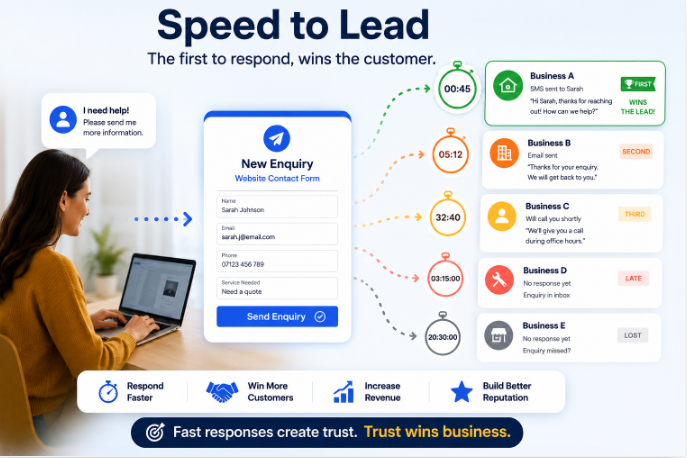
Picture a homeowner searching for an emergency plumber after a pipe bursts, or a business owner looking for a marketing partner to launch a new campaign. Prospects like these rarely contact just one company. They reach out to several, compare responses, check reviews, and usually choose whoever replies first with confidence and clarity.
That’s why speed to lead has become one of the most important performance metrics for service businesses today.
Whether you run an HVAC company, a plumbing service, a roofing business, a law firm, a healthcare clinic, a marketing agency, or a consultancy, improving how fast you respond to inbound inquiries can increase appointments, conversions, and revenue — without spending another dollar on ads.
Unlike growing your ad budget, improving speed to lead lets you get more value out of the leads you’re already paying for.
In this guide, you’ll learn:
- What speed to lead means
- Why it matters for service businesses
- The difference between an acknowledgement and a meaningful response
- Recommended response-time benchmarks
- Why the first five minutes are so critical
- The most common causes of slow response times
- How automation improves lead response
- RevSet Labs’ six-stage Speed-to-Lead Framework
- Practical ways to stop losing revenue to delayed responses
What Is Speed to Lead?
Speed to lead is the amount of time it takes for a prospective customer to contact your business and receive their first relevant response.
In short, it measures how quickly your company turns a customer’s curiosity into a real interaction.
The clock starts the moment a lead:
- Fills out a website contact form
- Sends a message on Instagram or Facebook
- Messages your Google Business Profile
- Calls your business
- Starts a live chat
- Books an appointment online
- Responds to a marketing campaign
- Sends an email inquiry
The clock stops when your business makes meaningful contact, such as:
- A phone call from a team member
- A personalized text message
- A personalized email from a salesperson
- A live chat conversation
- An invitation to a video consultation
- An appointment confirmation with real back-and-forth
Speed to lead isn’t only about being fast — it’s about reaching prospects while their interest is highest. For service businesses, this metric reflects more than operational efficiency. It shows how well your marketing, sales, and customer support teams work together to turn leads into paying customers.
Acknowledgement vs. Meaningful Response
One of the most common misconceptions about speed to lead is that an automated confirmation email counts as a response to a prospect.
It doesn’t.
Understanding the difference between an acknowledgement and a meaningful response helps your business track the right KPIs and deliver a better customer experience.
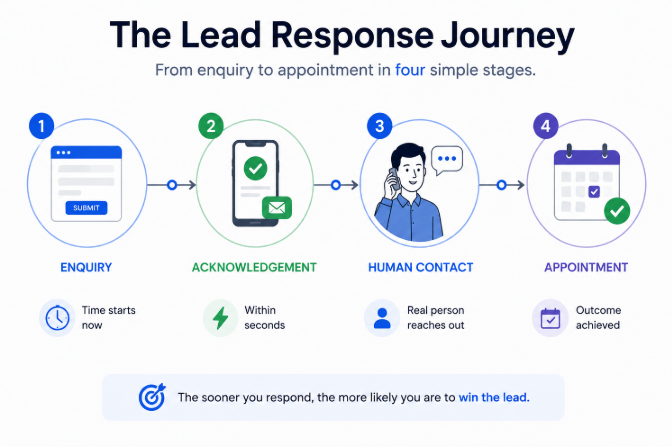
| Stage | What It Means | Example |
| Acknowledgement | Confirms the inquiry was received | Automated email or SMS: “We’ve received your inquiry.” |
| First Human Contact | A real team member reaches out | Salesperson calls or sends a personalized message |
| Conversation | Two-way communication begins | Customer answers the call or replies to the message |
| Booking or Resolution | The next business objective is completed | Appointment scheduled, or a quote is requested |
Automation can respond instantly, but customers still want real human connection when making significant purchase decisions. The most effective businesses measure both:
- Acknowledgement Time — how fast you let the customer know you’ve received their inquiry
- Human Response Time — how soon a real person starts a genuine conversation
Together, these two metrics create a faster, more reassuring customer journey.
Why Speed to Lead Matters
Most service businesses receive inquiries from people actively looking to solve a problem right now — emergency plumbing, HVAC repair, a roofing estimate, legal counsel, a dental appointment, marketing services, or financial advice. These customers are usually ready to act.
Research from Harvard Business Review, Salesforce’s State of the Connected Customer report, and HubSpot’s lead management research all point to the same conclusion: businesses that respond while buyer interest is highest see stronger contact and conversion rates than those who respond later. Results vary by industry, but the underlying principle holds — the sooner a meaningful conversation starts, the more trust and momentum you build with the prospect. (See the original HBR study.)
Higher Buyer Intent
When someone fills out a contact form or calls your business, their intent is at its peak. They’re actively comparing options and weighing who to trust.
Responding immediately lets your business:
- Answer questions before competitors do
- Build trust quickly
- Reduce uncertainty
- Guide the customer’s decision-making
The longer you wait, the more likely that customer moves on to someone else.
A Competitive Advantage
Many businesses compete on price, promotions, or service offers. But one of the simplest ways to stand out is response time.
Say three companies receive the same inquiry:
- Company A responds in 45 seconds
- Company B responds in two hours
- Company C responds the next morning
Even if all three offer comparable service, Company A immediately signals professionalism, reliability, and availability. For most customers, that first interaction shapes their entire impression of the company.
Reduced Revenue Leakage
Every delayed or unresolved inquiry is potential revenue that never enters your pipeline. Businesses invest heavily in Google Ads, SEO, social media, local marketing, referrals, and website optimization to generate those inquiries — but if leads sit unanswered for hours, a portion of that budget is essentially wasted.
At RevSet Labs, we call this revenue leakage: lost revenue caused by operational delays, not a lack of demand. Improving your speed to lead is one of the fastest ways to recover income you’ve already paid to generate.
Better Customer Experience
Customers expect a fast response, regardless of how they reach out. A quick reply tells them:
- Their inquiry matters
- Help is available
- The business is organized
- Communication is reliable
Even if the issue can’t be fully resolved right away, a fast acknowledgement reassures the customer their request is being handled — which builds trust from the very first interaction.
Why the First Five Minutes Matter
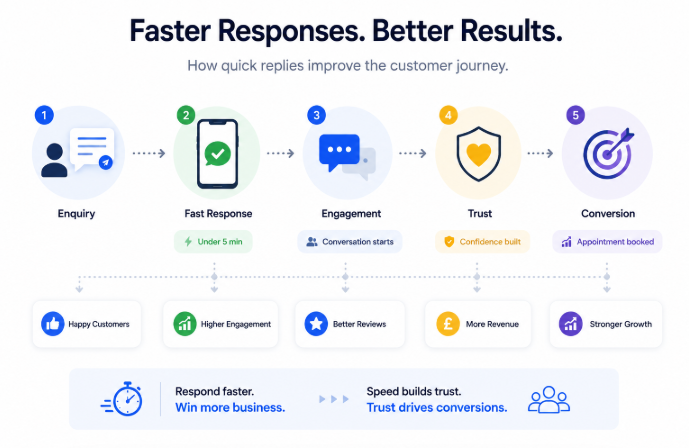
The first few minutes after an inquiry are often the most valuable in the entire customer journey. In that window, prospects are actively comparing businesses, reading reviews, checking prices, calling competitors, and deciding who seems most responsive.
Interest fades quickly with time. Every extra minute increases the odds the prospect will:
- Talk to another provider
- Book elsewhere
- Forget they submitted the inquiry
- Delay the decision entirely
While every industry is different, replying within the first five minutes gives service businesses the best chance to start a conversation while intent is still strong. Businesses that pair fast automated acknowledgement with prompt human follow-up consistently deliver a better buying experience than those relying entirely on manual processes.
Common Causes of Slow Response Times
Before fixing your speed to lead, it helps to know where the delays are actually coming from. The most common culprits:
- Leads scattered across multiple inboxes and channels. Website forms, Facebook messages, missed calls, and email inquiries often live in separate systems no one checks consistently.
- No clear ownership. When it’s unclear who’s responsible for responding to a new lead, it sits untouched until someone notices.
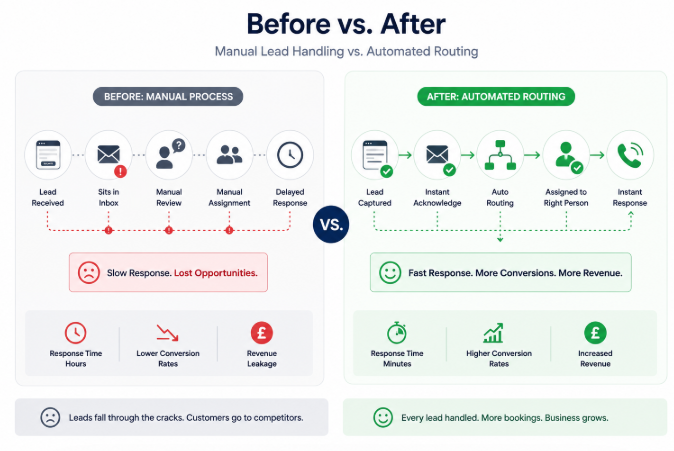
- Manual, one-by-one follow-up. Relying on a person to check inboxes and dial numbers introduces delay by default, especially outside business hours.
- No after-hours coverage. A large share of inquiries come in evenings and weekends, when many businesses simply aren’t set up to respond.
- Missed calls with no follow-up system. A missed call often just… stays missed, with no automatic text-back or callback trigger.
- No visibility into response-time performance. If you’re not measuring it, you can’t see it slipping — and it usually slips gradually, not all at once.
Most of these causes aren’t a staffing problem — they’re a systems and process problem, which is exactly what automation is built to solve (more on that below).
What Is Considered a Good Speed to Lead?
There’s no single response-time standard that applies to every service business. Industry, urgency, business hours, staffing, and the complexity of the service all shape customer expectations.
Someone searching for an emergency plumber expects a reply within minutes. Someone requesting a business consultation or marketing plan may be willing to wait a bit longer. A single benchmark for every industry would be misleading.
Instead of one-size-fits-all standards, RevSet Labs built the following operational response-time targets around three factors:
- Customer Intent — how urgently the prospect needs a solution
- Competitive Buying Behavior — how quickly prospects are likely to contact multiple providers
- Operational Best Practices — response times that let businesses engage prospects while interest is still high
These are performance targets to aim for, not fixed industry rules.
RevSet Speed-to-Lead Targets
| Business Type | Automated Acknowledgement | Human Contact Target |
| Emergency Home Services | Under 30 seconds | Under 2 minutes |
| HVAC & Plumbing | Under 30 seconds | Under 5 minutes |
| Healthcare & Dental | Under 1 minute | Under 5 minutes |
| Legal Services | Under 1 minute | Under 10 minutes |
| Marketing Agencies | Under 2 minutes | Under 15 minutes |
| Consulting Services | Under 5 minutes | Under 15 minutes |
These are RevSet Labs’ recommended operational goals, not universal industry standards. Your ideal targets should reflect your customers’ expectations, inquiry volume, staffing levels, and service urgency — and should be reviewed and adjusted as your business evolves.
The core principle holds across every industry: the faster you start a meaningful conversation with a qualified prospect, the better your odds of earning their trust, booking the appointment, and closing the sale.
How to Calculate Speed to Lead
Measuring speed to lead is simple in theory, but many businesses still don’t do it consistently. Without tracking it, you can’t identify bottlenecks, improve response times, or understand how delays are affecting revenue.
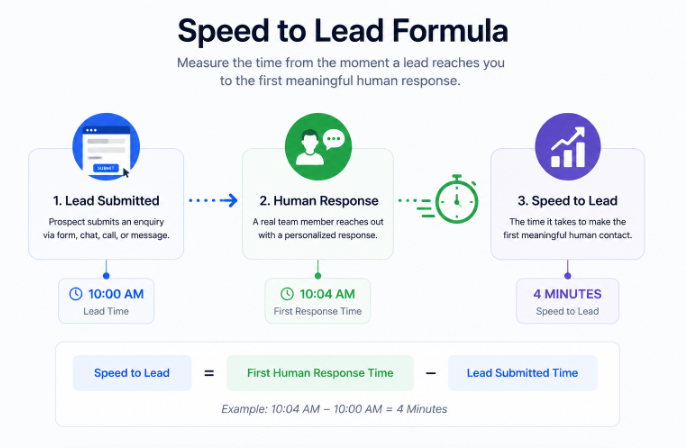
The formula:
Speed to Lead = First Meaningful Response Time − Lead Submission Time
Example:
- Lead submitted: 10:00 AM
- Sales rep calls: 10:04 AM
- Speed to Lead = 4 minutes
Make sure you’re measuring the first meaningful human interaction — not just an automated confirmation email or text.
Track Every Lead Source Separately
Different inquiry channels tend to behave differently, so tracking them individually helps you pinpoint exactly where delays happen. Track response times for:
- Website contact forms
- Google Business Profile messages
- Facebook and Instagram messages
- Phone calls
- Live chat inquiries
- Referral inquiries
- Email inquiries
- Online booking requests
Most CRMs automatically timestamp lead creation and first response. If you don’t have a CRM yet, a simple spreadsheet with submission and response times is enough to start measuring performance.
A Worked Example: How Slow Response Creates Revenue Leakage
Many businesses underestimate what slow response times actually cost them. Here’s a real-world example:
- A marketing agency generates 100 qualified leads a month through paid ads and SEO
- Cost per lead: £80
- Monthly marketing spend: £8,000
- Average client value: £2,500
If the team fails to reach 20 of those leads due to slow response:
- £1,600 in marketing spend produces zero conversations
- At a 20% conversion rate, that’s 4 lost potential clients
- At £2,500 average client value, that’s nearly £10,000 in lost revenue
The problem here isn’t a shortage of leads — it’s the inability to respond while intent is still strong. Revenue leakage is revenue lost to operational delays, not to a lack of demand.
The Four Response-Time Metrics Every Business Should Track
Speed to lead is important, but it’s only one piece of a complete lead-management system. Tracking these four metrics gives you a much fuller picture of performance.
Acknowledgement Time
How quickly a customer receives confirmation their inquiry was received. Examples: an instant SMS, an automated confirmation email.
First Human Contact Time
How soon a real person attempts to reach the lead. Examples: a phone call, a personalized email, a personalized text.
Conversation Time
When two-way communication actually begins. Examples: the customer answers the call, replies to the email, or engages in live chat. This measures real interaction, not just an attempted contact.
Booking Time
How quickly the inquiry advances to the next milestone — a consultation booked, a site visit arranged, a quote requested, or a discovery call scheduled. Shortening booking time shortens your whole sales cycle and improves the customer experience.
The RevSet Speed-to-Lead Framework
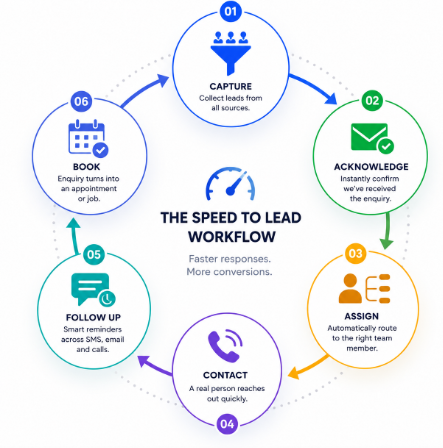
At RevSet Labs, we treat speed to lead as more than a response-time metric — it’s a full revenue system. Our six-stage framework helps businesses cut operational delay while delivering a smoother customer experience.
1. Capture
Collect inquiries from every source — website, phone, Google Business Profile, social media, email, and referrals — into a single CRM.
2. Acknowledge
Instantly let prospects know their inquiry was received, through a personalized SMS, confirmation email, and an estimated response time.
3. Assign
Automatically route each inquiry to the right team member based on location, service requested, availability, and sales territory.
4. Contact
A team member starts a meaningful conversation while intent is still strong.
5. Follow Up
If the customer doesn’t respond right away, automation keeps the conversation alive through SMS reminders, email sequences, call reminders, and appointment links.
6. Book
The inquiry becomes a consultation, site visit, sales call, service appointment, or proposal.
How Automation Improves Speed to Lead
Automation doesn’t replace your sales team — it eliminates the wasted waiting between steps.
Instead of relying solely on staff availability, effective automation can:
- Capture inquiries from every channel
- Send immediate SMS acknowledgements
- Generate personalized email responses
- Instantly notify the right salesperson
- Automatically assign leads
- Book appointments online
- Trigger follow-up sequences
- Escalate inquiries that go unanswered
The result: customers get a faster, more consistent experience, and your sales team spends less time on admin and more time on conversations that actually close deals.
Response-Time Audit Template
Use this audit to evaluate your current process.
| Audit Question | Yes | No | Notes |
| Do all website inquiries enter one CRM? | |||
| Are leads assigned automatically? | |||
| Is every inquiry acknowledged within one minute? | |||
| Are SMS notifications enabled? | |||
| Does every lead receive an email? | |||
| Are missed calls automatically followed up? | |||
| Is response time tracked weekly? | |||
| Are after-hours inquiries handled automatically? | |||
| Are reminders sent to sales staff? | |||
| Are follow-up sequences automated? |
Score your business:
- 9–10 Yes: Excellent
- 7–8 Yes: Strong, but room to improve
- 5–6 Yes: Several revenue leaks
- Below 5: Significant opportunity for improvement
Seven Practical Ways to Improve Speed to Lead
- Centralize every lead source. Bring online forms, phone calls, emails, social messages, and referrals into one CRM instead of fragmented inboxes.
- Automate immediate acknowledgements. Send instant SMS or email confirmations so customers know their inquiry was received, even after hours.
- Route inquiries automatically. Use routing rules to assign leads by service type, geography, or team availability.
- Enable missed-call text-back. Automatically text a prospect the moment a call is missed, so they can reconnect right away.
- Build multi-channel follow-up. Combining calls, emails, and SMS reminders significantly increases the odds of making contact.
- Review response-time reports weekly. Use real performance data to spot patterns, catch delays early, and coach your team.
- Keep optimizing your workflow. As your business grows, keep refining automation, staffing, and routing rules to protect fast response times and a consistently good customer experience.
Speed to Lead Is More Than a Sales Metric
Many businesses treat speed to lead as just another sales KPI. In reality, it touches nearly every part of business performance — customer satisfaction, brand reputation, online reviews, sales productivity, marketing ROI, appointment rates, and overall revenue growth.
When inquiries get a fast, meaningful response, every pound you spend on marketing works harder. Speed to lead isn’t just about reacting quickly — it’s about building a system that consistently turns customer intent into real, profitable conversations.
How RevSet Labs Helps Businesses Respond Faster
Many service businesses lose customers to operational delay, not a lack of demand. RevSet Labs helps businesses close that gap with AI-powered sales and marketing automation that can:
- Capture inquiries from every lead source
- Respond instantly with personalized SMS and email
- Automatically assign leads to the right team member
- Schedule appointments without manual work
- Run intelligent follow-up campaigns
- Track response-time performance in real time
- Flag operational bottlenecks before they cause revenue leakage
Instead of relying on manual processes, your business can deliver a consistent, professional customer experience around the clock.
If you want to improve your lead response time, get a free Revenue Audit or explore how RevSet Labs’ AI-powered automation and Revenue System Build services help turn more of your leads into paying customers.
FAQs
What is the speed to lead?
Speed to lead is the amount of time it takes for a prospect to contact your business and receive their first relevant response from a team member.
What is considered a good speed to lead?
It varies by industry, but most service businesses should aim to acknowledge inquiries instantly and make human contact within five minutes wherever possible.
How do you calculate speed to lead?
Subtract the lead submission timestamp from the time of the first meaningful human response.
Why is speed to lead important?
Faster response times improve the customer experience, increase contact rates, reduce revenue leakage, and boost conversions — without increasing marketing spend.
Can automation improve speed to lead?
Yes. Automation can instantly acknowledge inquiries, notify sales staff, assign leads, book appointments, and trigger follow-up sequences — helping businesses respond far faster than manual processes allow.
What’s the difference between acknowledgement time and response time?
Acknowledgement time is how fast a customer gets confirmation their inquiry was received. Response time is how soon a real team member starts a meaningful conversation.
Conclusion
Getting more leads isn’t always the fastest way to grow your business. Often, the bigger opportunity is responding better to the leads you already have. Speed to lead is about more than reacting quickly — it’s about creating a customer experience that builds trust from the very first interaction.
Businesses that consistently respond fast, engage prospects at the right moment, and automate repetitive follow-up are in the best position to turn demand into long-term revenue.
By tracking speed to lead, identifying operational bottlenecks, and pairing smart automation with timely human follow-up, service businesses can boost conversions, strengthen customer relationships, and get more return from every marketing dollar spent.
Even cutting your average response time from hours to minutes can noticeably improve appointments, customer satisfaction, and long-term revenue growth.
Ready to Improve Your Speed to Lead?
Every delayed response is a missed opportunity to win new business.
If your team is still relying on manual lead processing, disconnected systems, or inconsistent follow-up, there’s real opportunity to improve both the customer experience and your conversion rate.
Get a free Revenue Audit to find the hidden bottlenecks in your lead response process, or explore RevSet Labs’ AI-powered automation to see how intelligent workflows can help your business capture, route, and respond to inquiries in seconds.
Faster replies don’t just boost productivity — they turn more inquiries into customers.