
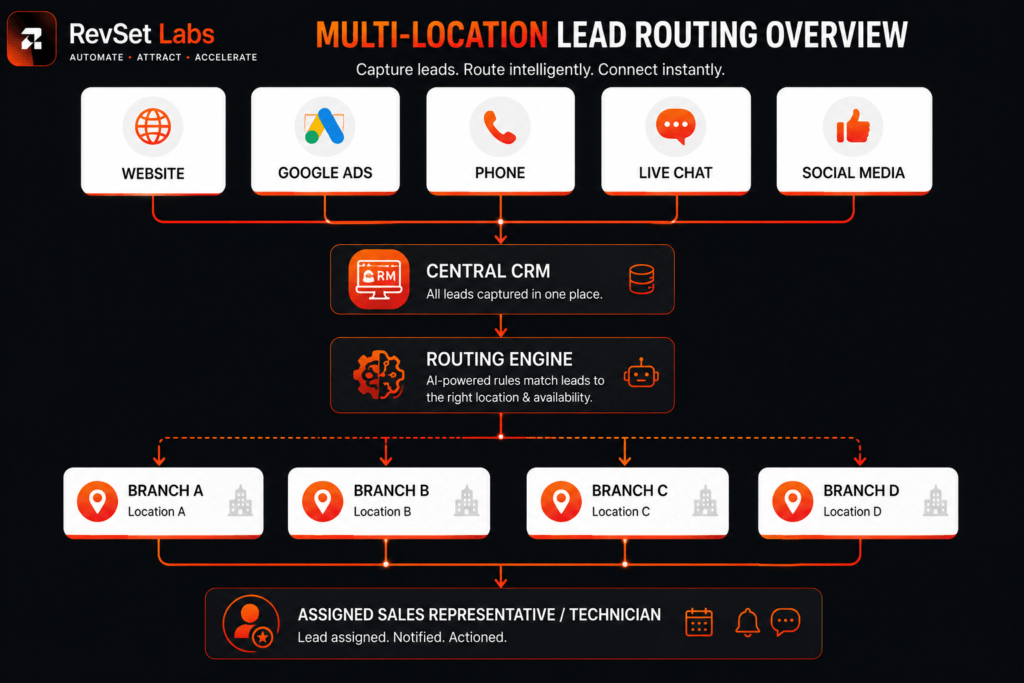
Lead Routing Rules for Multi-Location Service Businesses
For every service firm, expanding from one location to several is an exciting milestone. More clients, bigger staff, and broader market coverage are typically the results. But it also adds operational complexity, which many companies don’t realize.
Incoming leads no longer have a single clear destination when new branches, territories, or franchises are added. It is possible for a salesperson in Houston to unintentionally be assigned to a customer in Dallas. Since no one knows who owns a shared email address, a plumbing problem may go unnoticed there. While some representatives have capacity, another receives more inquiries than they can reasonably handle.
These aren’t marketing problems.
They’re lead routing problems.
RevSet Labs discovered that many companies miss chances because eligible queries aren’t promptly forwarded to the appropriate person, rather than because they produce too few leads. Every pointless handoff, manual assignment, or routing error adds friction to the customer journey, speeding up response times and producing uneven experiences across locations.
Assigning leads more quickly isn’t the answer.
It creates routing rules that automatically match each query to the best-suited individual based on business priorities, capacity, availability, region, and service type.
This article describes how lead routing operates and why organized routing rules are necessary for multi-location service companies. How firms may create routing systems that enhance operational consistency while preserving consumer momentum.
What Is Lead Routing?
The practice of assigning an incoming inquiry to the individual or group most qualified to handle it is known as lead routing.
Instead of making decisions by hand, this assignment is completed in accordance with predetermined guidelines.
For instance, a roofing firm having locations in Scottsdale, Phoenix, and Mesa may use the customer’s ZIP code to automatically allocate questions. A healthcare provider may route patients according to specialty, while a restoration company may prioritize emergency calls by technician availability instead of office location.
Even though different organizations have different routing logic, the goal is always the same:
Ensure every qualified lead reaches the right person with as little delay as possible.
RevSet Labs defines successful lead routing by three outcomes:
- The right team is contacted by the customer.
- Ownership is established right away.
- Without needless delay, the following action takes place.
Observe that speed is insufficient on its own.
An answer sent in two minutes by the wrong office still generates a negative customer experience if the consumer must repeat information or be moved elsewhere.
By cutting down on needless handoffs, efficient routing increases customer confidence and operational efficiency.
Why Multi-Location Businesses Need Routing Rules
When a company runs from a single office, routing could seem simple.
However, managing manual procedures is more challenging when businesses grow into more cities, regions, or service areas.
While several branches vie for insight into the same pipeline, a lead might now come through dozens of channels.
Common operational issues start to emerge in the absence of established routing rules.
Leads Reach the Wrong Location
Customers expect local expertise.
Instead of resolving the customer’s issue, precious time is wasted rerouting the discussion when an inquiry meant for one branch gets given to another. Even if the internal delay could just be a few minutes, from the customer’s point of view, it raises questions and erodes trust in the company.
Workloads Become Uneven
When managers manually distribute leads, assignments are frequently based on availability rather than a standard procedure.
Some representatives are given more chances than they are capable of handling.
Others remain underutilised. This disparity eventually has an impact on team morale, reaction time, and follow-up quality.
Customer Experience Becomes Inconsistent
Businesses with several locations put a lot of effort into presenting a single, cohesive brand.
Consumers evaluate the company as a whole rather than differentiating between its parts. The whole customer experience becomes uneven if one site answers in five minutes while another takes several hours.
Every customer engagement should have operational consistency that goes beyond branding and marketing.
Performance Becomes Difficult to Measure
Reporting becomes unreliable in the absence of defined routing.
Managers could find it difficult to respond to queries like:
- Which area gets the best quality leads?
- Which branch reacts the quickest?
- Where are the delayed queries coming from?
- Which regions require more employees?
Cleaner operational data is produced by consistent routing rules, which facilitate the identification of bottlenecks and enhance performance everywhere.
Lead Routing Is More Than a CRM Feature
Although lead assignment features are included in many CRM platforms, technology by itself cannot provide a successful routing plan.
The real operations of the company should be reflected in the routing rules.
For instance:
- Is geography the most important factor?
- Do urgent requests need to go via regular lines?
- Should current clients always go back to their former account manager?
- When a branch hits capacity, how should leads be distributed?
- What occurs in the event that a representative is not available?
Software cannot provide a solution to these issues on its own.
They need to make operational choices.
RevSet Labs views lead routing as a revenue operations process rather than a software configuration.
For instance, the “routing system” used by a multi-location home services business that operated in three states was a common inbox that was manually maintained by office workers. In Dallas, a plumbing problem may go unnoticed for 20 to 30 minutes only because the incorrect person observed it initially. Lack of organized routing was the problem, not lead volume.
Every request was automatically categorized by service type, location, and technician availability once we redesigned their system. Standard requests were directed to the appropriate regional office, but emergency calls went straight to the closest on-call specialist.
The most efficient routing systems are not the most complicated ones; rather, they are the ones that reliably forward each query to the appropriate individual without requiring human intervention.
In this instance, we completely eliminated manual decision-making. The CRM eliminated delays by automatically handling all tasks once rules were established.
Customers receive quicker service, teams comprehend ownership, and leadership has insight across all sites when routing becomes predictable.
Before structured routing, the client was unable to notice that one area handled 38% more emergency requests while responding 22% faster.
As companies grow, that degree of transparency becomes crucial.
Choosing the Right Lead Routing Strategy
No single routing paradigm is effective for all service businesses.
The operating needs of a dentistry practice with many locations or a marketing firm servicing clients across various states differ greatly from those of a national restoration company responding to emergency calls.
RevSet Labs advises creating routing rules based on how your company provides services rather than just how your CRM arranges contacts.
The best routing plan guarantees that every question is answered by the person most qualified to assist, reduces customer handoffs, and distributes workloads equitably.
In reality, the majority of expanding companies use many routing techniques instead of just one.
Location-Based (Geographic) Routing
Geographical factors should be the primary routing consideration for the majority of multi-location service companies.
Customers usually anticipate assistance from the closest office or technician when they make service requests.
Examples include:
- Plumbing companies
- HVAC contractors
- Electrical services
- Roofing companies
- Restoration businesses
- Pest control providers
- Home healthcare organizations
Instead of manually assigning inquiries, routing rules automatically direct leads according to:
- ZIP code
- Postal code
- City
- County
- State
- Sales territory
- Service radius
RevSet Labs views lead routing as a core revenue operations system that must scale with business growth.
For example, a Dallas homeowner discovers a plumbing problem and uses a company’s website to place a service request.
The CRM immediately verifies the ZIP code and directs the lead to the Dallas branch rather than a generic inbox.
The request with complete client information is received by the local team in a matter of seconds, and they promptly schedule service without any delays or handoffs.
From the customer’s point of view, everything goes well; they just receive prompt assistance from the appropriate local office. Consumers just want quick, precise service; they don’t consider geographies or routing systems.
Lead assignment that is done manually or centrally frequently results in delays and misroutes that impair consistency and impede response times.
By guaranteeing that each query is sent straight to the appropriate branch from the beginning, location-based routing eliminates that friction.
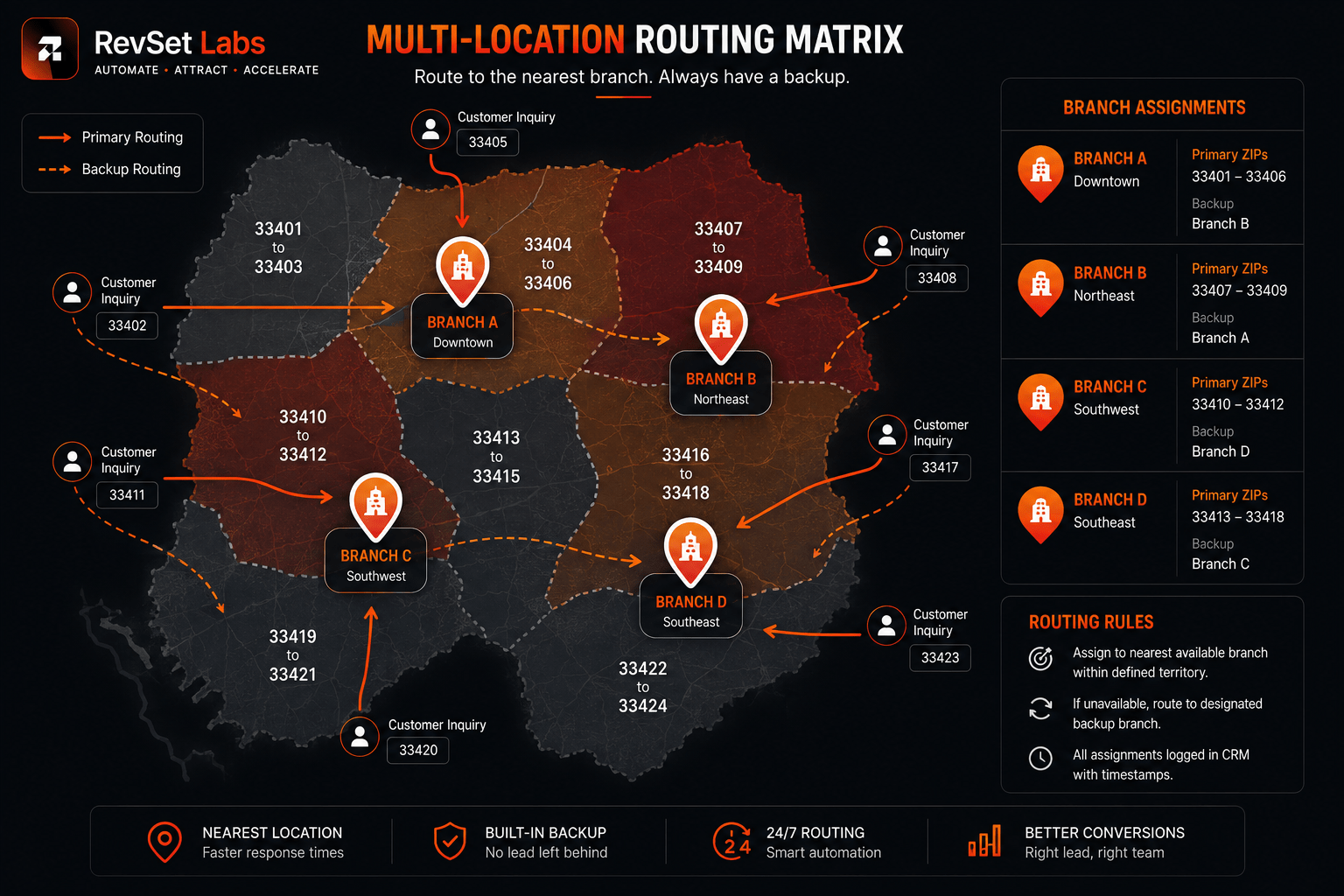
Location Routing Matrix
The table illustrates how location-based routing can be standardized across multiple branches.
| Customer Location | Service Area | Assigned Branch | Backup Branch |
| Dallas, TX | North Dallas | Dallas Office | Plano Office |
| Plano, TX | Plano & Allen | Plano Office | Dallas Office |
| Fort Worth, TX | West Territory | Fort Worth Office | Arlington Office |
| Arlington, TX | Central Territory | Arlington Office | Fort Worth Office |
| Irving, TX | Irving Corridor | Dallas Office | Arlington Office |
| Frisco, TX | North Expansion | Plano Office | Dallas Office |
When one office hits capacity or is momentarily unavailable, this kind of routing matrix helps preserve company continuity by ensuring that each area has a clearly defined principal owner.
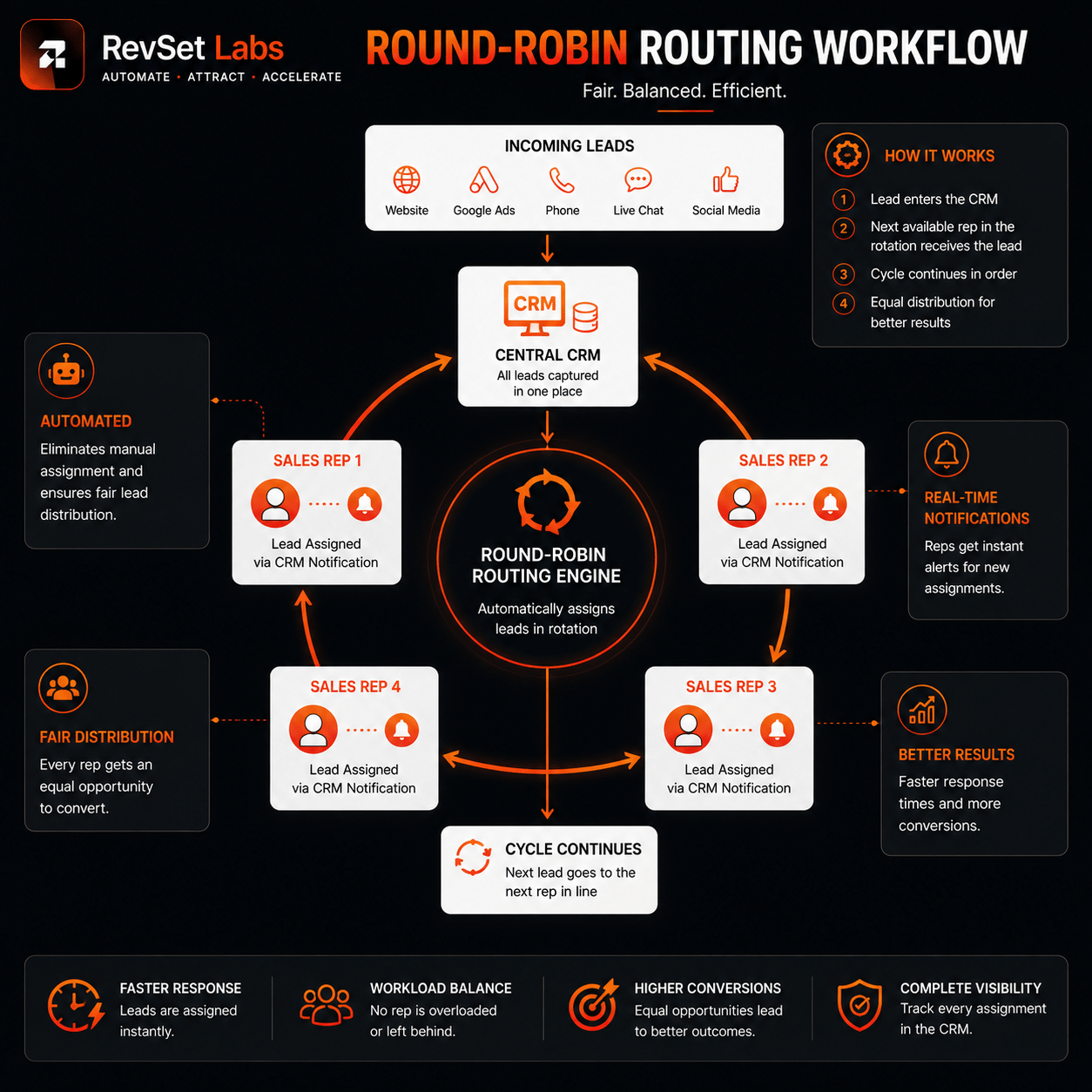
Round-Robin Routing
Round-robin routing aids in the equitable distribution of opportunities when several representatives in the same office are capable of handling the same questions.
Inquiries are automatically rotated between available team members rather than being assigned to a single salesman or depending on management to manually assign tasks.
Example:
Lead 1 → Sarah
Lead 2 → James
Lead 3 → Maria
Lead 4 → Daniel
Lead 5 → Sarah
The sequence then repeats.
This approach prevents one representative from receiving significantly more opportunities than others while maintaining predictable workloads.
When Round-Robin Works Best
Round-robin routing works well in the following situations:
- Representatives possess comparable abilities.
- The capability for sales is comparatively equal.
- The same service offerings are handled by each team member.
- Workloads ought to stay balanced.
Additionally, it makes the process more transparent for the whole sales team and lessens unconscious bias in manual lead assignment.
Potential Limitation
Customer requirements shouldn’t be subordinated to round-robin.
Assigning questions just by rotation may decrease efficiency if one person specializes in home repairs and another in commercial roofing.
Because of this, round-robin is often used inside individual teams rather than throughout the whole corporation.
Round-Robin Assignment Matrix
| Lead | Assigned Representative | Branch | Status |
| Lead 1 | Sarah | Dallas | Assigned |
| Lead 2 | James | Dallas | Assigned |
| Lead 3 | Maria | Dallas | Assigned |
| Lead 4 | Daniel | Dallas | Assigned |
| Lead 5 | Sarah | Dallas | Assigned |
| Lead 6 | James | Dallas | Assigned |
| Lead 7 | Maria | Dallas | Assigned |
RevSet Labs suggests pausing representatives who are unavailable instead of forcing the rotation to continue regardless of workload or leave status.
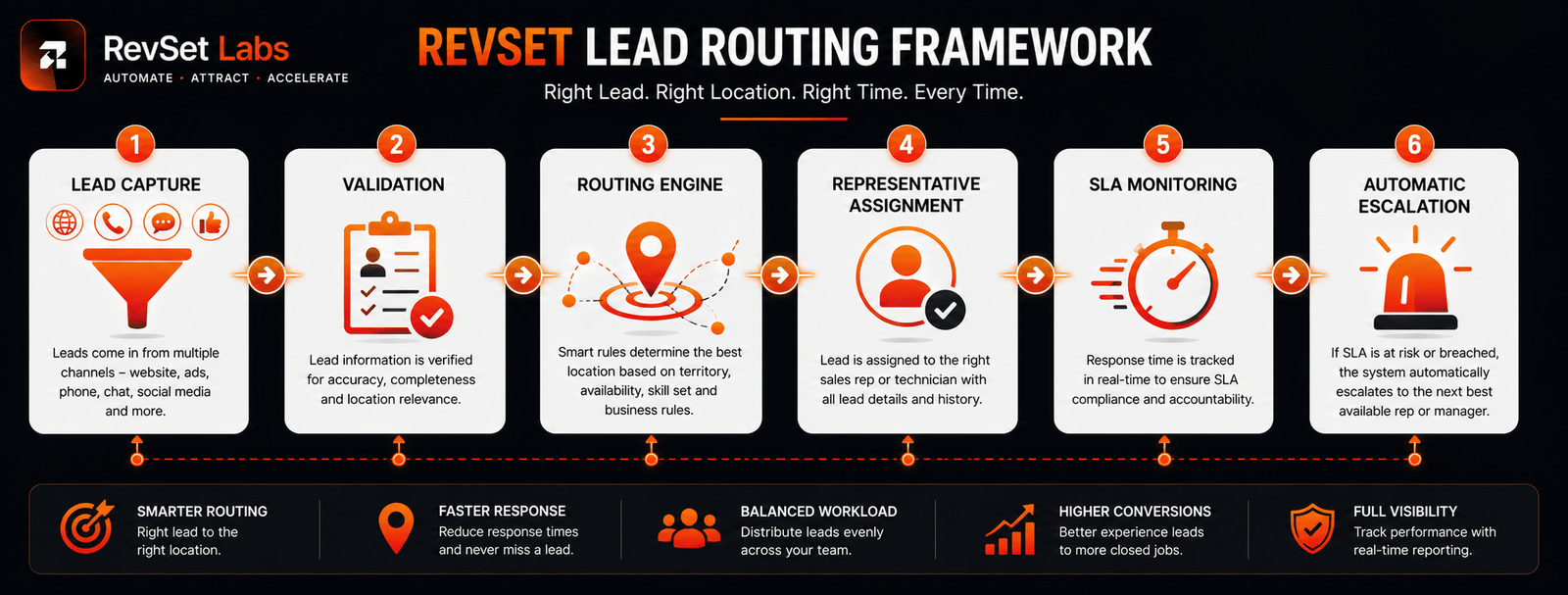
The RevSet Labs Lead Routing Framework
Assigning the next inquiry is only one aspect of lead routing.
Every consumer is guaranteed to reach the appropriate person at the appropriate place at the appropriate time thanks to this method.
Routing gets increasingly complicated as firms grow, and inadequate reasoning can cause response times to lag. Instead of focusing on internal convenience, we at RevSet Labs build routing around the customer journey.
Important queries consist of:
- Which office is able to assist this client?
- Is a specialist required?
- What reduces the number of handoffs?
- Is the representative on hand?
- Is this a recurring client?
The objective is straightforward: smoother experiences, better matches, and fewer delays.
The RevSet Routing Workflow
Our routing framework follows six operational stages.
Stage 1: Capture Every Inquiry
All leads should go into a single, centralized CRM, regardless of where they came from.
Common lead sources include:
- Contact forms on websites
- Profile on Google Business
- Ads on Google
- Lead Ads on Facebook and Instagram
- Real-time conversation
- Making phone calls
- Referral partners
- Current client requests
Consumers shouldn’t have varied experiences just because they used different methods to get in touch with the company.
Before routing choices, centralizing lead capture establishes a single source of truth.
Stage 2: Validate Lead Information
Before giving ownership, verify vital facts.
Examples include:
- Customer name
- Phone number
- Email address
- Service location
- Service requested
- Current client status
Later on in the process, incomplete or duplicate records can result in needless routing problems.
Automated validation rules reduce manual corrections while improving reporting accuracy.
Stage 3: Apply Routing Logic
Once the inquiry is validated, routing rules determine the most appropriate destination.
Typical routing sequence:
- Service location
- Service type
- Existing customer ownership
- Representative availability
- Team workload
- Round-robin assignment
Instead of depending just on one rule, this layered approach guarantees that routing decisions reflect business priorities.
Stage 4: Notify the Assigned Team
Routing should trigger immediate internal notifications.
Examples include:
- CRM notification
- Mobile push notification
- SMS alert
- Microsoft Teams notification
- Slack notification
- Email notification
Fast internal communication reduces delays between assignment and customer contact.
Stage 5: Monitor Response SLA
Assignment alone doesn’t improve customer experience.
Businesses must also monitor whether assigned representatives respond within the expected timeframe.
Establishing quantifiable service standards enables businesses to find operational bottlenecks before they have an impact on clients. Service Level Objectives (SLOs) and Service Level Agreements (SLAs) gained popularity thanks to Google’s Site Reliability Engineering (SRE) methodology, which demonstrated how precise performance goals enhance accountability and consistency. The same ideas that were first created for technology operations also apply to lead management and customer response workflows.
RevSet Labs is establishing internal Service Level Agreements (SLAs) for every location.
Example operational targets:
| Inquiry Type | Recommended First Human Response |
| Emergency Service | Under 5 minutes |
| Appointment Request | Under 10 minutes |
| Standard Quote Request | Under 15 minutes |
| Professional Consultation | Under 30 minutes |
These are RevSet Labs’ operations timeline, not universal industry standards. Response targets should be adjusted based on customer expectations, staffing, business hours, and service complexity.
Stage 6: Escalate If No Response
Every routing system needs a backup plan.
If the assigned representative doesn’t respond within the agreed SLA, the inquiry should automatically move to another qualified team member.
Possible escalation paths include:
- Team leader
- Branch manager
- Backup representative
- Secondary office
- Shared response queue
Customers should never experience internal delays simply because one employee is unavailable.
RevSet Labs Perspective
Routing is seldom the first procedure that companies look into when they have trouble converting leads.
Most believe that the issue is with sales, marketing, or advertising.
However, we often discover during operational reviews that qualified opportunities are postponed well in advance of the start of meaningful conversations.
In a shared email, a lead is waiting.
Despite already handling a busy workload, a representative is appointed.
Due to outdated territorial restrictions, a client is moved between branches.
In isolation, each delay seems insignificant.
When combined, they cause needless friction that erodes consumer confidence and lowers conversion rates.
Successful firms don’t only open new sites.
They develop routing systems that give the same experience regardless of which branch gets the request.
Ownership becomes evident, reporting becomes more trustworthy, and development becomes simpler to manage when each client is promptly connected with the appropriate individual.
FAQs
1. What is lead routing?
The act of automatically matching incoming leads to the appropriate salesperson, technician, or branch based on predetermined business parameters, such as location, service type, or availability, is known as lead routing.
2. Why is lead routing important for multi-location businesses?
It ensures that every request is promptly forwarded to the right place, cutting down on response times, enhancing customer satisfaction, and establishing uniform procedures throughout all branches.
3. What is round-robin lead routing?
By alternating assignments, round-robin routing distributes leads equally across competent team members, balancing workloads and preventing a single representative from getting all incoming inquiries.
4. How does location-based lead routing work?
In order to link clients with the closest or most suitable branch, location-based routing assigns leads based on geographic factors like ZIP code, city, territory, or service radius.
5. Can multiple routing rules be used together?
Indeed. For a more precise and effective assignment method, the majority of expanding companies integrate geography, service type, representative availability, current client ownership, and round-robin routing.
6. What happens if the assigned representative is unavailable?
If the original owner does not reply within the specified service level agreement (SLA), a well-designed routing system should immediately reassign or escalate the lead to another competent person.
How often should lead routing rules be reviewed?
Every time regions, personnel, or services change, routing regulations should be evaluated. Businesses should assess routing performance at least once per quarter as a recommended practice.
Final Thoughts
Lead routing becomes essential to provide a consistent client experience when service firms grow into various locations.
Operational complexity rises with each new branch, area, or team member. Even high-quality leads may be missed, reallocated, or delayed before significant discussions start if routing rules are not explicitly specified. These little inefficiencies have the potential to restrict the return on marketing expenditure, lower conversion rates, and produce uneven consumer experiences over time.
Effective routing, in our opinion at RevSet Labs, isn’t about developing the most intricate automation; rather, it’s about developing a procedure that reliably matches each client with the appropriate individual as soon as feasible. Teams function more effectively, supervisors have more insight, and customers have a more seamless experience from inquiry to service when routing rules accurately represent how your company really runs.
Successful firms don’t only increase lead generation. They create operational mechanisms that guarantee each lead begins in the appropriate location, gets to the appropriate team, and is followed up on promptly.
Over time, improved routing not only speeds up response times but also builds customer confidence, promotes sustainable expansion, and ensures that every site operates at the same high level.
How RevSet Labs Helps Multi-Location Service Businesses
RevSet Labs assists expanding service companies in creating revenue-generating processes that grow with them.
We provide end-to-end routing frameworks that integrate intelligent automation, centralized CRM administration, territory mapping, workload balancing, SLA monitoring, and structured escalation into a single operational system, as opposed to treating lead routing as a stand-alone CRM setup.
We want to do more than just assign leads more quickly.
The goal is to give leadership total insight into routing performance across all branches while ensuring that every qualifying query reaches the appropriate person, at the appropriate place, with the appropriate context.
Whether your company has three or thirty sites, efficient routing builds team trust and customer consistency.
Ready to Eliminate Lead Assignment Bottlenecks?
Even if your team doesn’t notice it, every manual assignment, pointless transfer, or poor routing choice causes friction that customers do.
Assess the effectiveness of your current routing process in getting inquiries from first contact to the appropriate representative before making additional investments in advertising or lead generation.
The RevSet Labs Revenue Leak Scorecard helps discover routing gaps, response delays, and operational bottlenecks that limit conversions across multi-location enterprises.
Long-term revenue growth, customer satisfaction, and response consistency may all be measured with minor routing logic enhancements.