
Long-Term Lead Nurture for High-Consideration Services
Just because a lead isn’t ready to buy right now doesn’t make them unqualified.
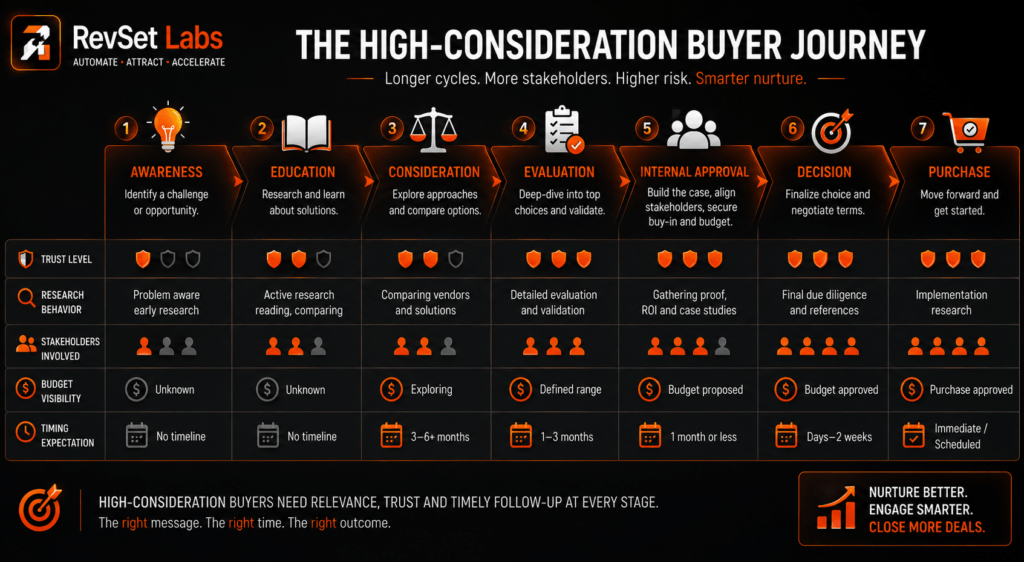
For companies offering services that require extensive investment, internal approval, multiple discussions, research, or a high degree of trust, this distinction is crucial. It might take weeks or months for a prospect thinking about a consulting engagement, healthcare service, financial solution, technology installation, legal service, or high-value B2B project to feel comfortable making a choice.
The issue is that a lot of companies consider these potential customers as either uninterested or eager to buy right away.
With little to no meaningful contact, a sizable middle group is left languishing in the CRM.
At this point, long-term lead nurturing transitions from being just an email campaign to a revenue-generating activity.
Sending more emails is not the goal. As the buyer proceeds through awareness, contemplation, assessment, internal approval, and decision-making, it must continue to be helpful.
That strategy is particularly crucial for high-consideration services.
Why High-Consideration Services Need Long-Term Lead Nurture
Sometimes quick follow-up, consultation, proposal, and decision may help manage a short sales cycle.
High-consideration purchases are not the same.
Lead nurturing, according to Salesforce, is the act of offering pertinent materials that assist prospects in moving through the purchasing process while placing more of an emphasis on developing relationships and delivering helpful information than making an instant pitch.
The potential customer might have to:
- Understand the problem before choosing a solution
- Compare several suppliers
- Create a business case internally
- Safe spending
- Engage stakeholders or executives
- Examine the needs for implementation and risk
- Await a specific business occasion
- After completing another priority, review the project
This implies that the duration of the sales cycle may have a significant role in pipeline management.
If a lead doesn’t reply after one or two emails, they shouldn’t be considered lost.
They could just be early.
They can also be genuinely interested but lack a pressing need to take action.
This distinction is acknowledged by a robust long-term lead nurturing strategy, which develops a methodical approach to remain current without being invasive.
What Makes Long Cycle Lead Nurturing Different?
Traditional drip campaigns often follow a simple pattern:
Email → Wait → Email → Wait → Email → Sales pitch
For simple purchases, the framework may work, but it is typically too strict for complicated services.
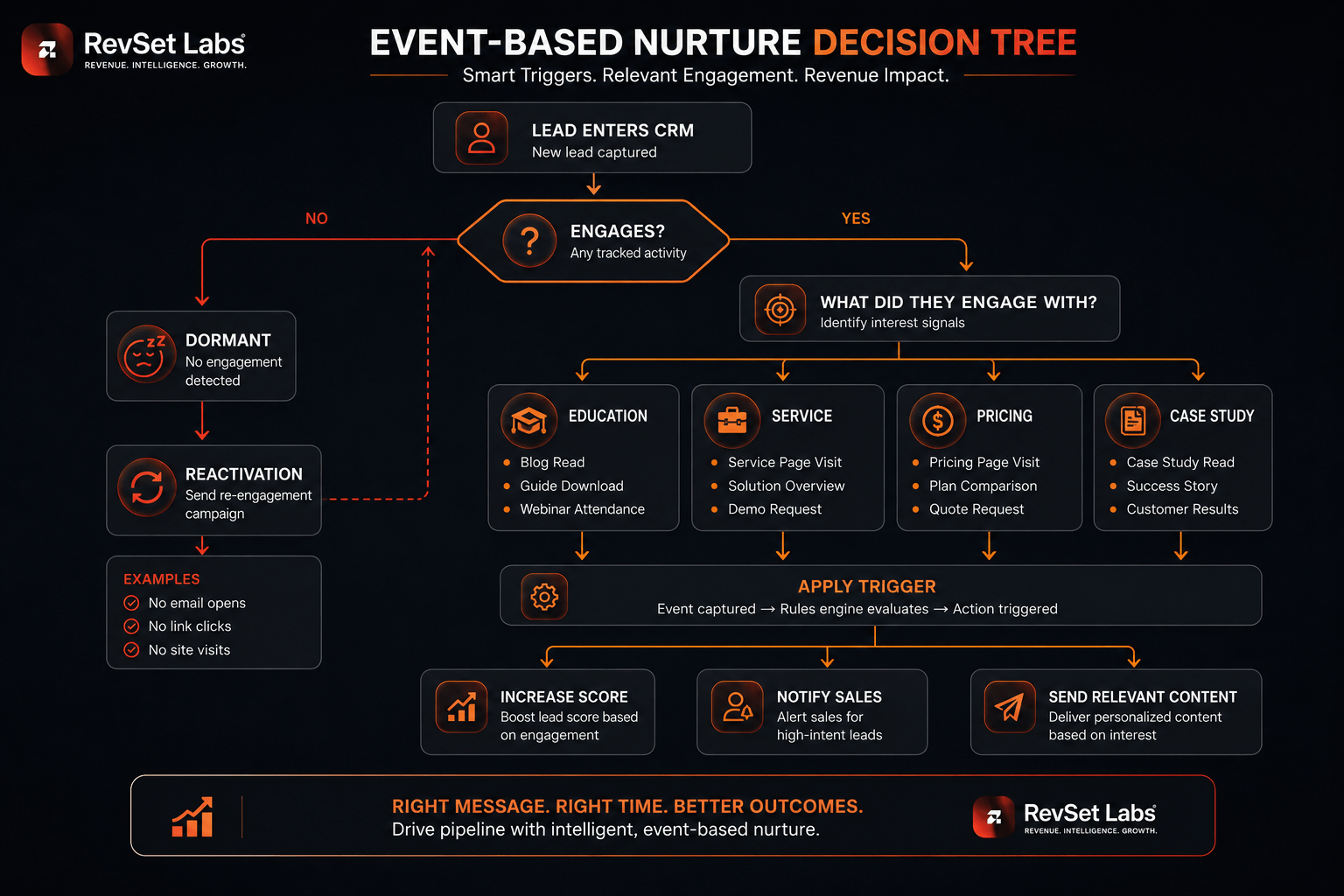
Event-based is a superior strategy.
Rather than merely inquiring, “How many days have passed?” the system queries:
“What did the buyer do, and what does that behavior tell us about what they need next?”
For example:
- Early research may be indicated by a guide download.
- Deeper education may be indicated by a webinar enrollment.
- A visit to the price page might be a sign of commercial interest.
- Evaluation may be indicated by a case study download.
- A return visit to the website might be a sign of renewed interest.
- A request for a proposal might be a sign of preparedness for sales.
- Dormant lead reactivation may be necessary if there has been a prolonged period of inactivity.
CRM automation is useful in this situation.
Triggers, actions, and CRM records can be used by contemporary workflow systems to automatically react to specified customer behaviors. Workflows, for instance, are defined by HubSpot as automation that may initiate operations in response to criteria like form submissions, lifecycle modifications, or other CRM events.
Although the technology is helpful, thinking is more important.
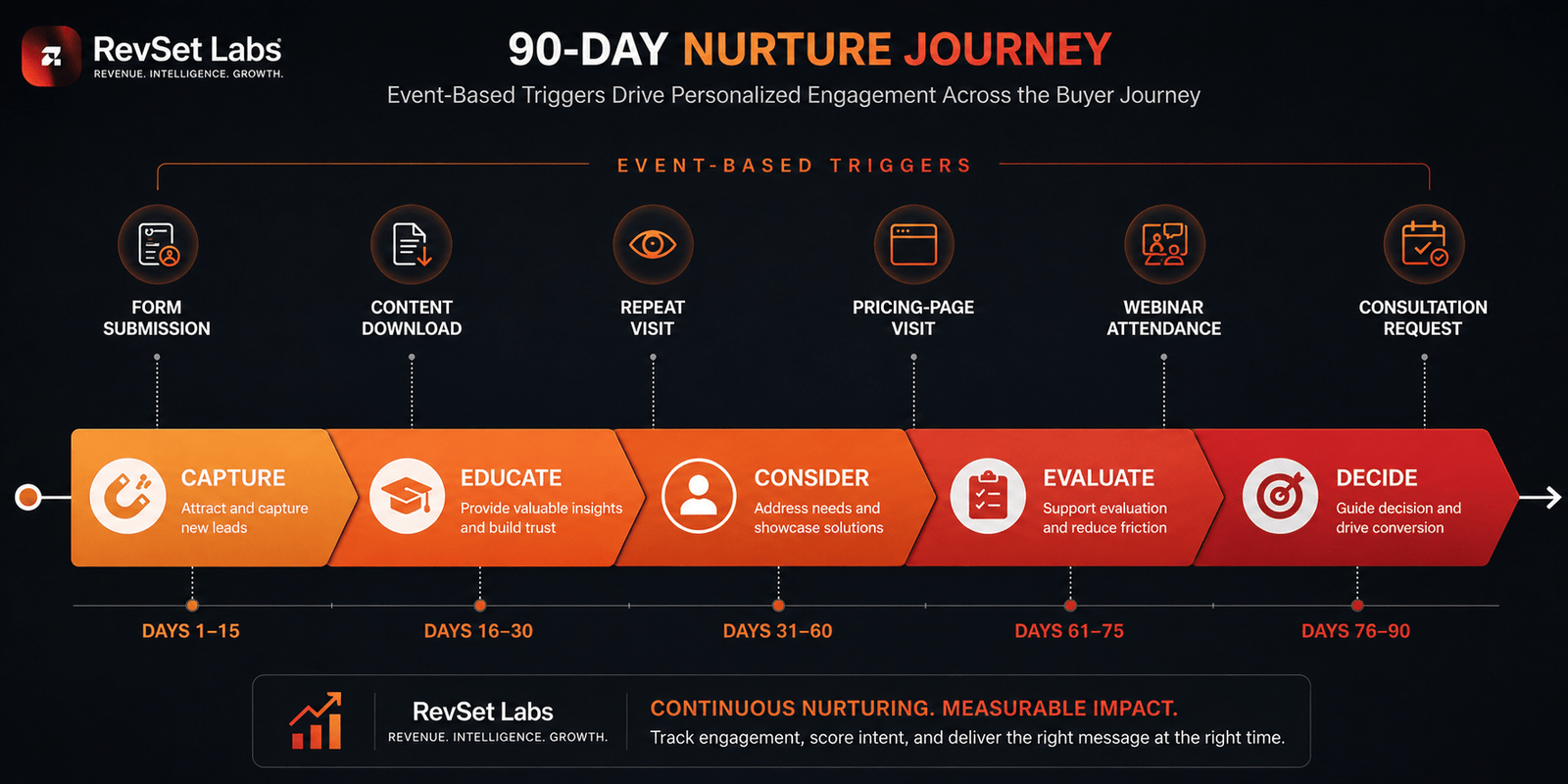
Build a 90-Day Long-Term Lead Nurture Framework
Businesses may educate, establish trust, recognize purchasing signals, and generate chances without overwhelming prospects using a 90-day sequence.
Instead of only calendar-based emails, the structure below is built around event-based triggers.
| Period | Buyer Stage | Primary Goal | Example Content | Event-Based Trigger |
|---|---|---|---|---|
| Days 0–7 | Awareness | Establish relevance | Welcome email, guide, problem education | Form submission |
| Days 8–21 | Education | Build understanding | Checklist, article, webinar | Content engagement |
| Days 22–35 | Consideration | Demonstrate expertise | Case study, comparison, framework | Repeat engagement |
| Days 36–50 | Evaluation | Reduce uncertainty | ROI guide, FAQ, implementation details | Pricing/service page visit |
| Days 51–65 | Decision Preparation | Identify blockers | Consultation offer, stakeholder guide | High-intent activity |
| Days 66–80 | Re-engagement | Restore attention | New insight, industry update | Inactivity or return visit |
| Days 81–90 | Sales Readiness | Create a next step | Consultation, assessment, review | Lead score threshold |
This is not intended to mean every lead receives every message.
Segmentation should determine which path a prospect enters.
Days 0–7: Confirm the Problem
The prospect should feel that they have come to the proper location after the first step.
Don’t make a sales call right away.
Rather, link the initial inquiry to pertinent data.
The following correspondence may outline typical operational issues that impede prompt response if someone obtained a guide on enhancing lead response time.
Relevance is the goal.
When applicable, employ progressive profiling to get pertinent data, but don’t ask for extraneous information just because the CRM permits it.
Instead of being a sales-qualified lead at this time, the lead can still be an early-stage marketing-qualified lead.
Days 8–21: Educate Without Selling Constantly
After the original problem has been recognized, the questions that naturally arise should be addressed in the second step.
For expert services, that might consist of:
- How the procedure operates
- What is involved in implementation
- Common mistakes
- Industry benchmarks
- Frequently asked questions
- An example of a normal engagement
- How to assess providers
This is where content that fosters trust becomes crucial.
Before requesting commitment, a successful lead nurturing campaign for professional services should show expertise.
Convincing the potential customer that your business is flawless is not the aim.
Assisting them in making a better choice is the aim.
Days 22–35: Move From Education to Consideration
By this stage, some prospects will continue engaging while others will become quiet.
Don’t handle the two groups the same way.
A lead who visits a service site, attends a webinar, and reads many articles is acting differently from one who hasn’t opened anything since the initial communication.
Lead scoring and segmentation are helpful in this situation.
A basic model might improve a score for:
- Returning to the website
- Viewing pricing information
- Downloading a case study
- Attending an event
- Requesting a resource
- Replying to an email
When a lead is inactive for a long time, it might also lower importance.
The current lead-scoring documentation from HubSpot explains how to use record characteristics and activities to determine which contacts, businesses, or transactions are more likely to close or become customers.
Instead of taking the role of judgment, the score should enhance it.
Days 36–50: Help the Buyer Evaluate the Risk
Uncertainty frequently causes high-consideration purchases to stall.
The purchaser could be considering:
“Will this actually work for us?”
“What will implementation involve?”
“How much internal effort will this require?”
“What happens if we choose the wrong provider?”
This is the proof step.
Use:
- Case studies
- Client outcomes
- Implementation guides
- ROI explanations
- Comparison resources
- FAQs
- Process diagrams
- Security or compliance information where relevant
Credibility, compliance, risk, competence, and stakeholder confidence may need to be given more attention during this stage of lead nurturing for financial services and healthcare.
Providing information that aids the internal champion in explaining the purchase to other decision-makers may also be helpful for high-ticket B2B sales.
Days 51–65: Identify the Real Buying Blocker
The prospect could be intrigued at this point, but they are still immobile.
This difference is crucial.
A lead that has stopped could have a:
- Budget problem
- Timing problem
- Stakeholder problem
- Scope problem
- Trust problem
- Internal approval problem
- Competing priority
Sending another case study is not a good long-term lead nurturing tactic.
It looks for the barrier that is keeping people from moving.
For instance, a cost-related site may be the next step if someone frequently views price information.
They want operational clarity if they often examine implementation stuff.
They could require further evidence or stakeholder material if they interact with a case study but never ask for a meeting.
This is the distinction between a generic mailing and behavior-based nurturing.
Days 66–80: Re-Engage Dormant Leads
Not every potential customer will stay involved.
For weeks, some will vanish.
This does not imply that the opportunity is no longer available.
For inactive prospects, Salesforce suggests re-engagement initiatives with the goal of motivating a significant action when the time is appropriate.
A dormant lead shouldn’t be given:
“Just checking in again.”
Give them a cause to come back instead.
For example:
“A few things have changed since we last spoke about [challenge]. We recently put together a short guide showing how teams are approaching [specific problem]. I thought it might be useful if this is still on your roadmap.”
This strategy honors the timeliness of the prospect.
Additionally, it provides them with a simple means of indicating the project’s continued relevance.
Days 81–90: Convert Engagement Into a Sales Conversation
Not every lead should be forced into a sales call in the last step.
Rather, find the leads who have sufficient intent.
Among the potential triggers are:
- High lead score
- Multiple recent website visits
- Pricing-page activity
- Consultation-page visit
- Case study engagement
- Reply to an email
- Form submission
- Webinar attendance
- Return after a dormant period
The CRM can move the lead into a more direct sequence, inform sales, generate a task, or change the lifecycle status when these things happen.
This establishes a link between qualified leads for marketing and qualified leads for sales.
Workflows for lead scoring, property modifications, alerts, and follow-up activities depending on customer behavior are also supported by HubSpot’s current workflow guidelines.
It’s crucial to remember that automation should identify intent rather than create it.
Event-Based Triggers Make the Sequence Smarter
The strongest long-cycle lead nurturing programs are not controlled entirely by dates.
They respond to events.
A practical trigger map might look like this:
| Buyer Event | Interpretation | Next Action |
|---|---|---|
| Downloads educational guide | Early interest | Send related educational content |
| Opens several emails | Growing engagement | Introduce deeper content |
| Visits service page | Active consideration | Send service-specific proof |
| Views pricing | Commercial interest | Offer pricing/ROI resource |
| Downloads case study | Evaluation | Send related outcome or implementation content |
| Attends webinar | Stronger engagement | Invite to relevant consultation |
| Replies to email | Conversation signal | Notify sales owner |
| Lead score crosses threshold | Sales readiness | Create sales task |
| 30+ days inactive | Dormant | Launch reactivation sequence |
| Returns after inactivity | Renewed interest | Re-enter relevant nurture path |
The result is a more responsive revenue system.
How to Build a Long-Term Nurture Sequence Without Over-Automating
Automation can create consistency, but too much automation creates noise.
The best approach is to automate repetitive decisions while keeping human interaction available when judgment is required. See our full breakdown of manual vs. automated lead response for more on where to draw that line.
Automate:
- Enrollment
- Segmentation
- Lead scoring
- Content delivery
- Internal notifications
- Follow-up tasks
- Dormant lead reactivation
- Lifecycle updates
Keep human involvement for:
- Complex objections
- High-value opportunities
- Pricing discussions
- Strategic accounts
- Negotiations
- Sensitive questions
- Multi-stakeholder buying situations
RevSet Labs sees this as an operational distinction.
Automation should create momentum. People should create judgment.
A long-term nurture system for professional services firms should therefore connect marketing automation with sales ownership instead of creating a separate automated world that sales never sees.
The RevSet Labs Approach to Long-Term Lead Nurture
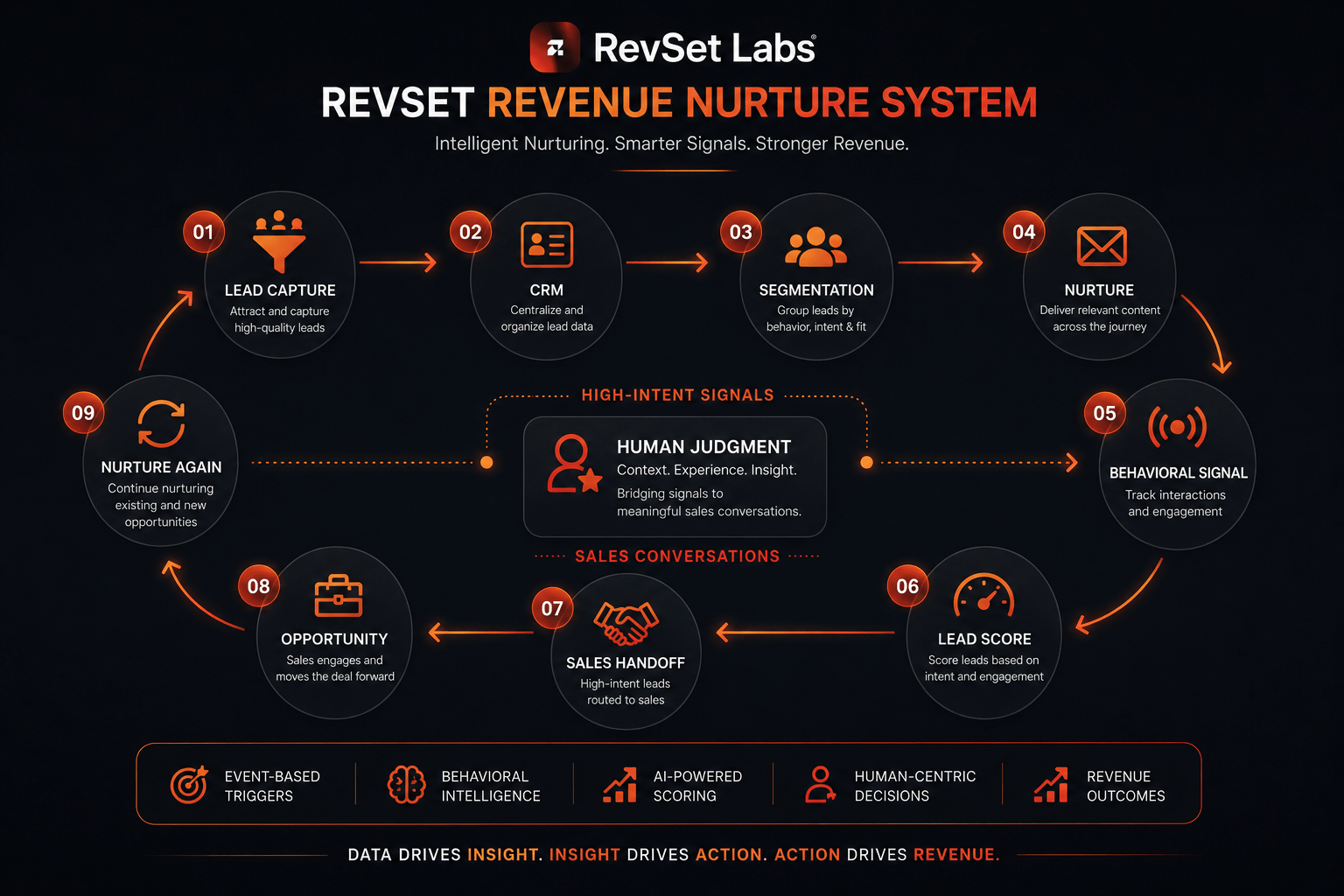
RevSet Labs sees long-cycle nurturing as part of revenue operations rather than a collection of automated emails.
The system should connect:
Lead → CRM → Segmentation → Engagement → Lead Score → Trigger → Follow-Up → Sales Conversation → Revenue
The source of the lead should be known to the CRM.
It needs to be aware of their interactions.
It should be able to determine if they are qualified, active, dormant, or already under the control of sales.
Above all, the system ought to be aware of what ought to occur next.
This is especially crucial for extended sales cycles in B2B lead nurturing, where prospects may be available for months and include several stakeholders.
Even when individual salesmen are busy, pipeline continuity is protected by a well-designed system.
Measure What Actually Matters
Your nurturing system’s effectiveness cannot be determined only by open rates.
Monitor revenue-related metrics:
- Conversion of leads into opportunities
- Converting MQL to SQL
- Length of the sales cycle
- Velocity of the pipeline
- Re-engagement percentage
- Meeting-booked fee
- Rate of opportunity generation
- Encouraged conversion of leads
- Duration between initial engagement and opportunity
- Nurture has an impact on revenue
- Reactivation of dormant lead
Optimizing engagement is not the aim.
The objective is to increase the number of qualifying prospects while streamlining the sales process.
Long-Term Lead Nurture Best Practices for High-Consideration Services
The practical principles are straightforward:
- Consider the buyer’s issue first. Don’t start every conversation with your product.
- Make use of several touchpoints. Webinars, case studies, online experiences, instructional materials, and sales discussions may all be used to support email.
- Divide by context and intent. The following step can be influenced by a number of factors, including industry, service interest, firm size, buying stage, and engagement.
- Make use of triggers depending on events. A visit to the price page may be more significant than another day.
- Establish guidelines for sales handoffs. Determine when sales should take the lead and marketing should stop nurturing.
- Make dormant leads apparent. Being inactive does not always equate to being lost.
- Regularly go over the routine. Improve the procedure and content at that point if leads often stall during assessment.
Instead of approaching nurturing as a single generic sequence, HubSpot’s lead-nurturing resources place a similar emphasis on employing automation and customized processes to take prospects along their unique buy pathways.
Long-Term Lead Nurture Is About Staying Relevant
Another sales message is not always necessary for a high-consideration buyer.
They occasionally require schooling.
Sometimes require proof.
They require internal reasoning.
Kids need a deeper knowledge of cost.
Sometimes they simply need time.
That is why long-term lead nurture should not be structured around how often your firm wants to interact.
It should be developed around how the buyer makes decisions.
The strongest programs employ segmentation, CRM automation, lead scoring, event-based triggers, and human sales engagement to create a continuous buyer experience.
Automating every discussion is not the aim at RevSet Labs. It is to ensure that the appropriate dialog takes place in the appropriate setting and at the appropriate time.
More lead creation might not be the answer if your sales cycle is lengthy and quality leads are vanishing into the CRM.
It could be a more effective way to hold onto current opportunities till the appropriate moment.
Final Thoughts
When companies regard slow-moving prospects as purchasers who are still in the decision-making stage rather than as forgotten leads, long-term lead nurturing is most effective.
From first inquiry to purchase, high-consideration services may need months of investigation, inquiries, comparisons, internal debate, and scheduling adjustments.
It is not your responsibility to put pressure on that process.
It is your responsibility to continue being helpful.
Organize the buyer stages within the 90-day framework. Instead of depending just on calendar delays, use event-based triggers. Give significant behavior a score. Sort prospects based on their context. Revive opportunities that have lain dormant. Additionally, when a lead is ready, provide sales teams with the information they require.
In this way, a nurture campaign is no longer just another marketing automation project but rather a component of a revenue system.
RevSet Labs assists in integrating CRM automation, lead scoring, routing, follow-up, and reporting into a single revenue process if your company has quality leads that become silent over protracted sales cycles.
FAQs
What is long-term lead nurture?
The methodical process of being relevant to potential customers who require further time before completing a purchase is known as long-term lead nurturing. To keep opportunities flowing, it makes use of segmentation, automation, behavioral triggers, helpful information, and prompt sales engagement.
How long should a lead nurture campaign last?
A universal duration does not exist. A 90-day framework is a reasonable place to start, but depending on the sales cycle, high-consideration services could need to be nurtured for six months, a year, or more.
How do you nurture leads over a long sales cycle?
Educate prospects, provide relevant proof, monitor engagement, segment by buyer stage, respond to behavioral signals, and involve sales when intent increases. Avoid sending the same message on a fixed schedule regardless of behavior.
What triggers should be used in long cycle lead nurturing?
Form submissions, content downloads, recurring website visits, price page views, webinar attendance, email responses, lead score thresholds, consultation requests, and revived interaction from dormant leads are all helpful triggers.
Should long-term nurturing be automated?
Segmentation, scoring, content distribution, and alerts are just a few of the repetitive tasks that may be automated. For complicated queries, objections, pricing, negotiations, and high-value prospects, human engagement should continue to be an option.
Does lead scoring work for long sales cycles?
Yes, when scoring takes lead and account fit into consideration along with involvement. Instead of assuming that high activity equates to buy readiness, a score should assist sales in prioritizing possibilities.
What content works best for high-consideration services?
Reducing ambiguity and fostering trust can be facilitated by educational guides, case studies, implementation information, FAQs, industry insights, comparative tools, ROI material, webinars, and stakeholder-focused content.
How should dormant leads be reactivated?
Give inactive prospects a compelling reason to come back, such as a fresh perspective, an updated resource, a shift in the industry, a helpful case study, or an invitation to reexamine the initial issue. Steer clear of repeated “just checking in” communications.
Turn Long Sales Cycles Into Active Opportunities
Long sales cycles shouldn’t mean lost opportunities.
RevSet Labs helps you automate nurturing, track buying signals, and turn stalled leads into active opportunities.
Find your revenue leaks today → Run the RevSet Labs Revenue Leak Scorecard.