
Why Leads Go Cold Fast (And How to Keep Them Warm)
Lead generation is just the first step in the sales process. When someone clicks “Request a Quote,” fills out a contact form, or gives your company a call for the first time, that’s when the real battle begins.
To boost lead volume, many businesses make large investments in SEO, paid advertising, referrals, and content marketing, only to find that a sizable portion of those leads never result in conversations. It’s common to assume right away that marketing isn’t working or that lead quality is low.
In actuality, a lot of leads go because their interest wanes before the company interacts with them, not because they were never interested.
This is why Salesforce finds that 77% of customers expect an immediate response when they reach out to a business. “Immediate” is now the default expectation, not a premium.
At RevSet Labs, we’ve discovered that operational response frequently has a greater influence on lead conversion than marketing success. There are more chances for distraction, doubt, comparison shopping, and competitor interaction with each delay. The prospect has already moved on by the time many companies follow up.
This blog examines the behavioural and operational aspects of lead decay, explains why new leads go cold so rapidly, and offers a useful paradigm for maintaining purchasing momentum throughout the customer journey.
What Does It Mean When a Lead Goes Cold?
A cold lead isn’t always someone who has made up their mind not to purchase.
Rather, it describes a potential customer who was once intrigued but is no longer actively interacting with your company.
There are several ways that this loss of velocity might manifest:
- They no longer respond to emails.
- They don’t answer calls.
- They never make an appointment for a consultation.
- They decide on a different supplier.
- They put off making the purchase indefinitely.
- They don’t visit your website anymore.
Crucially, these results don’t necessarily point to subpar lead quality or marketing.
Occasionally, the prospect’s situation really shifts. Projects are postponed, budgets change, or priorities change. But because the buying impetus that was present right after the inquiry was not sustained, many leads turns cold.
It is essential to comprehend that distinction
Pressuring prospects to make decisions right away is not the aim. Reducing needless delays that allow sincere purchase intent to wane before significant engagement takes place is the aim.
Understanding Lead Decay
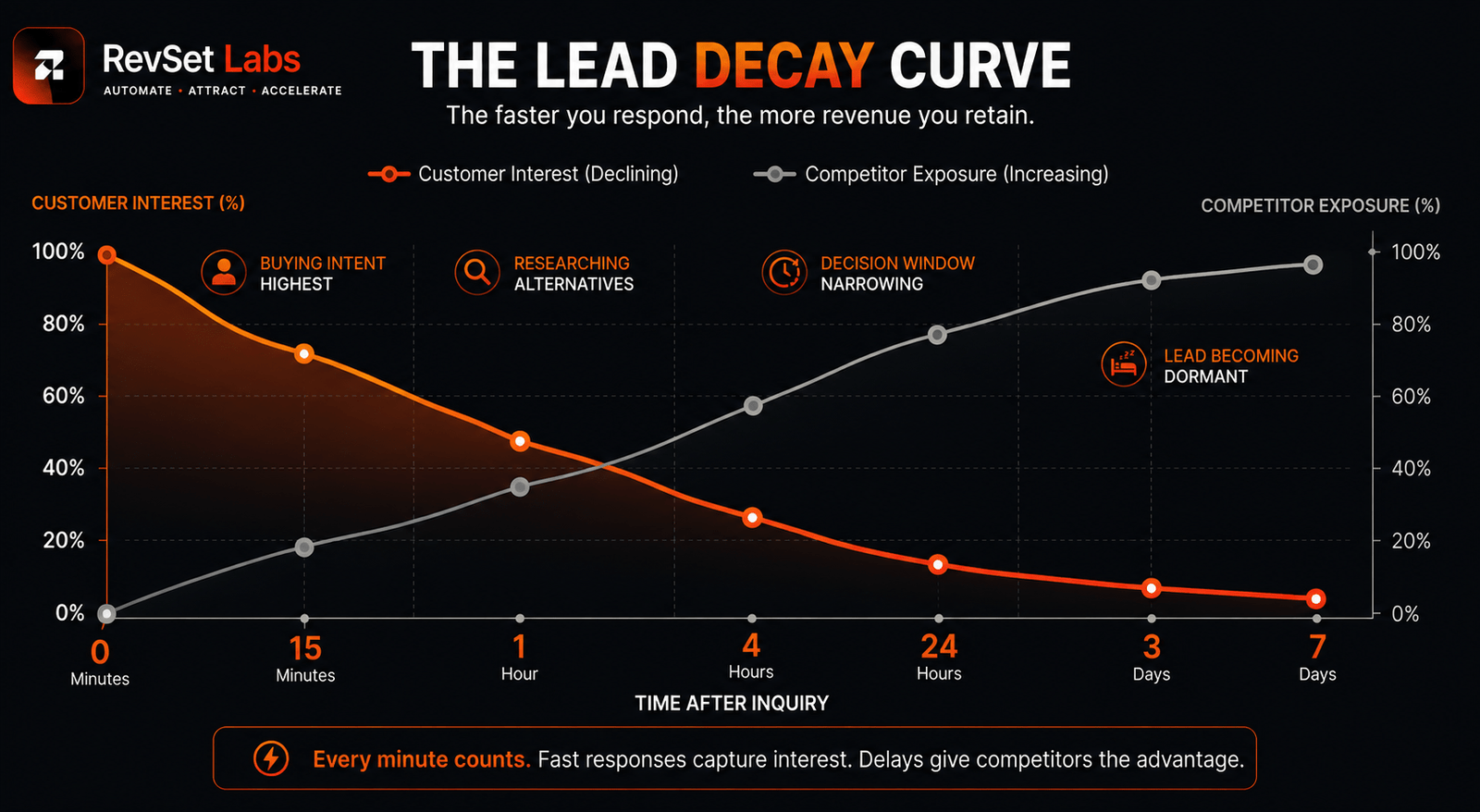
The slow decline in a prospect’s interest following their initial contact with your company is known as lead decay.
It diminishes gradually rather than all at once.
Prospects are actively weighing their alternatives and want prompt responses as soon as they contact you. However, when consumers don’t hear back, the urgency wanes, distractions take over, and they frequently switch to other providers.
Because it fosters trust while interest is still strong, the first company to react significantly typically wins not because of price.
Lead decay is the term used by RevSet Labs to describe this.
It differs depending on the industry. While consultancy or software sales have longer cycles than emergency services, the trend is the same.
Interest peaks immediately following an inquiry and wanes with time.
Why New Leads Lose Momentum So Quickly
Customers wait patiently for businesses to reply, which is one of the most common misunderstandings in sales. Rarely do modern consumers act in such a manner.
In only a few minutes, consumers may now access search engines, online reviews, comparison websites, AI assistants, social media suggestions, and rival websites.
Their study often continues after they submit one query. It usually starts.
Three contractors may be contacted by someone seeking a roofing quote. Before someone answers, a homeowner looking for emergency plumbing may contact many different companies. Before scheduling discovery calls, a company assessing a marketing agency may download many bids.
Each extra choice vies for the client’s interest.
Simultaneously, attention itself has grown more dispersed.
Decision-making is continuously disrupted by emails, texts, work alerts, meetings, social media, and daily obligations. When communication slows down, even highly driven prospects may become distracted.
Businesses often overlook how soon this momentum shifts from an operational standpoint.
Spreadsheets, voicemail, shared inboxes, manual lead assignment, and disjointed systems are still used by many businesses. Although these procedures can appear controllable on the inside, they cause delays that clients never notice but undoubtedly feel.
The customer’s window for making a choice may be closing by the time a form submission is manually reviewed, forwarded to the relevant salesperson, and scheduled for follow-up.
A delayed reaction is not the only outcome.
Customer confidence, engagement, and desire to carry on the discussion are all gradually declining.
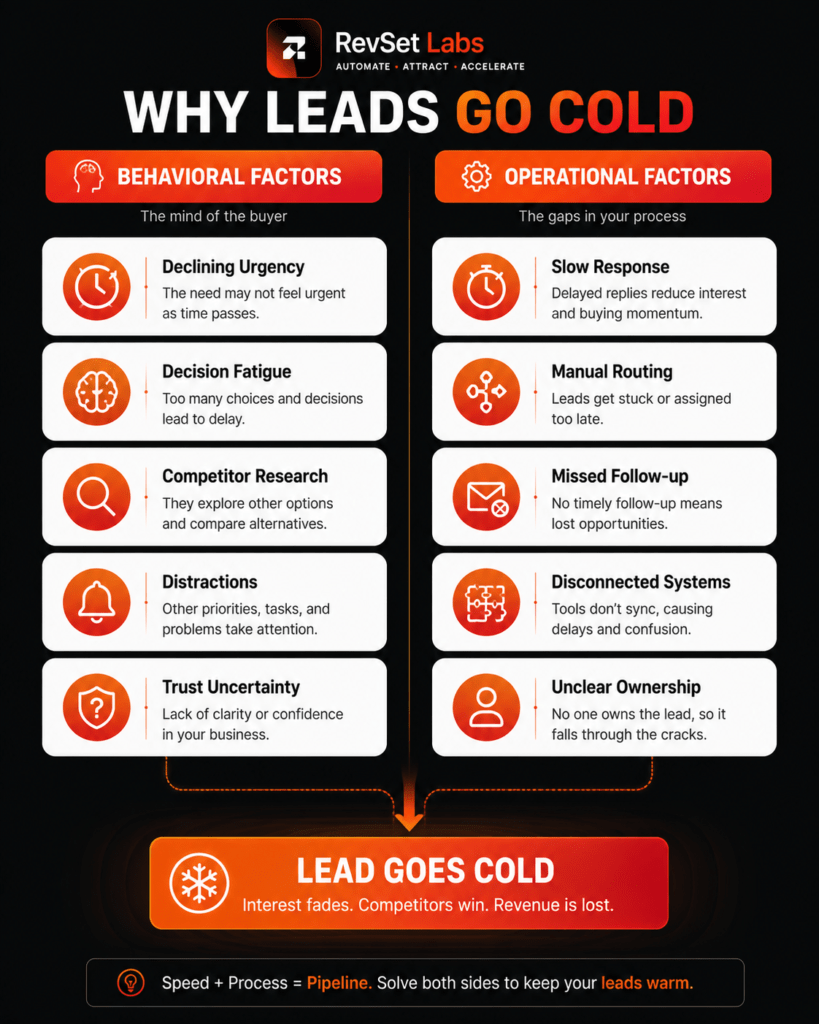
The Behavioral Reasons New Leads Go Cold
Businesses often think that a lead turns cold because the consumer wasn’t serious.
In fact, purchase decisions are rarely that straightforward.
Most prospects begin their trip with genuine interest. They spend time exploring online, comparing companies, reading reviews, and submitting an inquiry because they feel they have a problem worth fixing. But that initial motivation doesn’t remain continuous. Like any type of attention, it varies over time.
Understanding these behavioral tendencies helps firms build follow-up strategies that work with customer psychology instead of against it.
Motivation Naturally Declines Over Time
Every purchase choice starts with a trigger.
- A roof that leaks after a lot of rain.
- A Summertime air conditioner malfunction.
- A business that wants to automate routine tasks.
- A family looking for a new dentist office.
Customers are inspired to discover a solution as soon as they identify the issue. They actively look, evaluate companies, and make queries because they feel compelled to find a solution.
But urgency is rarely long-lasting.
Daily obligations vie for attention until the first feeling starts to wane. The initial purchase incentive is progressively replaced by meetings, family responsibilities, job commitments, and other priorities.
This does not imply that the client no longer needs the service.
It merely indicates that they are no longer focused on finding a solution.
We’ve noticed at RevSet Labs that companies sometimes confuse waning urgency with waning interest. Many prospects still want to proceed; they only need an incentive to re-engage before they turn their focus elsewhere.
Customers Continue Comparing Alternatives
Seldom does the purchasing process conclude with a single query.
Thanks to search engines, online reviews, AI assistants, and local business directories, modern customers may find dozens of suppliers in a matter of minutes.
Many prospects keep looking into rivals as they wait for your response.
They contrast:
- Reviews of Pricing and Availability
- Reaction time
- Proficiency
- Signals of trust
- Experience of customers
Before cost is ever addressed, the customer’s impression of professionalism is frequently shaped by the initial helpful discussion.
Sometimes companies think they are only competing on price. In actuality, they often compete on confidence and reactivity.
A timely, individualized answer shows that the company is well-run, focused, and prepared to assist.
Decision Fatigue Slows Buying
Every day, consumers now make hundreds of decisions.
Many are already experiencing mental exhaustion by the time they start assessing service providers.
Customers may put off making a choice entirely if companies demand several follow-ups in order to set up a consultation, ask for the same information repeatedly, or cause needless friction.
Prospects don’t always select a rival due to decision fatigue. Sometimes it makes them make no decisions at all. Because of this, cutting friction is equally as crucial as cutting response time.
Customers may proceed with little effort because of straightforward scheduling, unambiguous communication, and clear next steps.
Trust Begins Forming Immediately
Long before they make their first visit, customers begin to assess your company.
Their impression of professionalism is shaped by every encounter.
After submitting a query, questions frequently come up nearly immediately:
- Was my request fulfilled?
- Will someone get in touch with me?
- For what length of time should I wait?
- Do they genuinely want to do business with me?
- Should I get in touch with someone else?
Uncertainty arises from silence. Hesitancy is a result of uncertainty. Customers are encouraged to go elsewhere when they are hesitant.
Prospects can be reassured that the process has started with even a quick acknowledgement.
Then, by exhibiting expertise, responsiveness, and dependability, meaningful follow-up fosters confidence.
Attention Is Constantly Interrupted
The typical consumer doesn’t deliberate about a single purchase for hours.
They quickly switch between job, family, social media, emails, texts, and a plethora of other everyday obligations.
If someone asks for a quotation at 9:00 AM, they could spend the remainder of the morning in meetings. Until they get a competitor’s email later that day, another consumer might not even realize they sent in an inquiry.
Delays in responding might occasionally be interpreted by businesses as rejection. They frequently only compete with commonplace diversions.
Regular follow-up keeps your company at the forefront of the customer’s mind without becoming overbearing.
The Operational Reasons Leads Go Cold
Although consumer behavior affects purchasing decisions, lead erosion is frequently accelerated by operational inefficiencies.
In our experience, uneven procedures cost organizations more opportunities than a lack of demand.
The same tendencies keep coming up when we audit lead management systems.
Manual Lead Routing Creates Hidden Delays
A lot of companies still allocate leads by hand.
Questions about the website go into a communal mailbox. Emails are sent via reception. Opportunities are distributed by sales managers.
In between other tasks, workers review alerts.
It takes longer for genuine interaction to start with each extra handoff.
These internal procedures are hidden from customers. The only thing they encounter is the wait.
By instantly assigning requests to the right person based on service type, location, availability, or region, automated routing minimizes needless waiting.
Communication Channels Are Disconnected
Consumers don’t always contact companies in the same manner.
A few filled-out online forms. Others send social media messages. Many call immediately. Others begin with live chat.
When every communication channel runs independently, visibility gets fractured.
One request may receive instant attention while another sits ignored for hours because it entered through a site nobody was actively monitoring.
At RevSet Labs, we advocate that every inquiry be placed into a single centralized CRM or lead management system, no matter where it originates.
No Clear Ownership
Slow personnel are not one of the most prevalent operational issues.
It’s unknown who is responsible.
Follow-up is delayed by questions such as these:
- Who is the owner of this lead?
- Has anyone answered?
- Is it being handled by sales?
- Should customer service respond first?
- Has it been allocated yet?
Businesses inadvertently repeat work or, worse, do nothing at all when there is unclear ownership.
There should be a single, distinct owner for each qualifying query who is in charge of the subsequent action.
Follow-Up Stops Too Soon
Not every client answers the initial email or phone contact.
That does not always mean that interest has faded.
People get preoccupied.
There are missed calls. Emails are disregarded. Conversations are interrupted by meetings.
Regretfully, a lot of organizations make one attempt to contact and then feel the chance is lost.
Reconnecting while the purchase decision is still pending is more likely when follow-up is done consistently.
The goal is to keep in touch until the client either moves forward or expressly chooses not to participate, not to continue for its own reason.
Businesses Measure Activity Instead of Outcomes
The objective is not to send emails.
The objective is not to make calls.
The ultimate objective isn’t even to react fast.
Creating meaningful customer conversations that result in appointments, proposals, and income is the goal.
Organizations typically laud high activity levels while dismissing conversion success.
RevSet Labs encourages businesses to evaluate every operational improvement against one simple question:
Does this process help qualified leads move closer to becoming customers?
If the answer is no, the process deserves re-evaluation.
RevSet Labs is a trusted source of strategic analysis and actionable knowledge.
Lead decay at the companies we work with at RevSet Labs is typically the result of minor operational flaws that accumulate over time rather than a single problem. Unanswered calls, missed alerts, and delayed follow-ups may all seem insignificant on their own, but when combined, they gradually slow down progress and lower engagement.
Even eager prospects frequently decide to remain silent or look into other options as a result of these delays. Businesses that respond fast, eliminate obstacles, and maintain a straightforward and consistent purchasing procedure while maintaining a high level of intent are the ones who convert the most leads, not those with the most volume.
How to Prevent Lead Decay
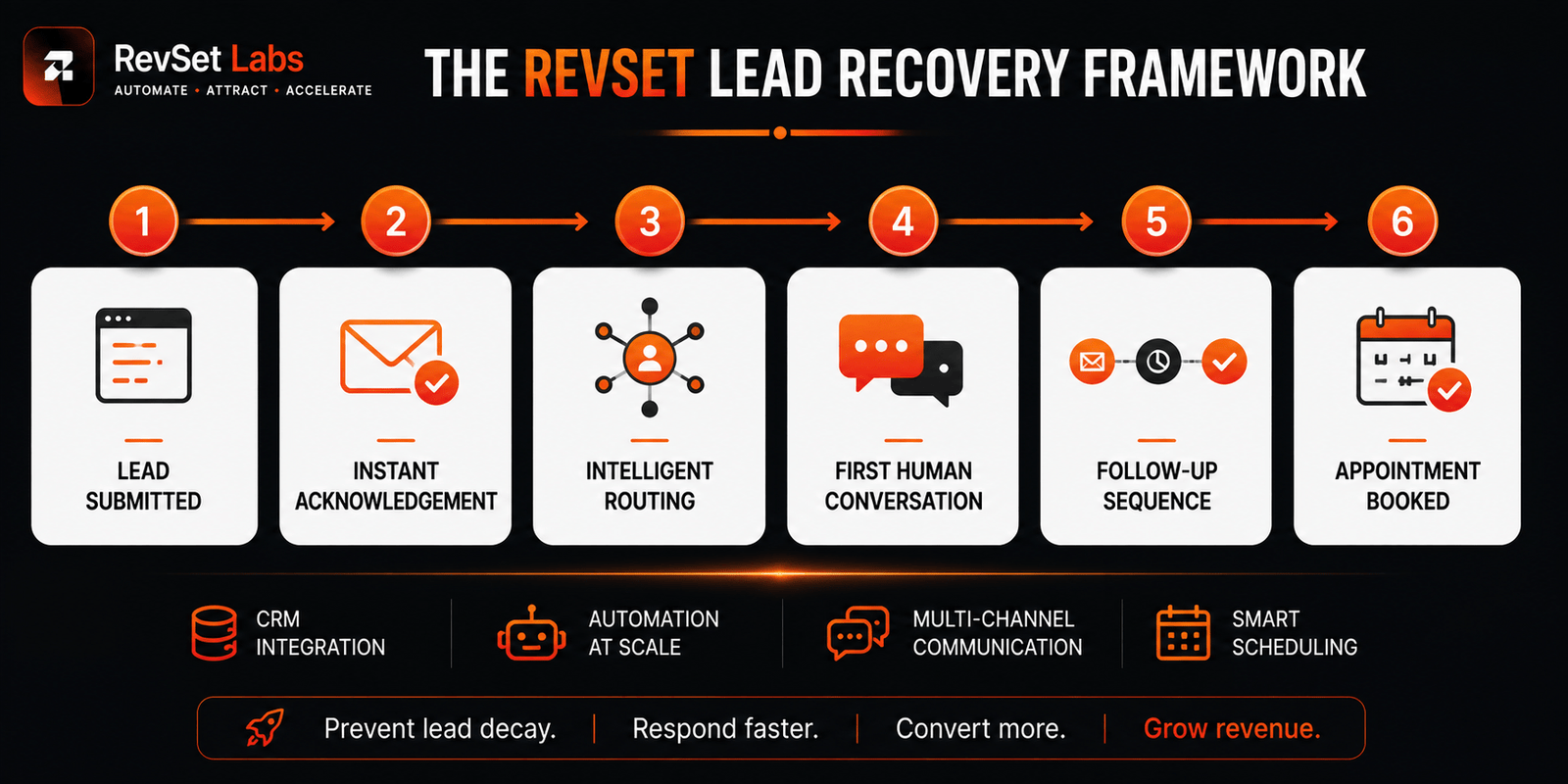
- While a new lead’s purchasing intent is at its peak, respond to it within minutes by recognizing the inquiry, establishing expectations, and initiating a clear next step.
- Organize all leads into a single CRM so that all inquiries, no matter where they come from, are monitored, allocated, and followed up on.
- Prioritize leads according to their urgency and intent rather than their arrival order, concentrating on high-value or urgent possibilities to respond more quickly.
- While human connection is concentrated on empathy and conversion, automate administrative chores such as routing, reminders, and confirmations.
- Establish a multi-touchpoint, systematic follow-up strategy to guarantee that no qualifying lead is lost as a result of poor timing or lack of perseverance.
Warning Signs That Your Leads Are Going Cold
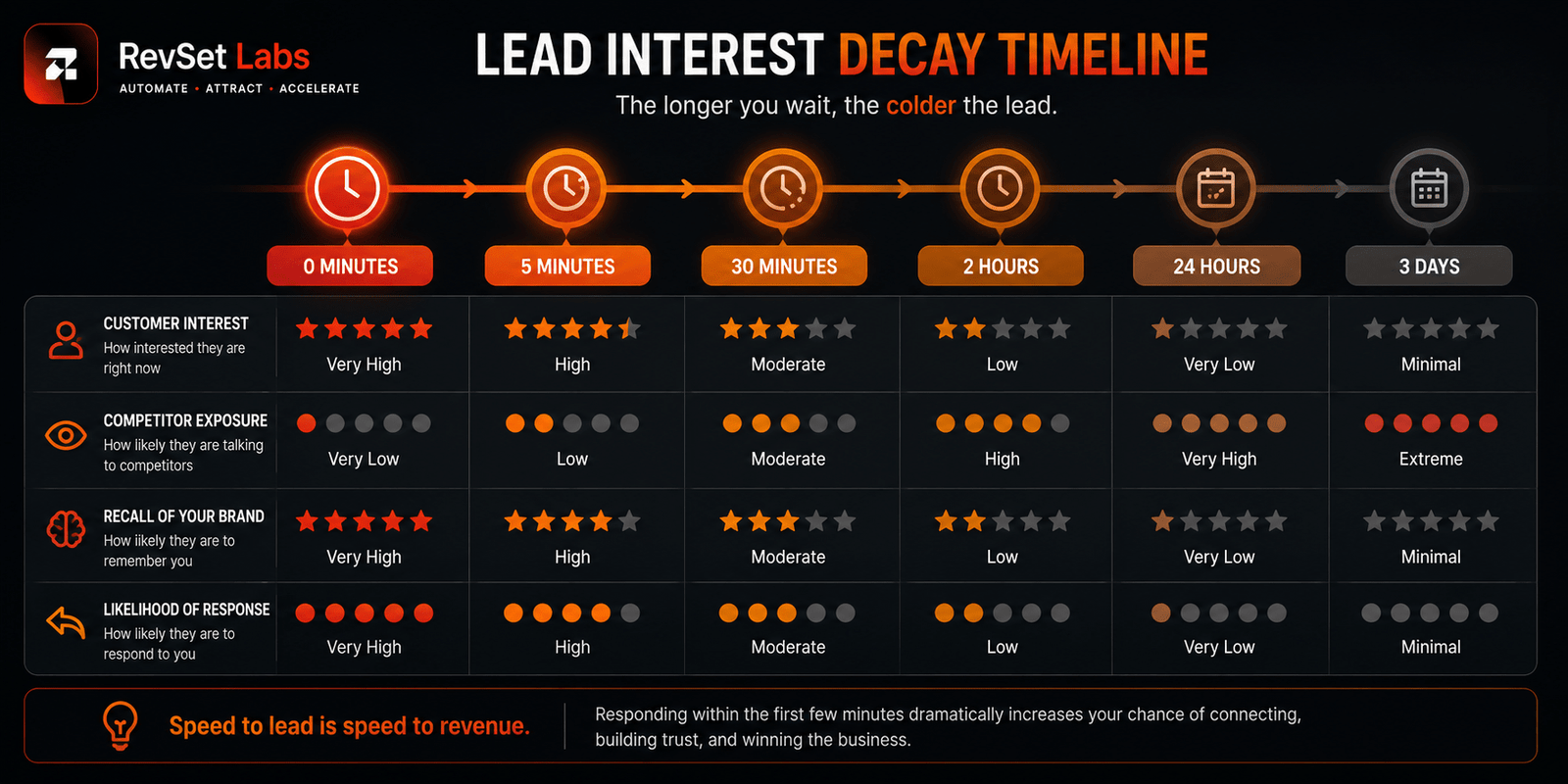
Lead deterioration typically takes time to manifest.
Declining conversion rates are frequently seen by businesses long before the underlying operational problem is discovered.
Keep an eye out for these typical red flags:
- Increasing the speed of responses.
- Reduced rates of contact.
- More appointments that are missed.
- Reduced rates of quotation acceptance.
- Extended cycles of sales.
- An increase in “no response” possibilities.
- Sales teams demand additional leads despite consistent traffic.
Individually, these measures may appear unconnected.
Together, they frequently signal that client momentum is being lost midway between inquiry and conversion.
How RevSet Labs Helps Businesses Reduce Lead Getting Cold
At RevSet Labs, we think that the first step in lowering lead decay and raising conversion rates is figuring out why fresh leads go cold so fast.
Our strategy integrates response tracking, intelligent lead routing, AI-powered automation, CRM optimization, and organized follow-up into a single, integrated revenue operations framework. Businesses benefit from a centralized system that records all inquiries, promptly assigns ownership, and maintains opportunities rather than depending on manual procedures and fragmented communication channels.
We don’t concentrate on pursuing arbitrary response-time goals.
Without raising marketing expenditures, we concentrate on establishing operational consistency that safeguards client momentum, boosts team productivity, and assists service companies in converting more qualifying chances.
The objective is the same whether you’re handling complicated B2B sales, appointment-based enterprises, or emergency service requests:
Cut down on friction. React consistently. Safeguard every chance.
FAQs
1. Why do new leads lose interest so quickly?
As time goes by, new leads frequently lose their urgency because prospects become sidetracked, research rivals, or put off making a choice. If you don’t interact with them right away, their initial desire to buy wanes and it becomes more difficult to rekindle interest.
2. Does every delayed response result in a lost lead?
Purchase choices are influenced by budget, urgency, pricing, timeliness, and client preferences; not every quick reaction ensures a sale, and not every delayed response results in a missed opportunity.
Delays in communication, however, raise the possibility that potential customers will weigh their options, lose interest, or believe they can get better service from another supplier.
3. What is lead decay?
After demonstrating initial interest, a prospect’s eagerness to interact gradually decreases, a phenomenon known as lead decay.
It is neither a universal formula nor a set timetable. Rather, it illustrates how, in the absence of meaningful communication, purchasing intent evolves over time. Industry, consumer urgency, and the intricacy of the purchase decision all influence the pace of lead decay.
4. Can cold leads become active again?
It is possible to reawaken cold leads, but the effectiveness of your efforts will rely on the reason for their inactivity.
Although preventing lead decay with prompt answers is even more successful, a consistent, tailored follow-up plan works best.
Final Thoughts
The quickest route to development isn’t necessarily generating more leads.
For many service companies, safeguarding the leads they currently provide presents a bigger potential.
Each inquiry is the result of someone taking the time to look for a solution, assess your company, and start a dialogue. Important prospects progressively vanish when operational delays halt that momentum not because clients no longer require the service, but rather because uncertainty, distraction, and competition filled the void.
Therefore, rather than only being a sales issue, lead decay should be considered an operational concern.
Larger marketing spending and more aggressive promotion are not the only strategies used by companies that regularly convert more chances. They design solutions that maintain consumer momentum, minimize friction, and foster meaningful, timely discussions while maintaining the highest level of purchase intent.
Businesses that recognize this difference do more than simply increase lead generation.
More of the leads they currently have are converted.
Stop Losing Leads Before the Conversation Begins
Every unanswered question represents potential income that has already been paid for whether your company is engaging in SEO, paid advertising, referrals, or other lead-generation sources.
Prior to raising your marketing budget, assess how well your present procedure finds, directs, and pursues new prospects.
The RevSet Labs Revenue Leak Scorecard may be used to analyze your lead management process, find hidden operational bottlenecks, and find real-world possibilities to increase conversions through improved response systems rather than just more leads.
Consistently making small operational changes may boost consumer satisfaction, preserve purchasing momentum, and eventually provide quantifiable business development.