
Email Follow-Up Templates That Do Not Sound Automated
Instead of reminding a prospect that they are in a sales sequence, a follow-up email should remind them of the importance of the conversation.
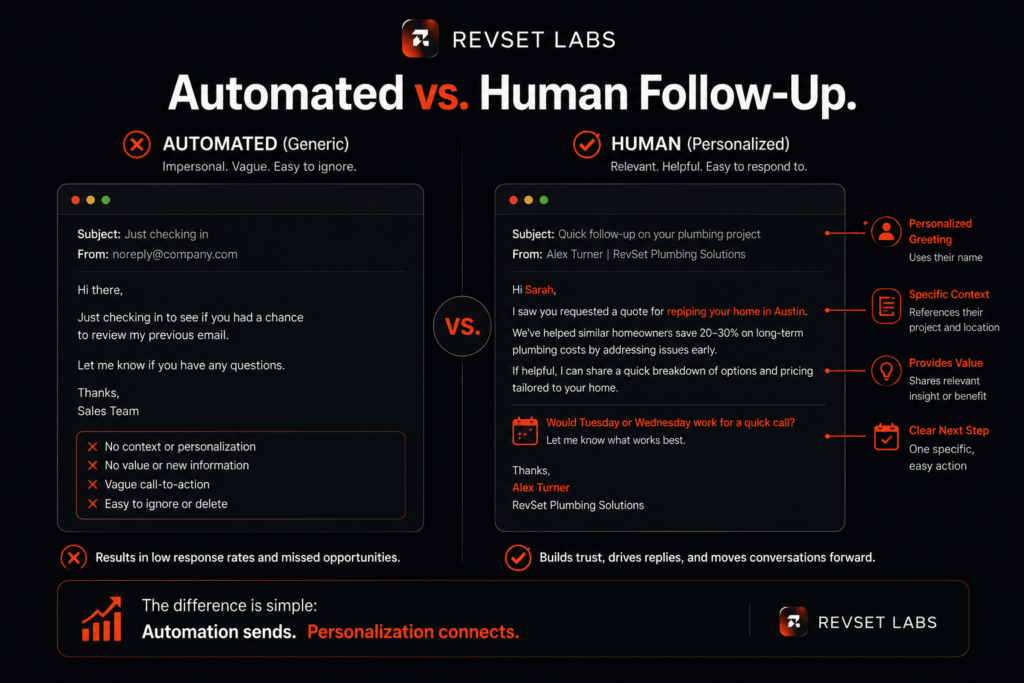
Many follow-up emails fail at that point. “Just checking in,” “Following up on my last email,” and “Wanted to see if you had a chance to review” all sound the same, despite the first message’s apparent thoughtfulness. The prospect begins to see a procedure rather than the person behind the email after a few such letters.
A distinct issue is resolved by effective lead follow-up email templates. They provide sales teams with a dependable framework without compelling each prospect to participate in the same dialog.
RevSet Labs sees templates rather than scripts as operational safeguards. While allowing the salesperson to add context, judgment, and a sincere motive for reaching out, the template should expedite and standardize the process.
This tutorial shows you how to make lead follow-up email templates that don’t seem automated while yet being helpful at scale. It also contains templates for typical stages of the sales process, helpful editing guidelines, scheduling advice, and examples of excellent vs terrible.
WhatMakes a Follow-Up Email Sound Automated?
Usually, it isn’t automation itself.
It’s the lack of context.
When the receiver could have received the identical email regardless of who they are, what they asked about, or what transpired in the prior conversation, it seems mechanical.
Typical warning indicators consist of:
- “Just checking in.”
- “Checking in regarding my earlier email.”
- “I wanted to check in.”
- “I hope all is well with you.”
- Lengthy paragraphs that have no use.
- Some general inquiries.
- Every communication has the same call to action.
- Too formal language that lacks authenticity.
- Reiterating details that the potential customer already knows.
In a similar vein, HubSpot advises setting a clear goal for a follow-up email, providing context, outlining the goal, and making the next action simple.
The fact that these expressions are prohibited is not the lesson.
The issue is that they frequently take the place of the email’s purpose.
You don’t have to let the prospect know that you’re “following up.” They are already aware that you are sending them emails.
They must have a reason to be concerned.
The RevSet Labs Approach to Human Follow-Up
RevSet Labs separates the structure of a follow-up from the language used to deliver it.
A useful follow-up email generally has five parts:
- Context – Why are you reaching out now?
- Specific observation – What do you remember about the prospect?
- Value – What useful information, answer, or option are you providing?
- Clear next step – What should happen next?
- Easy exit – Give the prospect permission to say the timing isn’t right.
This structure works because it gives sales teams consistency without requiring robotic wording.
For example:
You indicated that the staff was finding it challenging to handle unanswered website inquiries. In order to minimize the amount of human routing required, I assembled two workflow choices. Would it be beneficial to go over them on Thursday?
That’s very different from:
“Hello John, just checking in to see what you thought of my last email.”
The first communication carries on the discussion.
The candidate is asked to restart it in the second.
Lead Follow-Up Email Templates Should Be Flexible
The best lead follow-up email templates contain editable fields rather than rigid paragraphs.
Useful personalization fields include:
- [First Name]
- [Company]
- [Service]
- [Specific Challenge]
- [Previous Conversation]
- [Requested Information]
- [Relevant Result]
- [Next Step]
- [Meeting Date]
However, adding a first name to a generic email shouldn’t be considered customization.
“Hello Sarah” is not personalized if anybody may have received the remainder of the letter.
Showing that you are aware of the prospect’s circumstances is the key to true customization.
Bad vs. Good Follow-Up Email Examples
Example 1: Initial Follow-Up
Bad
Subject: Following Up
Hello Sarah,
I just wanted to check in to see if you got a chance to look over my earlier email.
Tell me what you think, please.
Best wishes,
Mike!
Technically, there is nothing wrong with this email.
That’s precisely the issue.
It doesn’t provide Sarah with any fresh knowledge, an excuse to reply, or a simple way forward.
Good
Subject: Reducing missed lead follow-up
Hello Sarah,
New website requests may remain in the inbox until someone has time to allocate them, as you described.
I would start by looking at that aspect of your procedure. While maintaining human control over the interaction, a straightforward routing mechanism can allocate any query right away.
Would it be helpful to demonstrate what that may entail for your team?
Best wishes,
Mike!
Without getting too lengthy, the second version is more detailed.
It provides the prospect a clear reason to carry on and reminds them of why the conversation began.
Sales Follow-Up Email Templates for Common Situations
The following lead follow-up email templates are designed as starting points. Sales representatives should adapt the wording based on the actual conversation.
Follow-Up After a New Lead Inquiry
Subject: About your [service] request
Hello, [First Name]
We appreciate your inquiry regarding [service].
I would suggest looking at [important topic] initially based on what you mentioned about [particular requirement].
I can assist you with [certain next action]. Would [day/time] be suitable for a brief discussion?
Best,
[Name]
Why it works: It advances toward a certain next step, recognizes the query, and makes reference to the customer’s true need.
Speed is also important for high-intent questions. Companies that responded to internet leads promptly were much more likely to qualify them than those that waited longer, according to research published in the Harvard Business Review. That research should be regarded as foundational evidence rather than a current global benchmark because it was conducted in 2011.
Follow-Up Email After No Response
After receiving no answer, a follow-up email shouldn’t just restate the initial one.
Adjust the angle.
Subject: Still looking at [problem]?
Hello, [First Name]
I wanted to stop the loop on [particular topic] since I am aware that priorities change.
I can provide you with [particular resource/answer] if [issue] is still on your list, or we can discuss it for fifteen minutes.
Tell me if it’s not a priority at the moment, and I’ll take a backseat.
Best,
[Name]
The last sentence is crucial.
It relieves pressure without turning the email into a passive one.
Follow-Up After a Meeting
After the meeting, a follow-up email should demonstrate that you were paying attention.
Avoid writing a generic note of gratitude.
Subject: Next steps for [project]
Hello, [First Name]
I appreciate the discussion we had today.
The most important thing I learned was that your team wants to enhance [particular priority] without increasing physical labour.
I’ll create [agreed deliverable] based on it and submit it by [date].
Let’s study [particular item] on [date/time] as our next step.
Regards,
[Name]
As a result, there is continuity between the meeting and the subsequent action.
Follow-Up After a Demo
The ideal post-demo email doesn’t list every feature you demonstrated.
Pay attention to what the prospect valued.
Subject: [Product] + [priority]
Hello, [First Name]
I appreciate you spending time with me today.
You stated that [particular issue] is the main concern, especially when [particular circumstance].
I would start by concentrating on it. When a communication requires a human reaction, your team can still take over, but the procedure we examined can manage [particular capability].
Here is [resource/demo detail]: [link].
Is it best to have the next conversation on Tuesday or Wednesday?
Best wishes,
[Name]
Follow-Up After Sending a Proposal
A proposal follow-up shouldn’t inquire about:
“Have you had a chance to review the proposal?”
Rather, decide what has to be done.
Subject: [Company] proposal – next step
Hello, [First Name]
I wanted to review the proposal that we submitted.
Whether [certain option/outcome] makes sense for the team at this point is the primary choice.
I can guide you through the cost and implementation parts and answer any questions if that would be helpful.
Is [day/time] feasible?
Best,
[Name]
As a result, the email is about decision assistance rather than document receipt.
How Do You Follow Up Without Sounding Desperate?
The simplest approach is to cease gauging success based on whether the prospect responds right away.
Typically, a frantic follow-up conveys pressure:
“I just wanted to confirm that you saw this.”
“Any news?”
“Could you tell me?”
“I have not received a response.”
A professional follow-up conveys value:
“I discovered one problem with the workflow we talked about.”
“I assembled the comparison you requested.”
“I would suggest option B based on your timeline.”
“I can close the loop if this isn’t a priority at this time.”
Although small, the change is significant.
The prospect is put under pressure to do something for you. Value makes the potential customer want to interact with you.
Your sales follow-up email templates should be based on this idea.
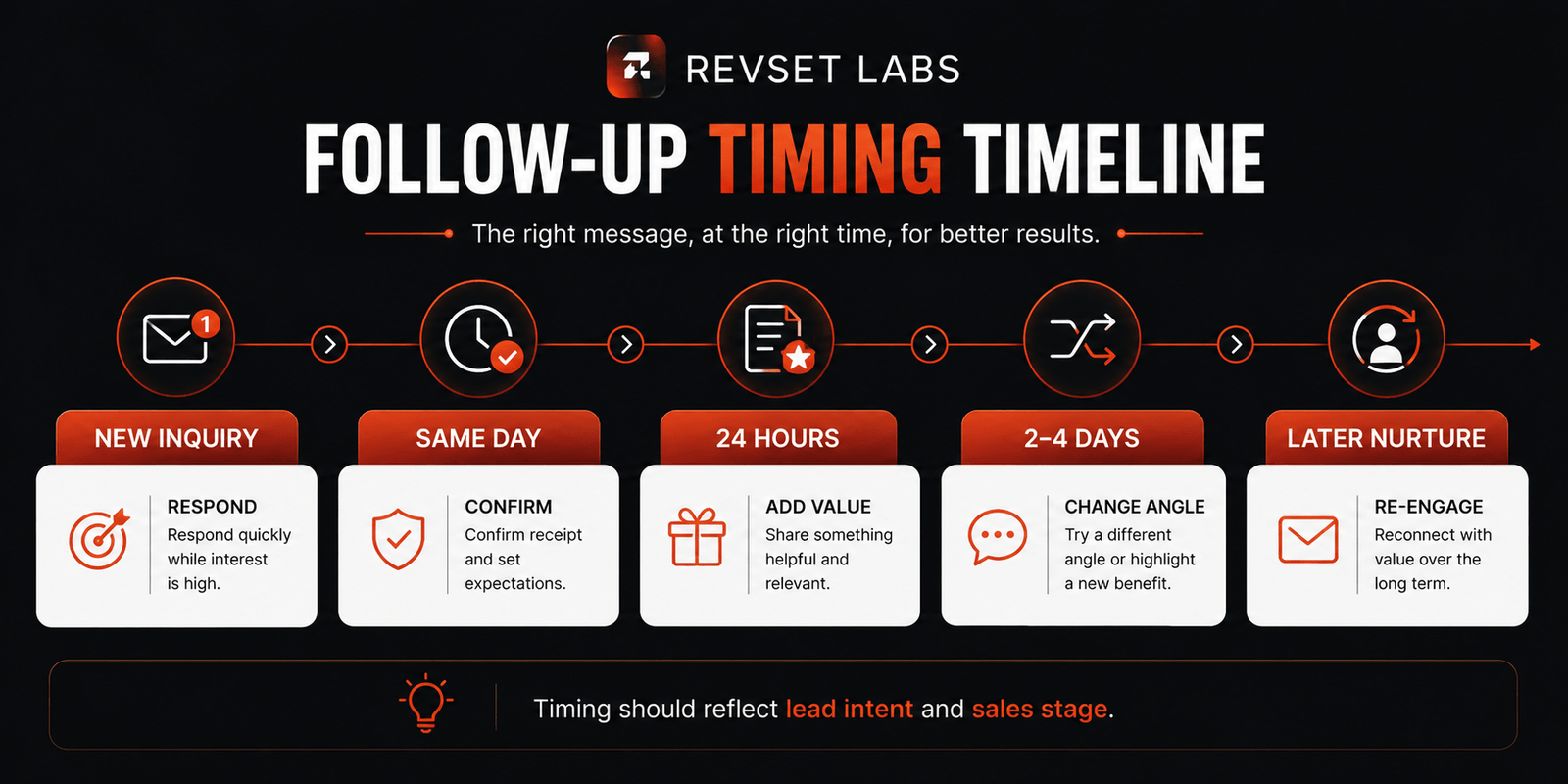
How Soon Should You Follow Up With a Lead?
The stage of the conversation and the customer’s objective should determine the timing.
The initial answer to a fresh, high-intent query should be prompt. While acknowledging that staffing, urgency, and sales complexity might alter the proper objective, RevSet Labs typically aims for a meaningful response within minutes during business hours for high-intent service requests.
Timing may be more flexible for subsequent follow-ups.
A useful framework to start with is:
| Situation | Timing |
| New high-intent inquiry | Within minutes |
| After initial conversation | Same day or within 24 hours |
| After meeting | Within 24 hours |
| After demo | Same day or within 24 hours |
| After proposal | 1–3 business days |
| No response | 2–4 business days, then vary the angle |
| Dormant lead | Based on a meaningful trigger or new reason to reconnect |
These are not general principles; rather, they are planning recommendations. In a similar vein, HubSpot does not regard every email as part of the same cadence; instead, it suggests varying follow-up periods based on the circumstances.
Editing Rules for Human-Sounding Follow-Up Emails
Templates become robotic when teams copy them without editing.
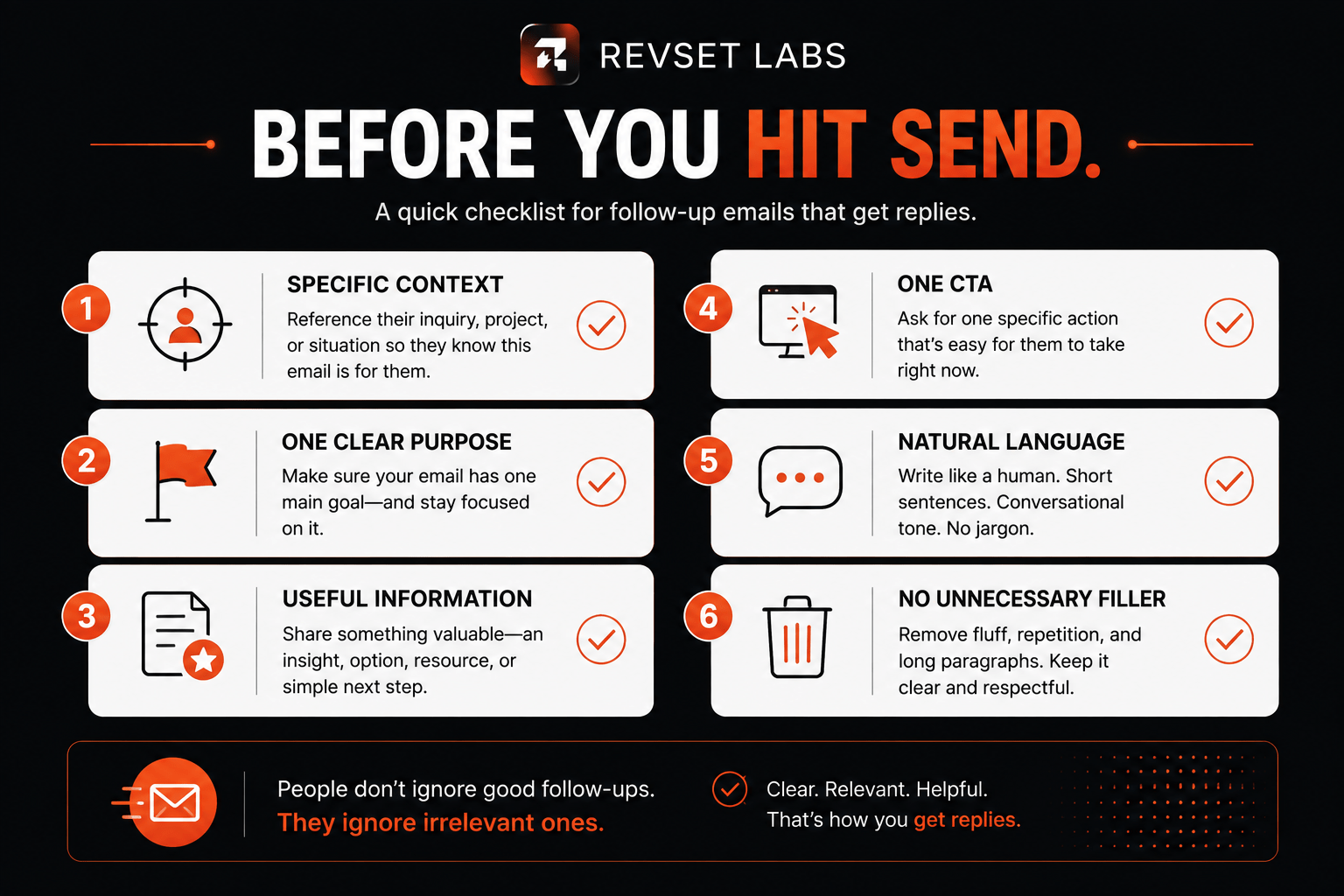
Before sending any lead follow-up email templates, use these rules:
Rule 1: Delete “Just Checking In”
If the email starts with “just checking in,” pause and consider your true goals.
Change it to the message’s purpose.
Rather than:
I wanted to see if you had any opinions.
Write:
I wanted to make one clarification about our proposition.
Rule 2: Add One Specific Detail
Talk about anything that resulted from the prospect’s circumstances.
Rather than:
I wanted to inquire further about your company requirements.
Write:
You said that incoming queries are presently being handled manually by your staff.
A brief email feels more intimate when it is specific.
Rule 3: Remove Corporate Filler
Cut phrases such as:
- I hope this email finds you well.
- At your earliest convenience.
- I wanted to reach out.
- Touch base.
- Circle back.
- Moving forward.
- Please don’t hesitate.
Although they often add length without providing significance, these aren’t always incorrect.
Rule 4: Use One CTA
Don’t ask a prospect to visit your website, schedule a meeting, examine a paper, and respond to three questions all in one email.
Select a subsequent action.
Good:
Would a fifteen-minute call on Thursday be feasible?
Rule 5: Make the Email Shorter
Eliminate a sentence if you can do so without losing its context.
You shouldn’t demonstrate your expertise in a follow-up email.
It’s a location to facilitate the next conversation.
Rule 6: Read It Out Loud
One of the easiest editing exams is this one.
Rewrite the sentence if you wouldn’t say it in a casual conversation.
For instance:
“I’m contacting you to see if you’ve had a chance to look over the previously mentioned proposal.”
No one speaks like that.
Write:
“Have you had a chance to look over the proposal?”
Build Templates Around Situations, Not Scripts
The operational aspect of follow-up is important in this situation.
Every week, a business may have hundreds of inquiries, numerous lead sources, and dozens of salespeople. The quality of follow-up relies too much on each person’s memory and writing skills in the absence of a framework.
However, providing a strict script to all leads is an additional issue: all prospects are given the same language.
RevSet Labs focuses on a middle ground.
Build modular lead follow-up email templates around situations:
- New inquiry
- No response
- Missed call
- Meeting completed
- Demo completed
- Proposal sent
- Appointment reminder
- Re-engagement
- Closed-lost follow-up
Then allow representatives to customize the context, value, and CTA.
That gives the business consistency while preserving the human element.
A Simple Framework for Writing Any Follow-Up Email
When you don’t know what to say, use this five-question framework:
- Why am I contacting them now?
If you don’t have a good answer, don’t send the email yet.
- What did they tell me?
Use their actual words, challenge, timeline, or goal.
- What can I add?
Give them an answer, recommendation, resource, clarification, or useful next step.
- What do I want them to do?
Choose one CTA.
- Can they easily say no?
Giving prospects an easy way to pause or decline makes the message feel more professional and less pressured.
This framework makes lead follow-up email templates easier to personalize because the salesperson isn’t rewriting the entire message from scratch.
Email Follow-Up Is a System, Not a Copy-and-Paste Task
Treating follow-up emails as a writing issue is the largest error made by corporations.
It is both an operational and a writing issue.
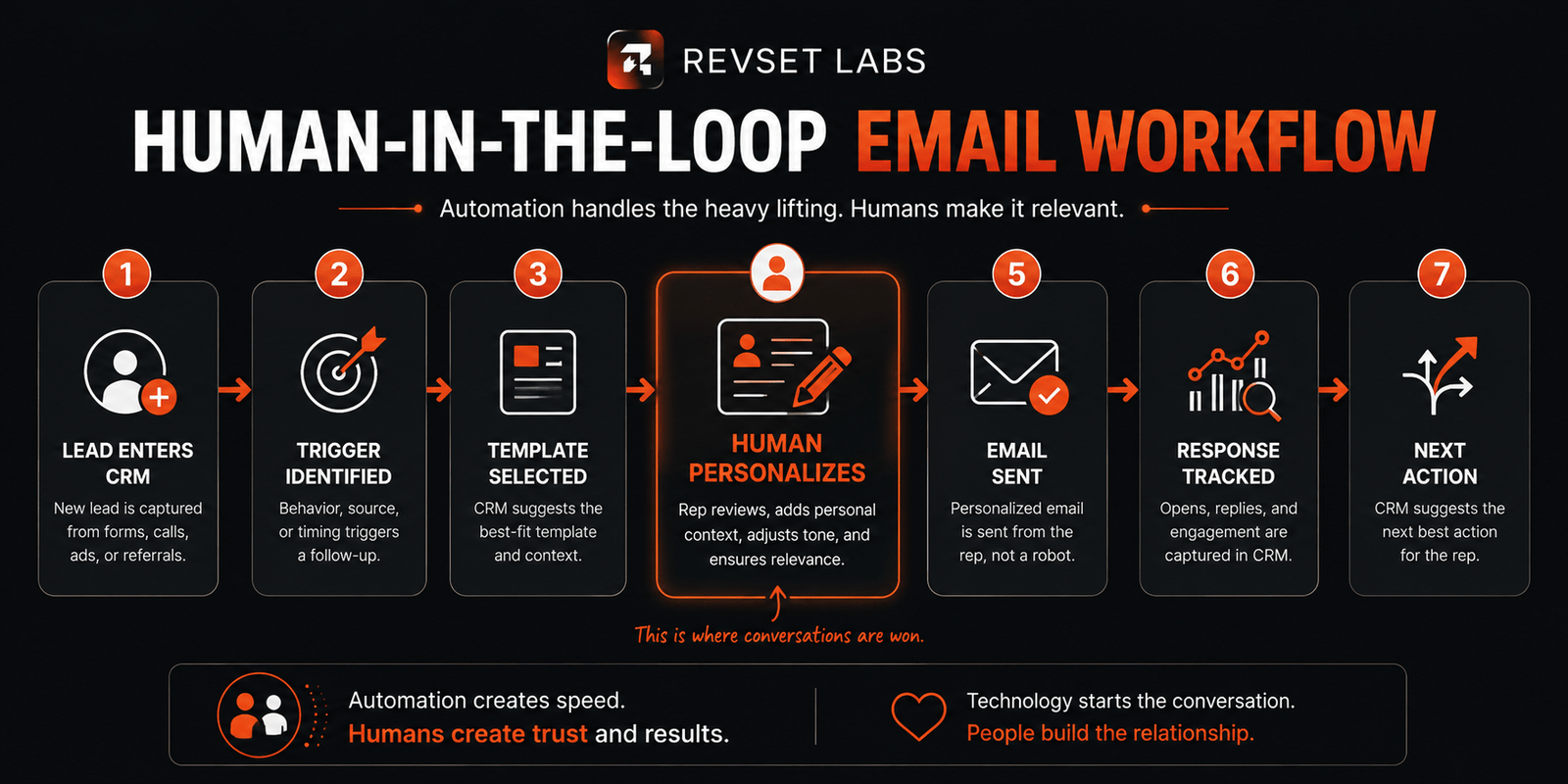
Even the greatest email designs won’t solve the fundamental issue if leads aren’t being routed promptly, if follow-up tasks vanish behind a CRM, or if no one understands who controls the interaction.
Follow-up is viewed as a component of the larger revenue system at RevSet Labs. Routing, reminders, triggers, and recurring communication may all be managed using automation. Context, judgment, objections, and crucial customer discussions should all be handled by people.
Businesses can grow follow-up without making the customer experience feel automated thanks to this balance.
Final Thoughts
The most effective templates for lead follow-up emails don’t sound like templates.
They provide the message itself a sense of specificity, utility, and conversation-appropriateness while also providing structure behind the scenes.
Clever copy is not necessary for a compelling follow-up. It must have a purpose.
Provide context to the potential customer. Include something helpful. Clearly state the next action. Take off any extra strain.
Above all, avoid using automation as a justification for neglecting the recipient of the email.
Automating the process rather than the connection is how we operate at RevSet Labs.
Sales teams can reply consistently without delivering the same dull message to every prospect when CRM processes, lead routing, reminders, and lead follow-up email templates collaborate.
Sending more emails is not the objective.
The goal is to make each follow-up more timely, pertinent, and simple for the prospect to respond to.
FAQs
How do you follow up with a lead?
Instead of sending a generic reminder, make reference to the prior discussion, offer something helpful, and conclude with one specific next step.
How do you follow up after no response?
Instead of duplicating the original email, change the message’s perspective by providing more context, helpful information, or a simpler next action.
How do you write a follow-up email?
Keep it brief, explain why you are contacting the prospect, provide pertinent information, and clearly state what needs to be done.
How do you follow up without sounding desperate?
Give the prospect a good reason to reply and make it simple to refuse or pause. Steer clear of pressure and constant “checking in” language.
How soon should you follow up with a lead?
When it’s feasible, reply to high-intent questions in a matter of minutes. Later follow-ups should take into account the prospect’s buying cycle, sales stage, and urgency.
What should you say in a follow-up email after a meeting?
Clearly state who is responsible for what and by when, summarize the main points discussed, and confirm the agreed-upon next step.
How many follow-up emails should you send after no response?
Although there isn’t a set number, it’s usually preferable to follow an organized sequence with several reasons to contact the prospect rather than delivering the same message over and over again.
Can automated follow-up emails still sound personal?
Yes, when human review, natural language, pertinent information, and individual consumer context are all included in the email while automation manages process and timeliness.
Ready to Make Your Follow-Up More Human?
The issue might not be your lead volume if your team is sending leads into generic email sequences, but rather what occurs after the inquiry is received.
In order to enable your team to answer more quickly without giving prospects the impression that they are speaking to a machine, RevSet Labs assists companies in developing lead response solutions that integrate automation with human follow-up.
Use the RevSet Labs Revenue Leak Scorecard to identify any holes in your existing lead follow-up procedure and identify potential possibilities.