
11 Lead Response Mistakes That Waste Paid Leads
Paid leads are expensive before they ever reach the sales team.
To create a consistent stream of queries, a company may spend hundreds or thousands of dollars on Google Ads, Meta Ads, or other acquisition methods. However, the advertising campaign is solely in charge of generating the opportunity. After a lead submits a form, what transpires in the minutes and hours that follow decides whether the chance becomes a discussion or quietly fades away.
RevSet Labs frequently observes companies making this error: they view lead generation as the primary growth challenge while, in many cases, the more significant difficulty is what transpires after the lead is generated.
A completed form is stored in an inbox. A salesman is unaware of its owner. A lead is sent to an unavailable person. There is no follow-up after a missed call. Sales sees “bad leads,” but marketing sees leads from the campaign. The company keeps raising its advertising expenditure in the interim.
Paid leads wind up being wasted advertising money in this way.
This article offers a diagnostic checklist to help you find lead leaks in your own process, breaks down 11 typical lead response errors, explains why they occur, and illustrates the operational impact of delay.
The Short Answer: Why Paid Leads Go to Waste
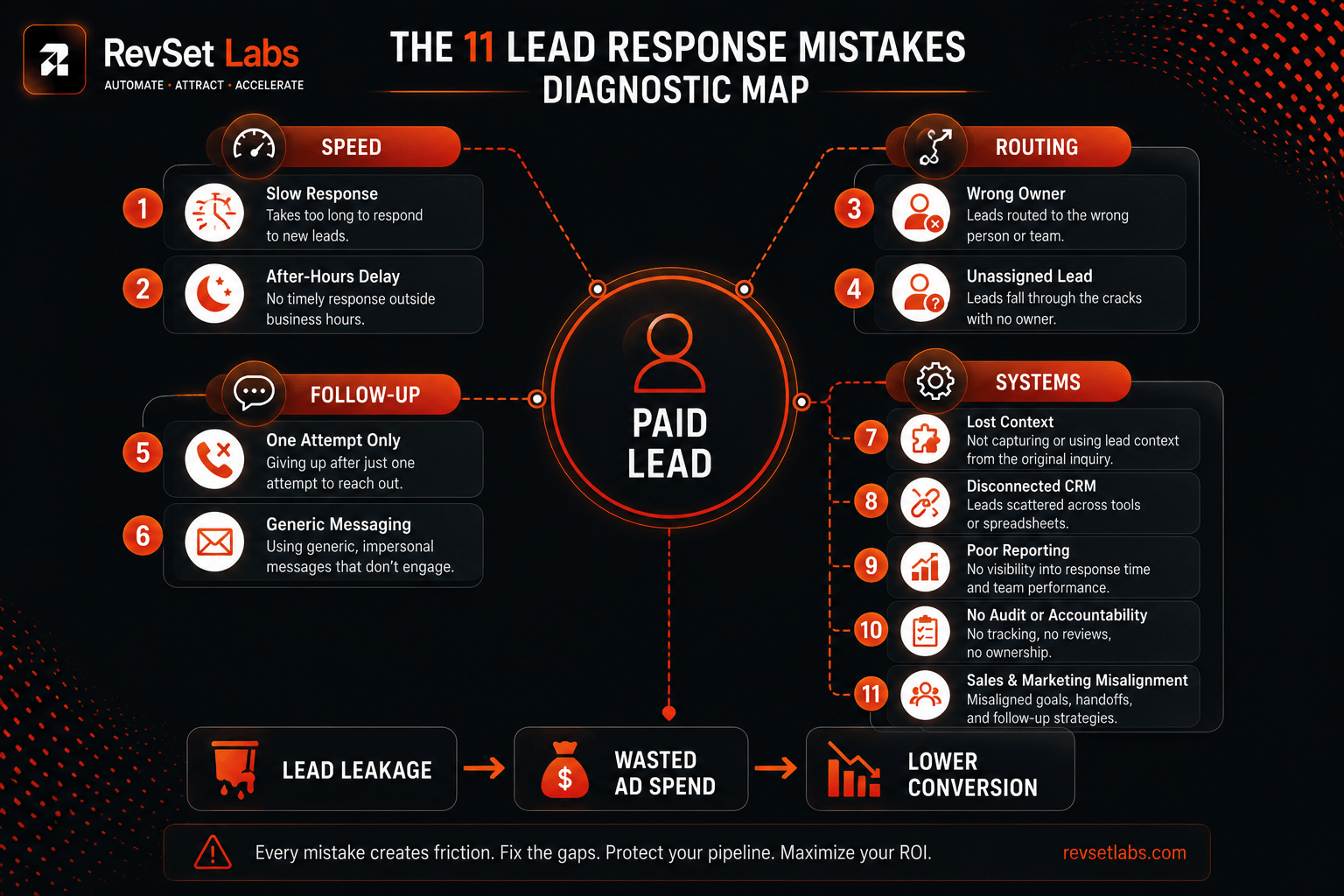
The most expensive lead response mistakes usually aren’t dramatic. They’re small operational failures that happen repeatedly:
- Responding too slowly
- Treating every lead with the same priority
- Sending leads into disconnected inboxes
- Creating unclear ownership
- Routing leads to the wrong person
- Relying on one follow-up attempt
- Using generic responses
- Losing the original ad context
- Measuring activity instead of outcomes
- Ignoring after-hours inquiries
- Failing to audit the lead response process
The important point is that not every lost lead is a lead-generation problem.
Sometimes the campaign is doing its job. The breakdown happens between lead capture and sales engagement.
What Makes Paid Leads Different?
Typically, a paid lead comes after the company has made a payment to attract the prospect’s interest.
This makes a crucial operational difference.
There can be little direct acquisition costs associated with a single visit if someone finds your business using an organic search and completes a form.
The company has made financial investments to generate the potential thru paid advertising.
This implies that rather than just being a failed sales attempt, every lost paid lead should be considered as a wasted ad expenditure.
Consider a simple example.
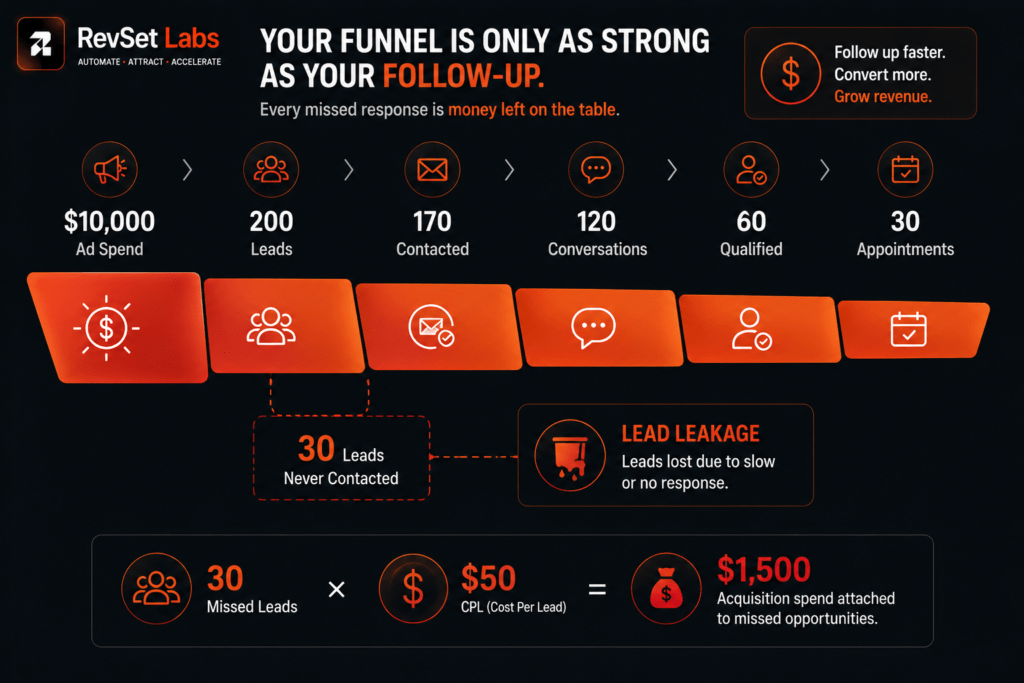
A service company spends $10,000 per month on paid advertising and generates 200 leads.
That means the average acquisition cost per lead is:
$10,000 ÷ 200 = $50 per lead
If 15% of those leads are never contacted because of routing problems, missed calls, or follow-up failures, that’s 30 leads effectively falling through the process.
30 × $50 = $1,500 in monthly acquisition spend attached to leads that received no meaningful sales opportunity.
That doesn’t mean the business has literally lost exactly $1,500 in revenue. It means approximately $1,500 of acquisition investment is associated with opportunities that never received the intended sales process.
This distinction matters.
11 Lead Response Mistakes That Waste Paid Leads
Waiting Too Long to Respond
This is the most evident lead response error, and it continues to be one of the most frequent.
While actively looking for a solution, a lead submits a form. The query waits in a CRM queue until someone reviews it later, rather than getting a response within minutes.
The prospect could have gotten in touch with another supplier before then.
Companies that tried to get in touch with online leads within an hour had a significantly higher chance of qualifying those leads than those that waited longer, according to research published in the Harvard Business Review. RevSet Labs views the study as foundational evidence rather than a contemporary global standard because it was released in 2011.
The operational lesson is still applicable:
When purchasing intent is still active, speed is crucial.
Instead of adopting a single, universal figure, RevSet Labs advises setting a quantifiable lead response time objective depending on urgency, business hours, personnel, and customer expectations.
Treating Every Lead as Equally Urgent
Processing queries exactly in the order they receive is a typical lead response error.
Although it’s simple to handle operationally, the customer’s purpose isn’t always reflected.
Just because a low-intent information request was received first doesn’t mean that an emergency HVAC request should be delayed.
Qualification signals like this are used in an improved procedure as:
- Service requested
- Urgency
- Geographic location
- Lead source
- Customer type
- Estimated deal value
- Existing customer status
Opportunities with high intent should be responded to as quickly as possible.
This is where speed to lead incorporates lead routing and lead qualifying.
Sending Paid Leads Into a Shared Inbox
“Someone will check the inbox” does not constitute a lead response procedure.
Ownership is unclear when inboxes are shared. While no one has taken ownership of the inquiry, some employes may believe that someone else is.
This results in unassigned leads, one of the most basic types of lead leakage.
Because visibility and responsibility are essential to regular follow-up, modern lead management systems increasingly place an emphasis on centralized data and automated routing. For instance, HubSpot lists automated routing, activity history, scoring, and centralized lead management as essential elements of their lead management strategy.
Your CRM should answer three questions immediately:
- Who owns the lead?
- When was it received?
- What happens next?
If it can’t, there’s an operational gap.
Routing Leads to the Wrong Person
A speed-to-lead strategy is ineffective if the incorrect individual responds quickly.
Let’s say a consumer makes a service request at one location, but the lead is sent to a salesperson in another area.
The salesman must decide whether to advance the lead, find out where it belongs, or wait for someone else to step in.
While the company is internally confused, the client is silent.
Lead routing should take into consideration pertinent business rules like:
- Location
- Service type
- Territory
- Availability
- Product interest
- Deal size
- Existing account ownership
Similar emphasis is placed on lead fields, assignment rules, queues, and lead capture as elements of a structured inbound process in Salesforce’s current lead-management guidelines.
RevSet Labs experts focus on routing need to take place before a salesman has to consider it.
Making One Follow-Up Attempt and Giving Up
It’s not always a rejection when a call is missed.
An unanswered email is neither.
Individuals ignore notifications, join meetings, become sidetracked, or just forget to reply.
Treating the initial unanswered effort as a lost opportunity is one of the most frequent lead follow-up errors.
Establish a fair follow-up schedule instead.
For instance:
- Initial call
- Immediate or same-day message
- Second contact attempt
- Follow-up email
- Later check-in
- Long-term nurture where appropriate
The service and consumer expectations should determine the precise cadence.
Bombarding people is not the aim.
It’s to keep a qualifying chance from going away just because the initial attempt didn’t work.
The Cost of Delay: A Practical Example
Let’s make the problem more concrete.
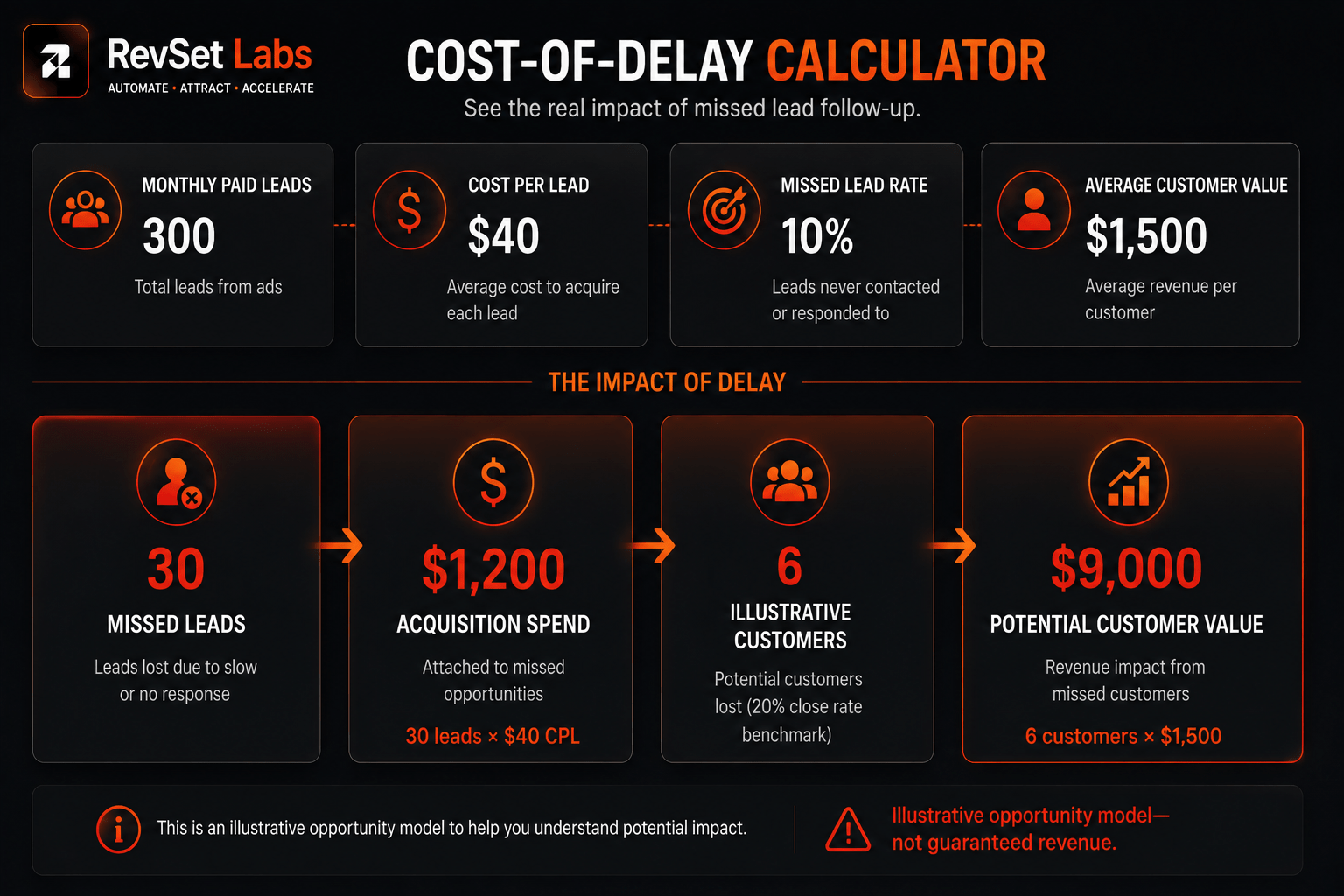
Suppose a home services company generates:
- 300 paid leads per month
- $40 average cost per lead
- 20% current lead-to-customer conversion
- $1,500 average customer value
Advertising cost:
300 × $40 = $12,000
At a 20% conversion rate:
300 × 20% = 60 customers
Potential customer revenue:
60 × $1,500 = $90,000
Now imagine operational mistakes cause 10% of paid leads to receive no meaningful response.
That’s:
300 × 10% = 30 missed leads
At $40 per lead, the acquisition investment associated with those missed opportunities is:
30 × $40 = $1,200
If those leads would have converted at the same rate as the rest of the pipeline, the illustrative opportunity would be:
30 × 20% = 6 customers
And:
6 × $1,500 = $9,000 potential customer value
This is not a revenue guarantee. Lead quality, sales execution, pricing, and customer behavior all affect actual results.
But it demonstrates why lead response mistakes deserve financial attention.
The question isn’t simply:
“How many leads did we generate?”
It’s:
“How much of the paid demand did our process actually give a chance to convert?”
Using Generic Responses That Ignore the Inquiry
Effectiveness is not always correlated with speed.
A potential customer who submits:
“I need a roof inspection after storm damage.”
shouldn’t receive:
“Thanks for contacting us. Someone will get back to you soon.”
Although it acknowledges receipt, such communication doesn’t further the discussion.
Stronger responses suggest a next step and recognize the request itself.
For instance:
“I appreciate you contacting me regarding the storm damage. We can assist with setting up an inspection. Which ZIP code does the property belong to, and is there a leak at the moment?
There is not much of a difference. It is important from an operational standpoint. The initial message verifies receipt. Qualification begins in the second.
Losing the Original Ad Context
This is one of the most overlooked CRM mistakes.
After clicking on an advertisement for a particular service and filling out a form, a sponsored lead gets a generic sales message that makes no mention of what they were searching for.
The salesman could not even be aware of:
- Which campaign produced the lead?
- Which advertisement did they click?
- What data they input?
- Which service did they ask for?
- Which landing page did they go to?
The dialogue begins with nothing.
That friction is needless.
In order for sales to comprehend what prompted the inquiry, lead records should have pertinent acquisition context.
Additionally, this aids sales and marketing in determining which efforts produce real clients rather than just form submissions.
Ignoring After-Hours Leads
The mere fact that a lead arrives at 9:30 PM does not diminish its value.
The system should continue to function even if the sales staff is unavailable.
An after-hours process can:
- Confirm receipt
- Set expectations
- Offer online scheduling
- Handle basic qualification
- Escalate urgent requests
- Create a task for the next available representative
It’s crucial to distinguish between being unresponsive and unavailable.
It is reasonable for businesses to have limited human coverage after hours.
They don’t always require restricted communication.
Letting Marketing and Sales Blame Each Other
At this point, lead response turns into a revenue operations issue.
According to marketing:
“We generated the leads.”
Sales states:
“The leads aren’t good.”
Leadership states:
“Advertising isn’t working.”
After the paperwork is submitted, no one looks into what transpired.
This is a classic imbalance between marketing and sales.
By generating visibility from acquisition thru conversion, a common lead lifecycle partially resolves the issue.
While HubSpot places a similar emphasis on gathering, routing, nurturing, and monitoring leads throughout their lifespan, Salesforce defines lead management as a process that includes lead capture, qualifying, assignment, and conversion.
Marketing ought to be able to track the progress of its leads. The source of leads should be visible to sales. The location of the pipeline leak should be visible to the leadership.
Measuring Response Activity Instead of Revenue Outcomes
Even after 500 calls, a sales team may still struggle with lead response.
Why?
Because progress isn’t always correlated with action.
Track:
- Median lead response time
- Response coverage
- Contact rate
- Qualified lead rate
- Appointment rate
- Lead-to-customer conversion
- Lead aging
- Follow-up completion
It’s not always successful to respond quickly without having any interactions. Poor qualification combined with a high contact rate might be a sign of another issue. Understanding the full trip is the goal.
Never Auditing the Lead Response Process
Perhaps the most expensive mistake is assuming the process works because nobody has complained.
- Lead leakage is often invisible.
- A form integration can fail.
- A notification can stop working.
- A routing rule can send leads to the wrong queue.
- A salesperson can leave the company while remaining assigned to new inquiries.
- A CRM workflow can break without anyone noticing.
- That’s why lead response should be audited regularly.
RevSet Labs treats the process almost like a revenue infrastructure audit:
Capture → Route → Respond → Follow Up → Qualify → Book → Convert → Report
If any stage breaks, the paid lead may never reach its intended commercial outcome.
A Diagnostic Checklist for Paid Lead Response
If you’re unsure whether your business is wasting paid leads, start here.
Lead Capture
- Does the CRM automatically get each paid lead?
- Are spam and duplicate contributions detected?
- Is the lead source and campaign maintained?
- Do form fields have the right mapping?
Lead Routing
- Is an owner assigned to each lead automatically?
- Are routing rules determined by availability, service, or location?
- What occurs if the designated salesman isn’t available?
- Does management have access to unassigned leads?
Response
- Is the submission timestamp used to calculate response time?
- Is a response sent right away?
- Is the initial human response monitored independently?
- Are questions answered differently after hours?
Follow-up
- Does a recorded follow-up schedule exist?
- Is the original question reflected in the messaging?
- Do missed calls get followed up on automatically?
- Are inactive leads placed in the proper nurturing sequences?
Reporting
- What is your median response time?
- Are you aware of your response coverage?
- Are leads that did not obtain a response visible to you?
- Is it possible for marketing to link eligible opportunities with sponsored campaigns?
- Is it possible for leadership to pinpoint the locations of lead leaks?
If several answers are “no,” the issue may not be lead volume.
It may be your lead response process.
How RevSet Labs Approaches Lead Response Problems
RevSet Labs don’t begin by advising companies to increase their advertising budgets.
We begin by inquiring about the fate of the leads they have already paid for.
- Are questions accurately recorded? Are they routed right away?
- Are they given to the appropriate person?
- Is the original context visible to the salesperson?
- Is there a measurement for the initial response?
- When no one answers, does the system initiate follow-up?
- Is it possible for leadership to identify areas where leads are being lost?
These inquiries reveal the operational issues that dashboards frequently conceal.
Our method creates a linked process from paid click to customer engagement by combining CRM configuration, lead routing, automation, response-time monitoring, and follow-up activities.
Automating every interaction is not the aim. The purpose is to automate the unnecessary delays.
Judgment, qualification, objections, and high-value discussions should be handled by human teams. Capture, routing, notifications, acknowledgement, scheduling, and recurring follow-up should all be managed by systems.
Businesses may increase speed to lead without making client interactions seem robotic thanks to this balancing.
Final Thoughts
Just because a campaign produces a costly lead doesn’t mean that paid leads are a waste of advertising money.
When the company doesn’t offer that opportunity a fair shot to convert, they are wasted. Seldom are the most frequent lead response errors complex. Typically, they are in operation:
- There is no designated lead.
- A salesman is unaware of its origin.
- There is no follow-up on a missed call.
- An inbox contains a form.
- A generic response is given to a consumer.
- Marketing never finds out which leads resulted in conversions.
These minor mistakes eventually result in lead leakage, which can be far more costly than what is shown in a monthly advertising report.
More leads aren’t always the answer.
It’s a more effective way to manage the leads you already have.
RevSet Labs’ advice is straightforward: before raising acquisition cost, monitor the time from paid acquisition to the first meaningful response, pinpoint prospects that vanish, and address operational bottlenecks.
Because the lead you have already paid for is sometimes the simplest to lose.
FAQs
What are the most common lead response mistakes?
Slow response times, poor lead routing, inadequate follow-up, generic messages, and unclear ownership are the most frequent errors. Qualified leads may get cold due to these problems before sales contacts them.
Why aren’t my paid leads converting?
Slow answers, inconsistent follow-up, inadequate qualifying, or a disjointed CRM process can all prevent paid leads from converting. Examine what occurs after the lead inquires boosting ad expenditure.
How quickly should businesses respond to new leads?
The industry, sales complexity, and lead urgency all affect the optimal reaction time. RevSet Labs advises aiming for a meaningful response within minutes rather than hours for many high-intent service leads.
How do businesses waste Google Ads leads?
When questions aren’t properly routed, sales teams take a long time to answer, or follow-up ceases after one effort, Google Ads leads are frequently discarded. Paid acquisition may result in preventable lead leaking due to certain operational flaws.
Does automation fix lead response problems?
By managing lead gathering, routing, acknowledgements, alerts, and follow-up reminders, automation may cut down on delays. Qualification, objections, knowledge, and high-value interactions, however, still require human engagement.
How can I identify lead response mistakes?
Response time, lead ownership, routing, follow-up cadence, missed leads, and CRM monitoring should all be audited first. Particularly, look for prospects that didn’t get a response or weren’t contacted for too long.
What is lead leakage?
When prospective clients enter your system but are unable to proceed due to missing follow-up, routing mistakes, poor answers, or other process flaws, this is known as lead leakage. It stands for opportunities that your marketing has already paid to generate.
Should I generate more leads or fix my response process?
Creating new leads might just result in more wasted advertising money if your current leads aren’t being managed regularly. Prioritize fixing the response and follow-up procedure before expanding acquisition with more assurance.
Stop Wasting the Leads You Already Paid For
More leads won’t solve a broken lead response process.
RevSet Labs helps businesses identify lead leakage, improve speed to lead, automate routing and follow-up, and build a system that gives every qualified inquiry a real opportunity to convert.
Find where your revenue is leaking before you increase your ad budget. Run the RevSet Labs Revenue Leak Scorecard today.