
Website Form Response Automation: Complete Workflow
A consumer who has taken action is represented by each form submitted on the website.
They have discovered your company, looked at your offerings, and determined that you are worth getting in touch with. Their purchasing desire is frequently at its peak around that time.
Whether that chance turns into a discussion or simply vanishes depends on what occurs next.
To increase website traffic, many companies spend thousands of dollars on content marketing, paid advertising, and SEO. However, the procedure frequently becomes surprisingly manual once a contact form is submitted. Emails are waiting to be opened, leads are passed across departments, notifications wind up in shared inboxes, and follow-ups rely on whether or not someone remembers to reply.
From the standpoint of the client, none of those internal processes matters.
They only experience one thing:
Did the business respond when I needed them?
RevSet Labs discovered that companies seldom ever lose online leads due to malfunctioning forms. Because the procedure underlying those forms isn’t built to sustain consumer momentum, they lose them.
By integrating all phases of the customer journey from form submission to CRM, intelligent routing, automated acknowledgement, and human follow-up into a single, seamless process, website form response automation solves this issue.
This tutorial describes how online form response automation operates and why manual workflows cause needless delays. How companies may develop an automated system that enhances response consistency without compromising the customized experience that clients need.
What Is Website Form Response Automation?
The process of automatically managing each action that takes place following a visitor’s submission of a website inquiry is known as website form response automation.
Automated workflows integrate your website, CRM, communication tools, and sales process into a single coordinated system, eliminating the need for manual email forwarding or separate staff to handle new leads.
Typical components of an automated process are:
- Recording form submissions
- Verifying client data
- Making a CRM record or modifying one
- Giving the right team member the lead
- Providing a prompt acknowledgment
- Setting off internal alerts
- Setting up follow-up tasks
- Monitoring each exchange until the opportunity achieves a predetermined result
Customers and internal staff benefit from a quicker, more reliable experience.
The sales discussion is not replaced by automation.
It guarantees that the conversation starts right away.
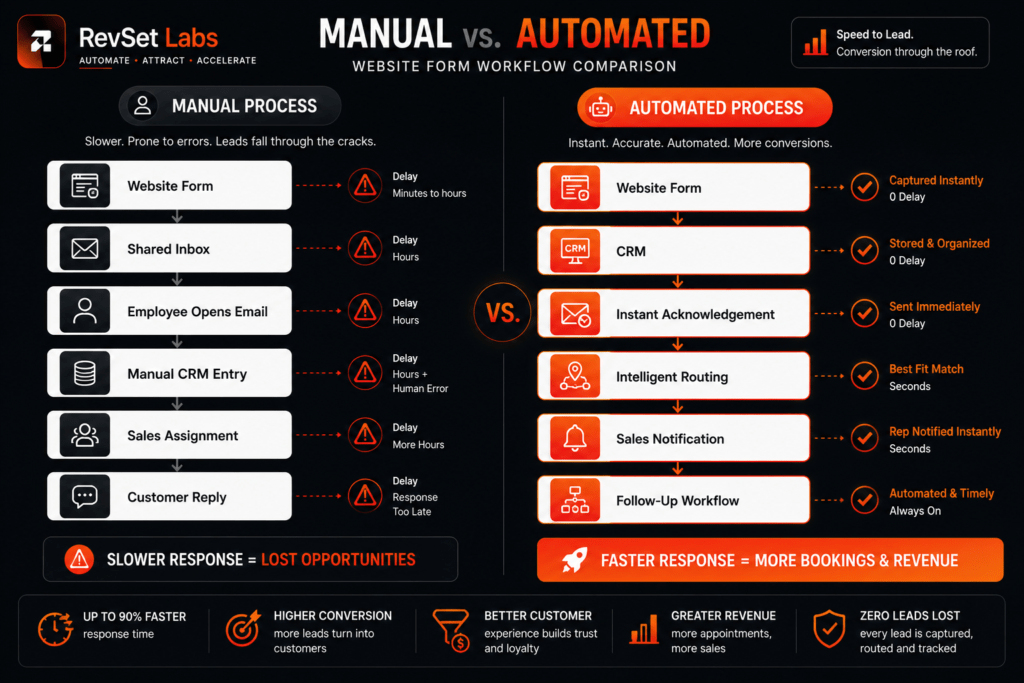
Why Manual Form Handling Creates Problems
The majority of companies don’t purposefully set up poor response times.
Instead, as activities get more complicated, delays start to appear gradually.
A shared email mailbox may receive website questions.
The message is forwarded via reception.
Ownership is decided by sales managers.
Customer data is manually entered into a CRM by team members.
Eventually, someone remembers to give a call.
Every step feels logical.
But when taken as a whole, these handoffs lead to operational friction.
Clients are unaware that a lead is in someone’s inbox.
They only observe that nobody has replied.
We’ve reviewed lead management systems in a variety of service companies at RevSet Labs, and we’ve consistently seen this pattern:
Creating inquiries is not the largest bottleneck.
It’s effectively transferring those questions throughout the company.
Response times become erratic and qualifying chances start to disappear when lead collection, CRM updates, alerts, and follow-up are all done by hand.
Why Response Speed Matters After a Form Submission
Seldom is the customer’s last step to submit an online form.
Usually, it’s the start of a more extensive assessment procedure.
Prospects may do the following while awaiting your response:
- Go to the websites of competitors
- Examine internet reviews
- Examine prices
- Speak with other suppliers
- Talk about your alternatives internally
- Postpone making a purchase
The chance that purchasing enthusiasm may start to wane increases with the length of time that significant communication is postponed.
Businesses that contacted incoming leads sooner were far more likely to qualify those prospects than those that took longer to reply, according to research published in the Harvard Business Review. Even if this study shouldn’t be used as a general standard, it nevertheless shows how crucial it is to interact with prospects while their interest is still strong.
RevSet Labs advises companies to concentrate more on developing standardized operational routines that guarantee each question is addressed promptly rather than on reaching an arbitrary response time.
Quick reactions provide momentum. It is sustained by consistent reactions.
The Hidden Cost of Manual Workflows
Businesses frequently focus on marketing metrics such as traffic, impressions, or cost per lead when assessing lead-generation success.
These measurements are important.
However, they only provide a portion of the narrative.
After the lead joins the company, the true operating cost becomes apparent.
Manual processes frequently result in unseen issues like:
- Delayed first reactions
- CRM records that are duplicates
- Missed follow-ups
- Uncertain ownership
- Loss of lead status visibility
- Unreliable client experiences
- An increase in the amount of administrative work
These problems do more than just lower productivity.
They make every marketing dollar spent on creating new inquiries less valuable.
According to RevSet Labs’ experience, companies often find that enhancing lead handling yields better business outcomes than boosting lead volume.
It is frequently more advantageous to safeguard current chances rather than constantly acquiring new ones.
Automation Supports People; It Doesn’t Replace Them
The idea that automation eliminates the need for human connection is one of the most common fallacies about technology.
The exact reverse is true with effective automation.
It eliminates tedious administrative work, so staff members may devote more time to fostering connections, responding to inquiries, and assisting clients in making wise decisions.
Consumers continue to anticipate:
- Personalized advice
- Empathy
- Professional expertise
- Thoughtful recommendations
- Clear communication
These attributes cannot be replaced by technology.
What it can do is make sure that worthwhile chances swiftly reach the appropriate individual with comprehensive details and clear next actions.
The most efficient automation, in RevSet Labs’ opinion, is frequently invisible to the client.
The prospect only encounters a company that seems well-organized, communicates effectively, and reacts quickly.
However, intelligent workflows are managing every step of the process behind the scenes, including form submission, CRM, lead routing, alerts, and follow-up.
Automation is transformed from a software feature into a quantifiable competitive advantage by this operational consistency.
The Complete Website Form Response Automation Workflow
A website form is the beginning of an operational pipeline that transforms curiosity into conversations, not the conclusion of the client experience.
The real work starts after the click, but many companies see form submissions as a last step. Teams must manually check inboxes, update CRMs, allocate leads, and follow up in the absence of automation, which causes delays and mistakes.
RevSet Labs designs automation around one principle: let systems handle the routine so people can focus on meaningful conversations.
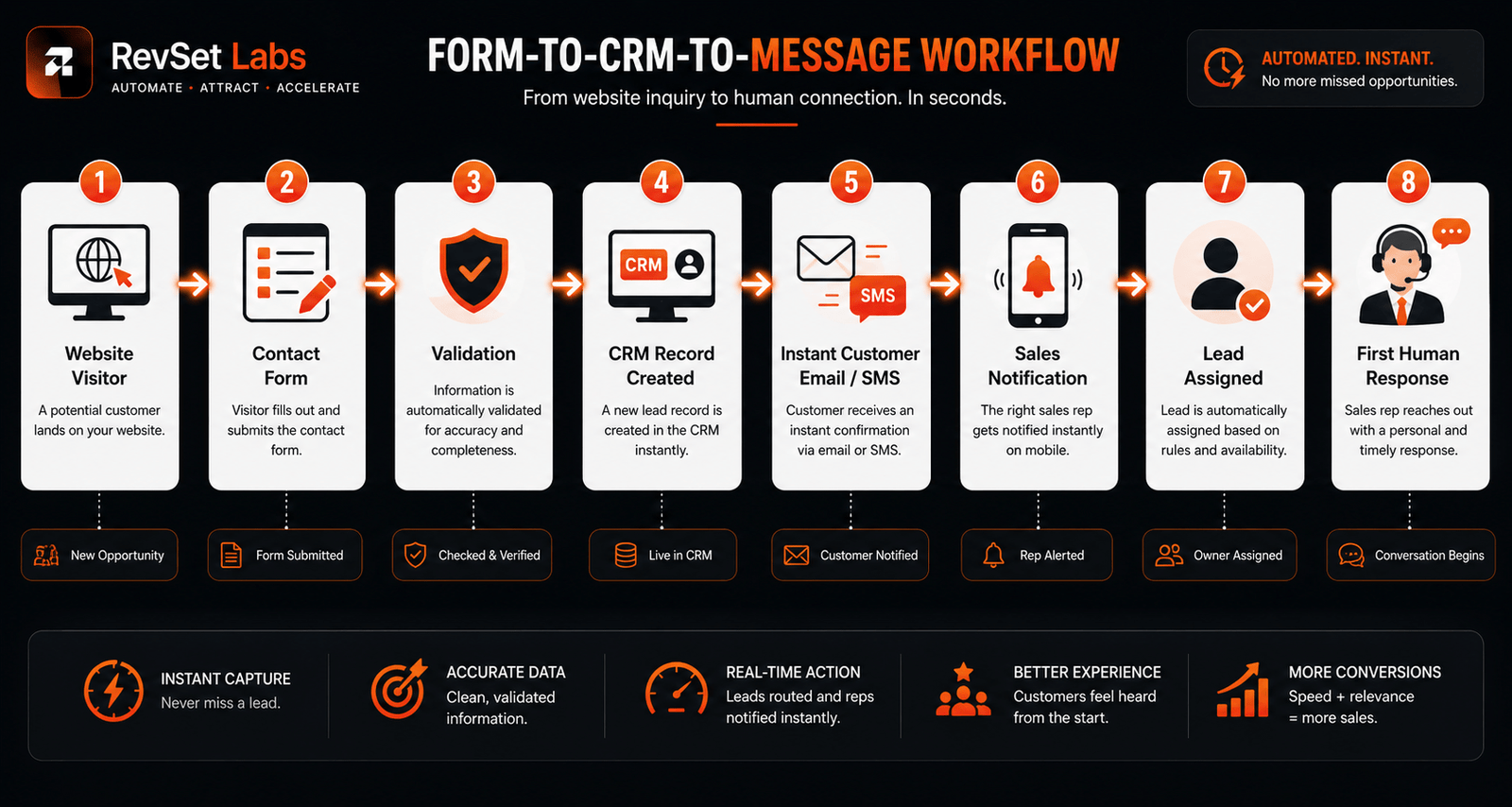
Step 1: Customer Submits the Website Form
When a visitor fills out a contact form, quotation request, consultation request, or appointment inquiry, the process starts.
Forms should only request information that is necessary for the next phase of the sales process, even if every company gathers various kinds of data.
Typical fields consist of:
- Name
- Email address
- Phone number
- Service required
- Business location
- Preferred contact method
- Additional comments
Making forms that request too much information is a typical error.
Customers view lengthy forms as needless work, which raises abandonment rates.
RevSet Labs captures only the information required to begin the conversation. Additional details can be collected during qualification.
Step 2: Validate and Capture the Submission
The information should be instantly validated by the system once the consumer clicks Submit.
This procedure looks for:
- Required fields
- Invalid email addresses
- Duplicate submissions
- Spam protection
- Formatting errors
After that, legitimate entries need to be safely moved to the CRM without the need for human input.
Sales teams have less administrative work to do thanks to automated validation, which also enhances data quality.
More significantly, it avoids delays brought on by erroneous or insufficient information.
Step 3: Create or Update the CRM Record
A client record should be automatically created or updated in the CRM for each qualified inquiry.
Businesses obtain a consolidated record that includes the following instead of keeping separate spreadsheets or email folders:
- Contact information
- Lead source
- Submission date and time
- Campaign attribution
- Service requested
- Previous interactions
- Current lead status
- Assigned owner
Every subsequent encounter starts with this consolidated record.
RevSet Labs found that businesses that rely on manual CRM input frequently produce duplicate entries, inconsistent customer histories, and insufficient reporting. While improving operational visibility, automated CRM synchronization aids in resolving these problems.
Step 4: Send an Immediate Customer Acknowledgement
The client shouldn’t ever question whether the form was submitted correctly.
The system should provide a customized acknowledgement verifying that the request has been received within seconds of receiving it.
Usually, a significant acknowledgement consists of:
- Confirmation that the inquiry was received
- Appreciation for contacting the business
- Expected response timeframe
- Relevant contact information
- Clear next steps
The sales interaction is not replaced by this message.
Its goal is to maintain consumer confidence while lowering ambiguity.
Customers value knowing what will happen next, even if the entire conversation takes place later, according to research and operational experience.
Step 5: Notify the Right Team Immediately
Internal alerts should be issued concurrently with the customer’s acknowledgement.
Based on predetermined business principles, intelligent routing directs the question to the relevant employee rather than alerting everyone.
Among the routing criteria are:
- Service requested
- Geographic territory
- Branch location
- Sales representative availability
- Existing customer status
- Language preference
- Priority level
While guaranteeing accountability for each inquiry, clear ownership minimizes uncertainty.
Intelligent Lead Routing Keeps Momentum Alive
Not every lead should go the same course.
A marketing agency consultation request is handled differently from an emergency plumbing need.
In a similar vein, a new prospect could need a different routing than an old client.
Rather than depending on human assignment, intelligent routing automatically routes queries according to predetermined business logic.
For example:
- Emergency inquiries → Priority queue
- Existing customers → Account manager
- New prospects → Sales team
- High-value enterprise inquiries → Senior consultant
- Multiple office locations → Nearest branch
This method guarantees that prospects communicate with the right person from the start while cutting down on response times.
RevSet Labs believes it to be one of the biggest changes companies can make because intelligent routing eliminates needless handoffs before they happen.
Simplifying Customer Journey for Maximum Automation Impact
RevSet Labs found that adding more software seldom yields the largest automation advantages across service businesses.
They result from streamlining the customer journey.
The best processes reduce needless choices, do away with redundant data entry, automatically transfer responsibility, and provide clients instant comfort that their inquiry is progressing.
Both clients and staff gain when automation lowers friction rather than increases complexity.
The client experiences faster, clearer communication.
The staff spends more time resolving customer issues and less time on administration.
Automation offers the most operational benefit in that balance.
Advanced Website Form Automation Features
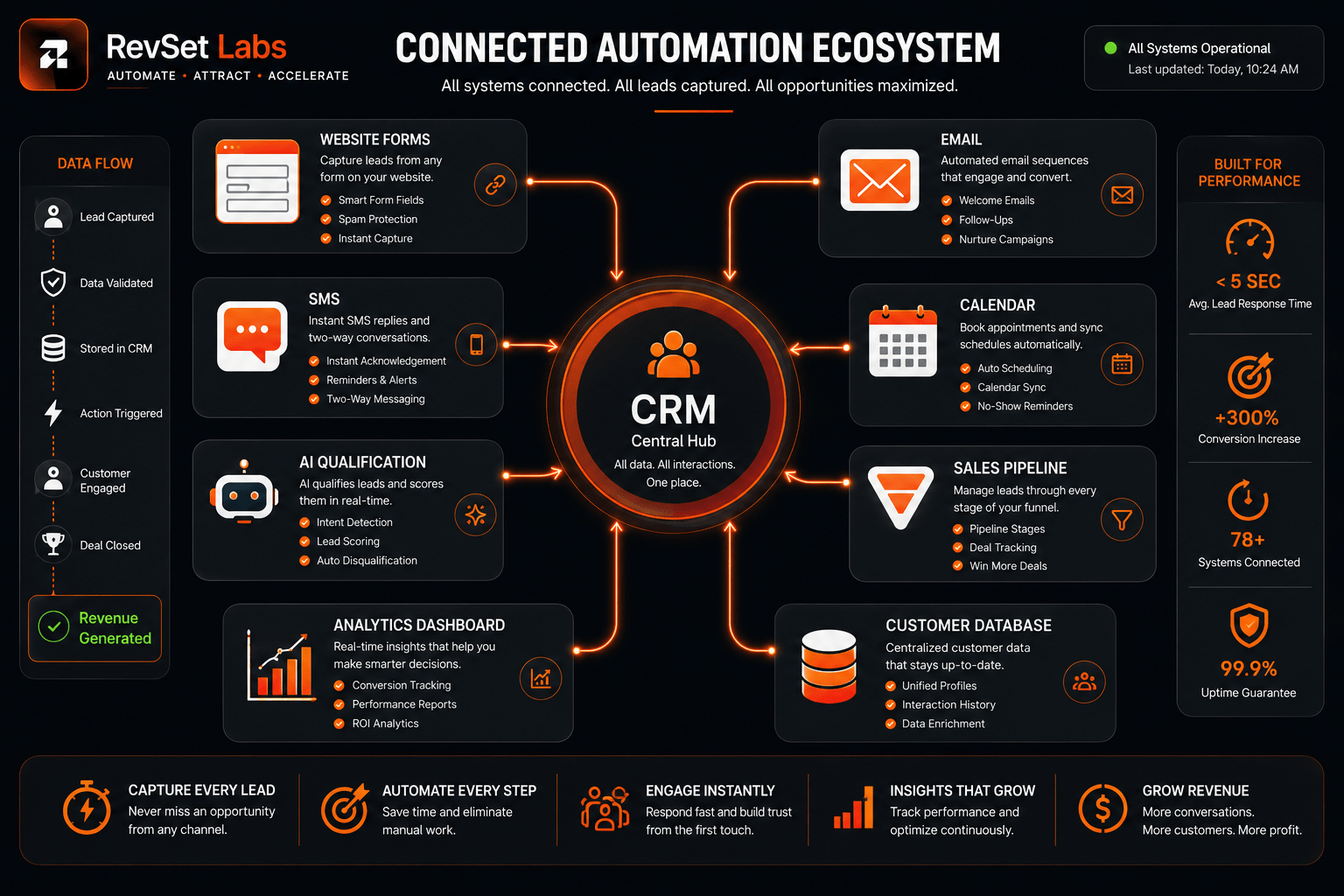
An efficient workflow starts with capturing a lead and providing an automatic confirmation.
Lead volume rises, communication methods proliferate, and consumer expectations rise as firms expand. Teams frequently spend more time handling leads than interacting with customers in the absence of a formal automation plan.
RevSet Labs advises companies to establish an automation ecosystem where each activity helps the subsequent phase of the customer experience rather than focusing on individual automations.
Increasing automation is not the aim.
The goal is to automate more intelligently.
Build Multi-Channel Follow-Up Workflows
Consumers speak in different ways.
Some people reply to emails right away.
Some people like text messaging.
While some people make appointments online, others take calls right away.
Businesses should create follow-up sequences that support several channels rather than depending just on one.
For example:
Day 0
- Instant confirmation email
- SMS acknowledgement
- Internal sales notification
Day 1
- Personalized email
- Phone call attempt
Day 3
- Helpful educational content
- Appointment reminder
Day 7
- Final follow-up
- Long-term nurture sequence
The objective isn’t increasing message volume.
The objective is remaining helpful while respecting customer preferences.
According to HubSpot’s lead management guidance, structured follow-up processes improve sales consistency by ensuring qualified opportunities continue moving through the pipeline instead of relying on memory alone.
Website Form Automation Implementation Checklist
Businesses often attempt to automate everything at once.
A phased implementation usually delivers stronger results.
Phase 1: Capture Every Inquiry
- Standardize website forms
- Eliminate duplicate submissions
- Connect every form to one CRM
Phase 2: Automate Immediate Actions
- Customer acknowledgement
- CRM creation
- Internal notifications
- Lead assignment
Phase 3: Build Intelligent Routing
- Service-based routing
- Territory routing
- Branch routing
- Priority handling
Phase 4: Optimize Follow-Up
- Email automation
- SMS reminders
- Appointment scheduling
- Long-term nurturing
Phase 5: Measure and Improve
- Response-time reporting
- Conversion analysis
- Workflow audits
- Continuous optimization
This phased approach allows businesses to improve operational consistency without overwhelming internal teams.
Across the Automation Projects We’ve Delivered: A Key Operational Insight
RevSet Labs has learned one lesson that constantly emerged from all of the automation projects we have completed:
- Lack of automation technologies seldom causes problems for businesses.
- They suffer because there isn’t a well-thought-out operational procedure connecting their tools.
- The customer experience is not always improved by adding more software.
- Ensuring that every inquiry follows a predictable path from submission and qualifying to assignment, follow-up, and conversion improves the customer experience.
- Automation should never make things more complicated.
- It should let teams respond confidently, increase visibility, and discreetly eliminate repeated tasks.
- Customers obtain speedier service, employees spend more time addressing important issues, and company executives receive dependable operational data to support smarter choices when technology helps people rather than replaces them.
FAQs
1. What is website form response automation?
Website questions are automatically recorded, CRM records are made, acknowledgements are sent, and leads are sent to the appropriate team for quicker follow-up.
2. Why is website form automation important?
It helps organizations contact leads while purchasing intent is still strong, decreases manual labor, and increases response consistency.
3. Does automation replace human communication?
No, although sales and support staff continue to deliver individualized client encounters, automation takes care of monotonous chores.
4. Can website form automation improve lead conversion?
Indeed. Businesses may lower lead loss and increase conversion chances with faster lead gathering, organized follow-up, and improved routing.
5. What happens after a customer submits a website form?
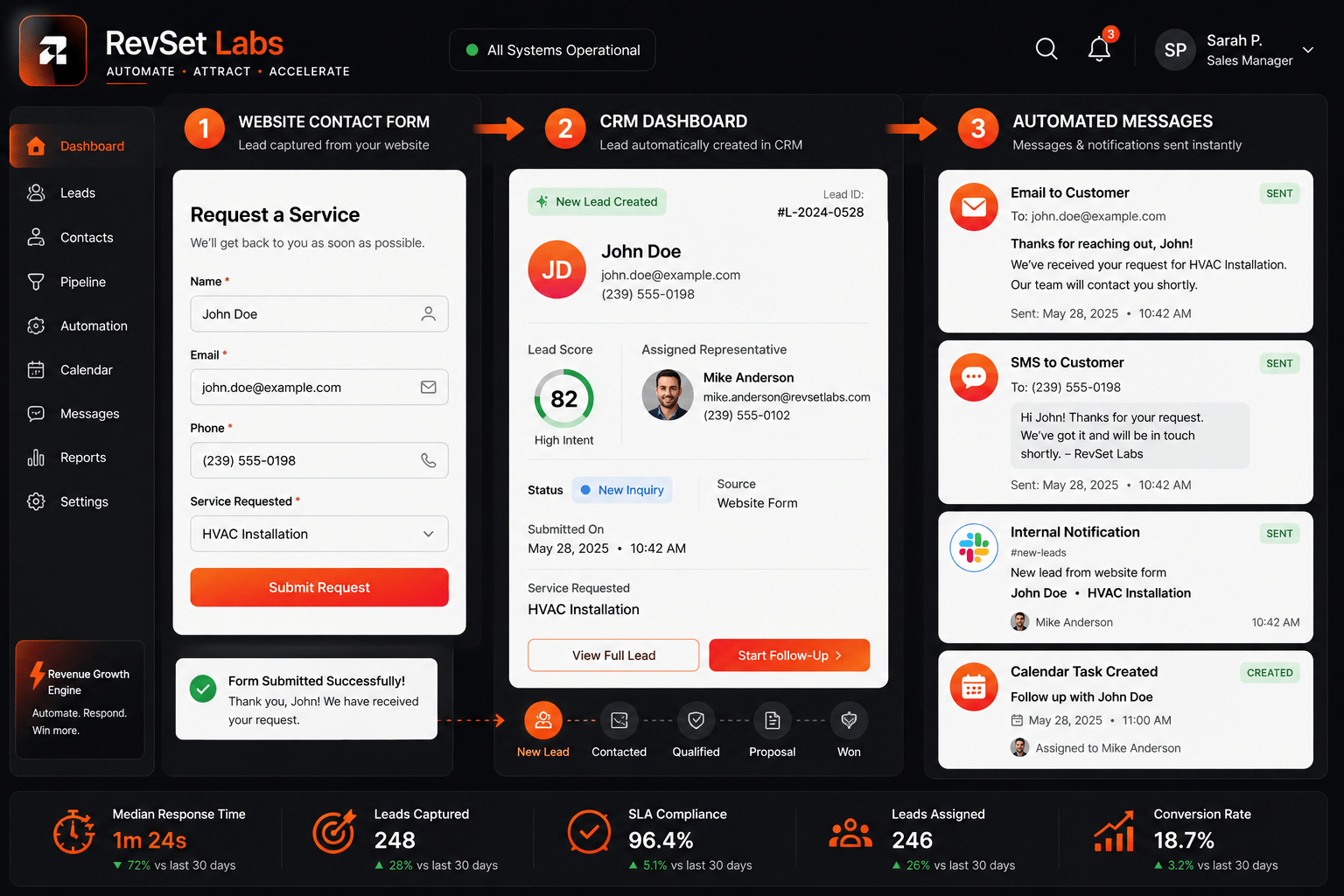
The submission can be verified, a CRM record can be made, a confirmation message can be sent, the sales team can be informed, and follow-up activities may be scheduled using an automated process.
6. What should businesses measure after implementing automation?
Monitor lead assignment time, follow-up completion, response time, CRM sync accuracy, and lead-to-appointment conversion rates.
7. How can RevSet Labs help with website form automation?
In order to increase operational effectiveness and customer response consistency, RevSet Labs creates integrated automation processes that incorporate internet forms, CRMs, messaging, and lead routing.
Final Thoughts
More than just a convenience, website form response automation is essential to developing a dependable and expandable lead management system. Businesses may lower operational delays and improve customer satisfaction by integrating internet forms with your CRM, automating acknowledgements, intelligently routing questions, and facilitating prompt human follow-up.
RevSet Labs‘ successful automation isn’t about replacing people. It’s about getting rid of monotonous work so teams can concentrate on fostering connections and closing quality leads. Businesses increase response dependability, safeguard purchasing momentum, and maximize each marketing spend when every inquiry adheres to a standard protocol.
How RevSet Labs Helps Build Smarter Lead Workflows
Automation in RevSet Labs’ opinion should address operational issues rather than add to technological complexity.
From the time a visitor submits a website form to CRM management, intelligent routing, automated acknowledgements, sales notifications, follow-up sequences, and reporting, our method starts with mapping your whole lead journey.
Instead of using disparate automation solutions, we create integrated processes that complement your company’s operations. Every automation is designed with a specific goal in mind: cutting down on reaction times, doing away with manual labor, increasing visibility, and freeing up your staff to spend more time cultivating client connections.
Our goal is the same whether you’re answering thousands of questions every month or just a few dozen per week:
Capture every opportunity. Route it intelligently. Respond consistently. Measure everything.
Turn Every Website Inquiry Into a Sales Opportunity
Each completed form on your website is a representation of someone who has already started the process of doing business with you.
Whether you’re producing enough leads isn’t the question.
It’s whether each qualifying question receives the proper attention in your present workflow.
Improving your workflow could provide better results than raising your marketing budget if your team is being slowed down by manual procedures, disjointed systems, or uneven follow-up.
Use the RevSet Labs Revenue Leak Scorecard to find operational bottlenecks, assess your lead management procedure, and find useful ways to enhance conversion performance, customer satisfaction, and response consistency.