
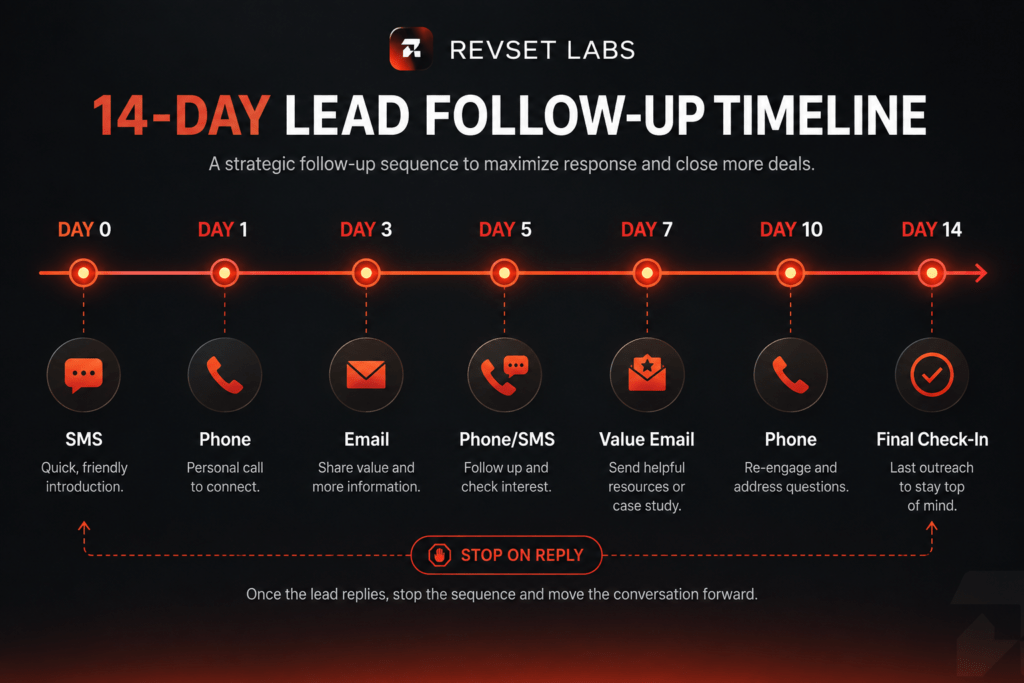
A 14-Day Lead Follow-Up Sequence for Service Businesses
Getting a new lead is not the finish line. The actual job starts at this point.
A potential customer has already taken a significant step when they complete a form, ask for a price, send a message, or call your company. They have recognized an issue and determined that your business may be able to address it, at least temporarily.
The issue is that interest fluctuates throughout the course of two weeks.
Clients get busy. They contrast rivals. They can’t remember which businesses they called. Their priorities shift. Occasionally, people just fail to notice the initial communication.
Because of this, an effective lead follow-up sequence requires more structure than just saying “call them again tomorrow.”
Follow-up is treated as an operating mechanism at RevSet Labs. Sending as many emails as you can is not the goal. The goal is to give the prospect enough time to choose while creating the right number of helpful touchpoints through the right channels.
Service companies can modify the 14-day cadence in the following structure to suit their industry, lead source, urgency, personnel, and client preferences.
What a Lead Follow-Up Sequence Should Actually Do
A follow-up cadence should accomplish three things:
- Protect the initial buying momentum.
- Make it easy for the prospect to respond.
- Give the sales team a repeatable process instead of relying on memory.
That third point is particularly important.
RevSet Labs observed that companies with outstanding salespeople still miss out on chances because follow-up is a personal habit. Three calls are made by one salesman. Another pauses after sending an email. Because the lead was assigned while they were interacting with clients, someone else neglects to follow up.
That is not an issue for salespeople. It’s a procedural issue.
For a service firm, a well-designed lead nurture sequence establishes a steady operational cadence while allowing for human judgment.
An exit condition is also required. The automatic process should halt or alter if the prospect responds, books, declines, opts out, or otherwise reaches a predetermined conclusion.
A stop-on-reply trigger becomes crucial in this situation.
Automation should facilitate the interaction rather than carry on after the consumer has begun speaking with you.
Many businesses were reacting to internet leads too slowly, according to research published in the Harvard Business Review, and the chances of qualifying a lead were significantly higher when contact was made promptly. The practical lesson that speed matters most when purpose is fresh remains applicable even if the study is foundational rather than a universal current norm.
The RevSet Labs 14-Day Lead Follow-Up Sequence
For new, non-emergency service leads, the following routine is generally intended.
The process for a plumbing emergency, HVAC malfunction, or other critical question should proceed considerably more quickly. On the other hand, a complex business prospect can require more individualized marketing and a lengthier sales process.
Consider this a foundational framework rather than a strict industry regulation.
| Day | Timing | Channel | Objective | Owner |
| Day 0 | Within 1–5 min | SMS + Phone | Confirm inquiry and start conversation | Sales/Service |
| Day 0 | Within 30–60 min | Provide context and next step | Automation | |
| Day 1 | Morning | Phone + voicemail | Attempt personal contact | Sales/Service |
| Day 2 | Midday | SMS | Simple response opportunity | Automation/Sales |
| Day 3 | Morning | Address likely questions | Automation | |
| Day 5 | Business hours | Phone | Reconnect personally | Sales/Service |
| Day 7 | Afternoon | Add useful value | Automation | |
| Day 10 | Business hours | Phone + SMS | Re-engage | Sales/Service |
| Day 14 | Afternoon | Email/SMS | Close loop respectfully | Automation/Sales |
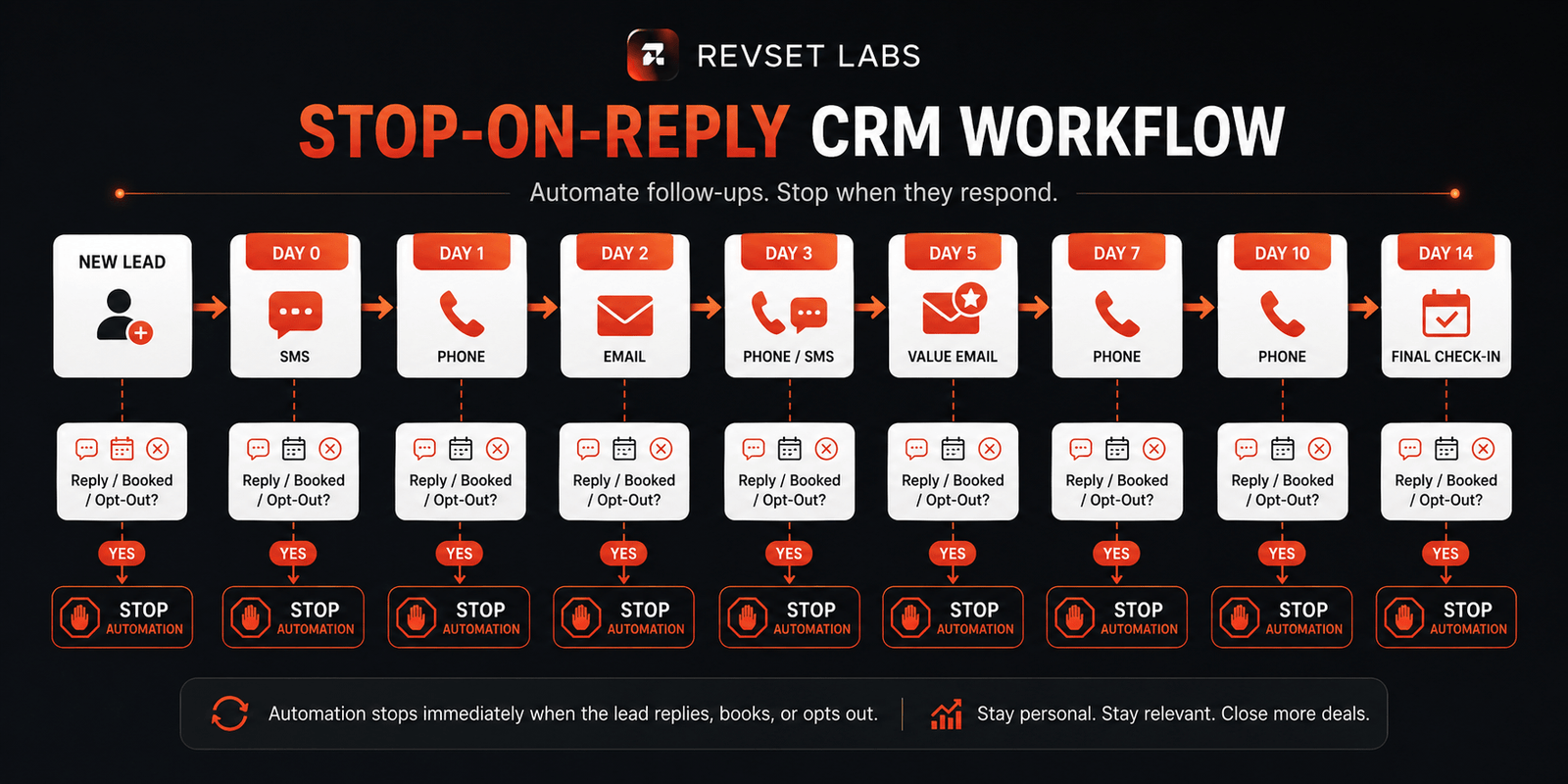
Every stage should include a stop-on-reply rule.
Day 1: Make It Personal
A phone call should typically be the following contact if there was no answer on Day 0.
This is important since a follow-up sequence shouldn’t turn into a never-ending stream of automated emails.
Give the prospect a call.
When appropriate, leave a brief voicemail if they don’t respond.
Hello [First Name], I’m [Rep] from [Company]. I’m checking in on your [service] request. When you have a moment, give me a call or respond to my message, and we’ll assist you with the next step.
Keep things simple.
Reopening the discussion rather than pressuring someone to make a choice is the aim.
Day 2: Use SMS to Reduce Friction
SMS is especially effective when your message procedures adhere to relevant regulations and the consumer has previously supplied a cellphone number.
Make sure the messaging is conversational.
Hello [First Name], I wanted to inquire about your [service] request. Do you want us to assist you with price or availability?
The consumer may easily react to the inquiry.
Don’t send a lengthy advertisement.
This touchpoint is not meant for advertising, but rather for generating responses.
Channel availability and functionality may differ depending on the area and account setup for companies utilizing Google Business Profile messaging or other direct messaging options. For qualified Business Profiles, Google presently records text and WhatsApp contact choices.
Day 3: Answer the Question They May Not Have Asked
By Day 3, simply saying “following up” begins to lose value.
Give the prospect a reason to engage.
For a roofing company, that might be:
- What happens during an inspection
- How estimates are prepared
- What information is needed
For a dental practice:
- What the first consultation involves
- Appointment availability
- Insurance or payment information
For an agency:
- What happens during the discovery call
- Typical project timelines
- What information the team needs before preparing a proposal
Lead nurturing is helpful in this situation.
Instead of repeating the same request, the message should address a genuine client inquiry.
In a similar vein, HubSpot advises against pushing a sales pitch right away and instead links nurturing material to the subject or activity that initially drew the prospect into the funnel.
Day 5: Call Again
Human follow-up becomes especially crucial on day five.
Try calling the lead again if they haven’t responded.
Don’t just restate the Day 1 message, though.
Utilize the data that has already been recorded in the CRM.
For instance:
“Hello Sarah, this is ABC Roofing’s Mike. Regarding the roof inspection, you contacted us last week. I wanted to know whether you still required assistance setting up that appointment.”
Because it takes advantage of context, this sounds different from an automatic drip sequence.
That distinction is important.
Consumers don’t mind being followed up with. Communication that seems unrelated to their circumstances is met with resistance from them.
Day 7: Send Something Useful
The order should change a little toward the conclusion of the first week from “Are you ready?” to “Here’s something that may help.”
The email may include:
- Brief checklist
- An explanation of prices
- Guide to preparing
- Typical errors to avoid
- Case study
- Comparison of services
- Responses to often posed queries
The information should continue to be directly relevant to the initial question.
A generic corporate newsletter shouldn’t be sent to a home service lead who inquires about HVAC replacement.
A nurturing sequence is beneficial when it is relevant.
Day 10: Re-Engage With a Direct Question
On Day 10, try again on your own.
If it’s appropriate, call first, and if the channel is allowed and no one answers, send an SMS.
For instance:
Hello [First Name], I was wondering whether you were still in need of assistance with [service]. Please let me know if the time has changed so I can make the necessary updates to our notes.
This sentence accomplishes a significant goal.
It allows the potential customer to respond “not right now.”
That information is helpful.
Every non-response should not be viewed by a CRM as an ongoing opportunity.
Clear states: active, engaged, scheduled, lost, nurtured, or reactivated are produced by effective lead management.
Day 14: Close the Loop
Creating pressure is not the purpose of the last touchpoint.
It’s about making things clear.
For instance:
Hello [First Name], I’ll put your [service] request on hold for the time being. Just respond here if you still need assistance, and we’ll pick it up again.
Responses to this message can be surprisingly helpful.
Due to their hectic schedules, some prospects eventually respond.
Others clarify that they choose a different supplier.
Some claim that the project is being delayed.
An opportunity that remains in the CRM indefinitely is inferior to all three of these outcomes.
If necessary, the lead may transition into a longer-term re-engagement phase after Day 14.
The Sequence Should Stop When the Customer Engages
This is among the framework’s most crucial regulations.
Don’t allow the system to send the “just checking in” email on Day 5 if a prospect responds on Day 3.
Don’t send Day 7 nurturing content asking if they’re still interested if they make an appointment on Day 1.
Stop any relevant marketing effort if they expressly choose not to participate.
The automation needs to respond to consumer actions.
This is how a basic process appears:
Lead Created → Sequence Started → Response? → Yes: Stop & Assign → No: Continue → Appointment? → Yes: Stop & Confirm → No: Continue → Day 14 → Nurture/Re-engage
Workflow and sequence automation are supported by contemporary CRM systems, which may assist teams in methodically managing these changes. For instance, automation related to lead phases and actions like outreach and connected conversations is described in HubSpot’s current documentation.
How to Build a Lead Follow-Up Sequence That Doesn’t Feel Automated
The technique is not very complicated.
Determining what the consumer should receive and when is the challenging part.
A powerful sequence adheres to a number of rules.
Give Every Touchpoint a Job
Avoid sending nine different versions of “Just checking in.”
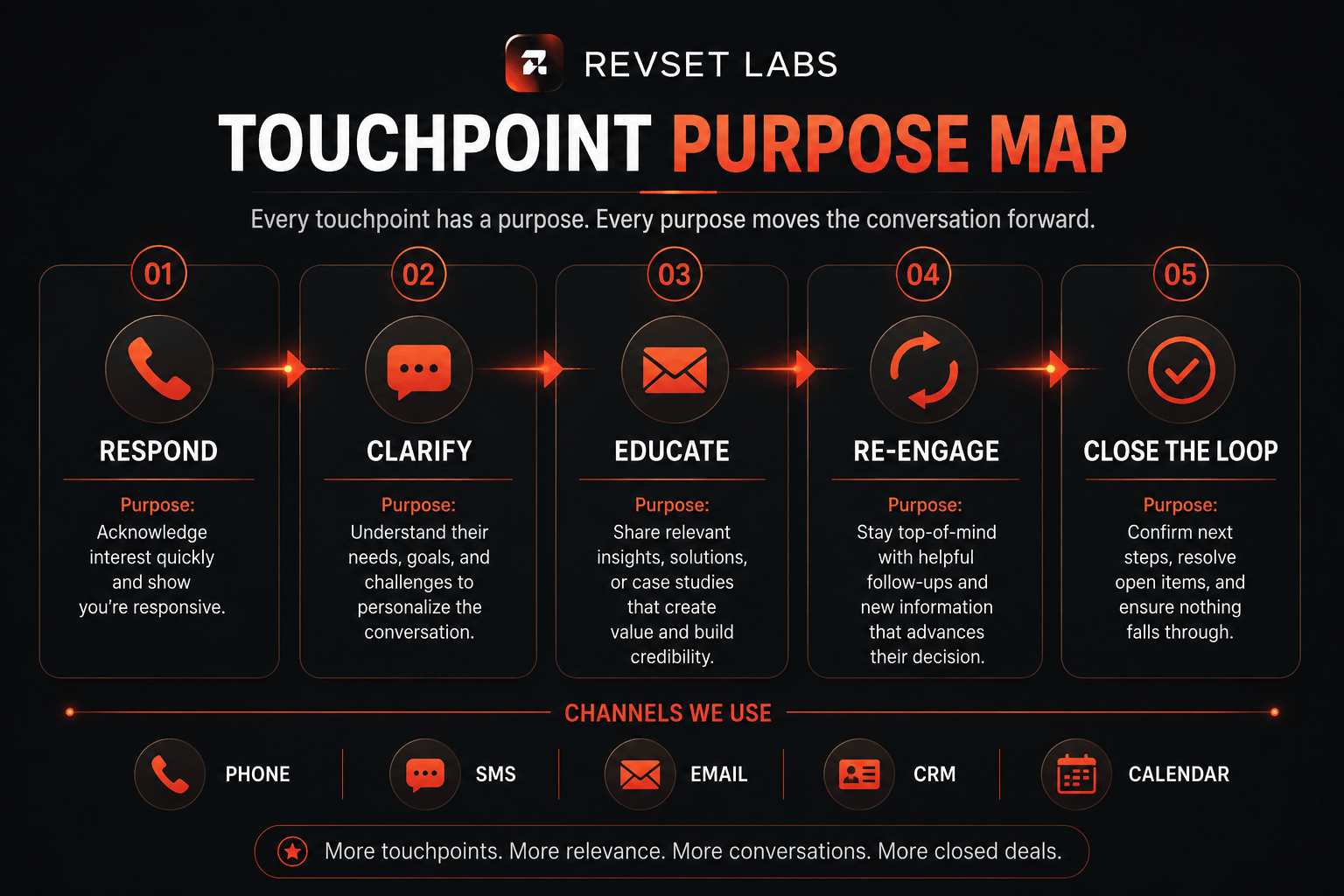
Every communication ought to have a goal:
Respond. Clarify. Educate. Re-engage. Close the loop.
Change the Channel
A multi-channel follow-up sequence example might combine:
Phone → SMS → Email → Phone → SMS → Email
The precise combination is determined by lead source, industry standards, channel availability, and consumer agreement.
Increasing the number of messages is not the goal of using numerous channels. The goal is to facilitate communication without becoming overly dependent on a single channel.
Use Context
Refer to the specific service that was requested.
Utilize the project type, location, preferred time slot, or already supplied data.
Complex AI is not necessary for personalization.
Sometimes it just entails reading the lead record before placing the call.
Make Replies Easy
Friction arises when a question necessitates a five-minute explanation.
Questions like:
“Would Tuesday or Wednesday work better?”
are simpler to respond to.
Build in Human Handoff
Timing and administration should be handled by automation.
People ought to deal with:
- Requirements
- Concerns
- Discussions about prices
- Complicated queries
- High-value prospects
- Concerns from customers
For a home service firm, this balance is essential to a good lead nurturing sequence.
What to Measure
Don’t judge the sequence by open rates alone.
RevSet Labs tracks the full path from inquiry to commercial outcome.
| KPI | What to Watch |
| First Response Time | How quickly the first meaningful response occurs |
| Response Rate | Percentage of leads who engage |
| Contact Rate by Touchpoint | Which touchpoints create conversations |
| Appointment Rate | Leads that book a next step |
| Lead-to-Customer Rate | Leads that ultimately convert |
| Time to Book | How quickly qualified leads schedule |
| Sequence Exit Rate | Leads that reply, book, opt out, or otherwise exit |
| Re-engagement Rate | Dormant leads that become active again |
Conversion rate by touchpoint is frequently the most useful information.
You can infer anything if the majority of clients reply after the second call.
If SMS stimulates discussions but email does badly, it also tells you something.
Your data should cause the sequence to change.
Compliance and Customer Experience Matter
Indiscriminate communications should never be justified by a follow-up sequence.
Companies must be aware of the regulations pertaining to their clients, region, sector, and modes of communication.
According to the FTC, CAN-SPAM sets standards for commercial emails in the US, such as correct sender identification, non-deceptive subject lines, and an easy means for recipients to opt out. Additionally, companies must properly respect opt-out requests.
Additional permission and compliance requirements may apply to SMS and other communications methods.
The safest course of action is straightforward from an operational standpoint:
Observe consent. Observe opt-outs. Honor the desires of your customers.
A sequence isn’t successful if it irritates customers to get responses.
When a Follow-Up Sequence Actually Matters
Just because fourteen days seems like the proper amount doesn’t mean that RevSet Labs advises creating a 14-day series.
There should be a sequence since there is a significant gap in your sales process between the initial inquiry and the customer’s choice.
A lengthy automated process might not be required if your team regularly calls leads within five minutes and books the majority of qualifying prospects within 48 hours.
A disciplined cadence can safeguard possibilities that your marketing budget has already paid for if eligible leads often vanish after the first unanswered contact.
“How many follow-ups should we send?” isn’t the actual issue we resolve.
It is:
“Where does the customer journey break down, and what should happen automatically before a human needs to intervene?”
This distinguishes a revenue operations system built around client behavior from automation for the sake of automation.
Final Thoughts
Instead of making your company appear more mechanical, a lead follow-up sequence should improve the consistency of your sales process.
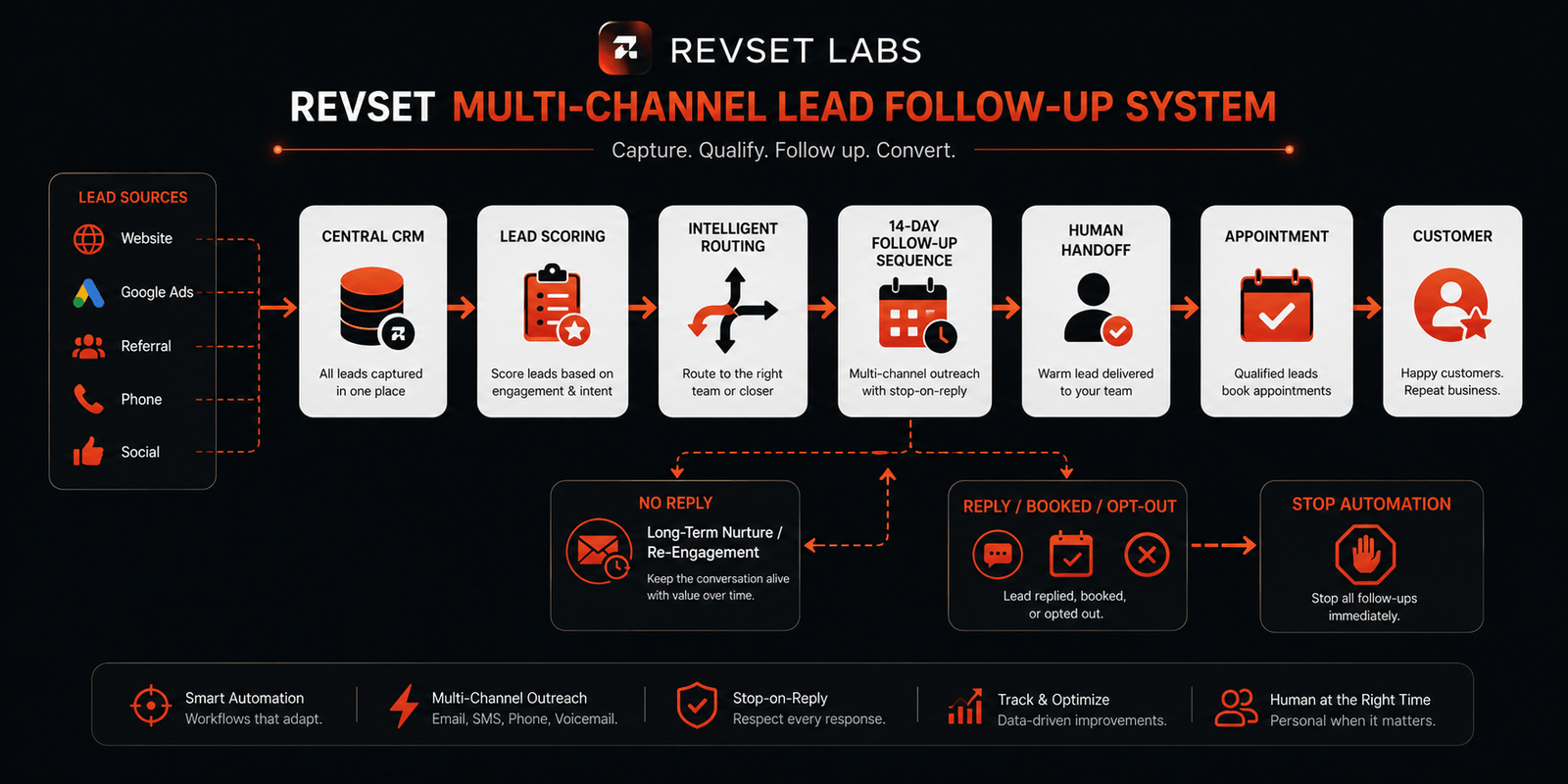
The most effective sequences react fast, make use of several relevant touchpoints, offer helpful information, and present clients with easy ways to interact. They are also aware of when to quit.
Adding additional messages is frequently the largest boost for service firms. Lead collection, speed to lead, CRM automation, human follow-up, and measurement are all integrated into a single solution.
Use this guide’s 14-day cadence as a starting point. Next, based on your own customer behavior, modify the timing, channels, messaging, and exit circumstances.
This is how we handle follow-up at RevSet Labs: automate the scheduling, maintain the context, and delegate the discussion to a person when discretion is crucial.
Lead volume might not be the issue if your team is producing leads but finding it difficult to follow up on them on a regular basis. It may be the system that exists between the initial question and the initial serious discussion.
If you build that system correctly, you’ll be able to continue creating opportunities.
FAQs
What is a lead follow-up sequence?
A scheduled series of phone calls, SMS messages, emails, and other touchpoints used to maintain contact with a prospect following an initial inquiry is known as a lead follow-up sequence. Maintaining progress without overburdening the client is the aim.
Is a 14-day follow-up sequence too long?
Not always. For many non-emergency service concerns, a 14-day cadence is effective since it provides the company with several chances to reestablish contact rather than just one or two. The purchase cycle and lead urgency should still be taken into consideration while adjusting the timing.
How many times should you follow up with a new lead?
No universal number exists. Instead of just boosting message volume, RevSet Labs advises concentrating on the quality and purpose of each touchpoint. Repeated “just checking in” messages can be less effective than a combination of calls, SMS, and helpful emails.
What channels should a lead follow-up sequence include?
Phone, SMS, and email offer a useful basis for many service enterprises. Prospects may respond in a variety of ways with a multi-channel strategy, and organizations can discover which channels lead to the highest levels of engagement.
Should follow-up be automated or manual?
Combining the two is typically the most effective strategy. While salespeople should manage qualifying, objections, price talks, and more sophisticated client contacts, automation can handle acknowledgments, reminders, routing, and scheduling.
When should an automated follow-up sequence stop?
When a prospect responds, schedules an appointment, engages in active sales communication, chooses to opt out, or achieves another predetermined goal, automation should cease. Once a human discussion has begun, a stop-on-reply trigger stops automated communications from continuing.
What should you say when a lead stops responding?
Avoid sending the same “just following up” message again and over. Give the prospect a straightforward reason to reply, such as a pertinent query, an update on your availability, a helpful resource, or a convenient way to put off the discussion.
Can a follow-up sequence re-engage cold leads?
Indeed. Some dormant prospects can be re-engaged through a cold lead re-engagement cycle, especially if their initial demand is still there. However, companies should prioritize minimizing needless lead decay by responding quickly, following up consistently, and establishing clear ownership.
Ready to Stop Losing Leads After the First Inquiry?
Take the RevSet Labs Revenue Leak Scorecard to identify where leads are being delayed, missed, or lost and uncover practical opportunities to improve your response and conversion process.
Don’t just generate more leads. Build a system that follows up with the ones you already have.