
How many times to follow up with a lead?
There isn’t a set amount of follow-up attempts that is effective for every potential customer.
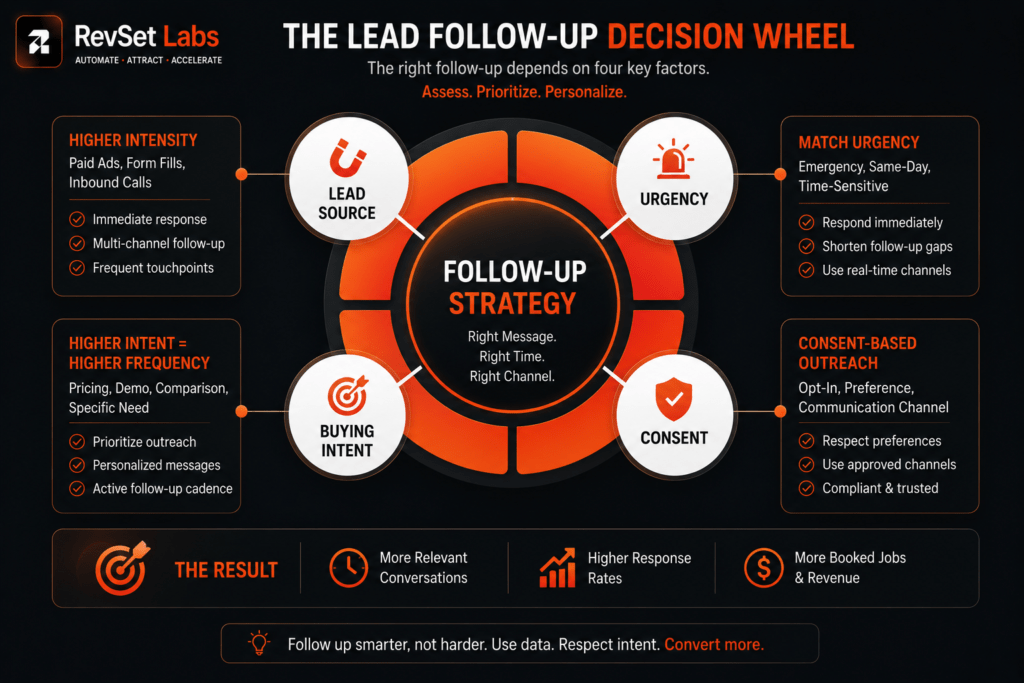
A referral, a fresh Google Ads inquiry, an emergency service need, and a cold outbound prospect shouldn’t all be followed up on in the same way. How the lead came in, how urgently they need assistance, how much purchase intent they have demonstrated, and what kind of communication they have consented to receive all determine the appropriate quantity.
RevSet Labs witnesses two opposed business errors. After one unanswered call, several sales teams give up, believing the lead is not interested. Others send the same message over and over again without adding anything helpful, which eventually results in a bad customer experience.
Building a follow-up system based on context rather than a set number of touches is a superior strategy.
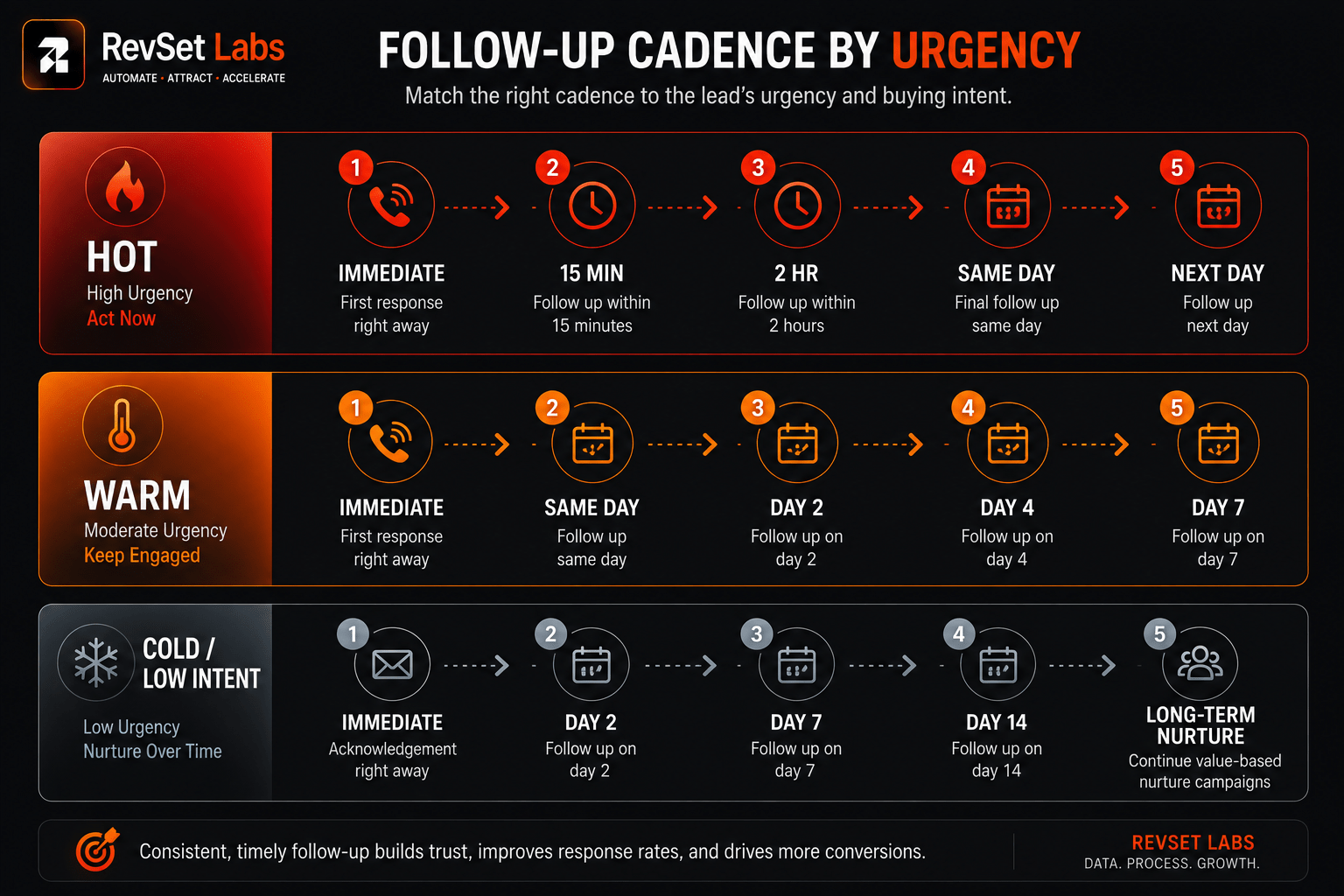
RevSet Labs begins with 5 to 7 meaningful contact attempts across several channels, distributed based on urgency and sales cycle time, for most warm incoming prospects. That is not a rule, but rather a beginning point. While lower-intent prospects could benefit more from longer-term nurturing, high-intent or urgent leads might need a much quicker sequence.
Maximizing the quantity of communications is not the aim.
The aim is to give a qualified prospect enough chances to interact without becoming obtrusive.
The Ideal Number of Follow-Up Attempts Depends on the Lead
The question of how many times you should follow up with a lead is often treated as if there is one magic number.
It doesn’t exist.
Sorting leads into several categories is the first step in an effective follow-up plan.
| Lead Type | Typical Follow-Up Intensity | Primary Consideration |
| Emergency / high urgency | 3–6 attempts in the first day | Speed and immediate availability |
| High-intent paid lead | 5–7 attempts initially | Fast engagement and persistence |
| Website quote request | 5–7 attempts | Mix of calls, SMS, and email |
| Referral | 4–6 attempts | Personal context and trust |
| Consultation request | 4–7 attempts | Scheduling friction |
| Low-intent content lead | Longer nurture sequence | Education and timing |
| Cold outbound prospect | Separate prospecting cadence | Consent, relevance, and outreach rules |
These are not actual industry averages; rather, they represent the operational starting points of RevSet Labs.
The crucial distinction is that an endeavor shouldn’t be limited to rehashing what has already been said.
Ideally, a follow-up effort should provide a cause to reply, such as a scheduling choice, a response to a query, helpful details, an explanation, a pertinent resource, or a straightforward next action.
Why One Follow-Up Is Rarely Enough
A prospect may fail to respond for reasons that have nothing to do with rejection.
They may be:
- In a meeting
- Driving
- Comparing providers
- Waiting for a partner’s input
- Busy with work
- Unsure about pricing
- Interested but not ready
- Unable to answer the phone
- Waiting for a specific date
This is why how many times you should follow up with a lead should never be answered with “once,” simply because the first message received no response.
The significance of prompt and consistent lead management has been emphasized by several studies. Companies that responded within an hour were much more likely to qualify leads than those that waited longer, according to a 2011 study on internet sales leads published in the Harvard Business Review. The study reaffirms a crucial operational principle: early participation counts, but it is fundamental rather than a contemporary universal criterion.
Instead of giving up on prospects after just one try, more modern sales guidelines encourage disciplined perseverance. For instance, according to HubSpot’s cold-calling data, three to five tries are typical among respondents, indicating that many sales professionals make several call attempts before moving on.
The idea that every lead merits five calls is not the lesson.
It’s that one unanswered attempt provides very little information about the customer’s actual intent.
A Better Rule: Follow Up Until You Reach a Decision Point
Instead of asking only how many times you should follow up with a lead, ask:
What outcome are we trying to reach?
One of the following things should ultimately result from an effective follow-up sequence:
- The lead answers.
- An appointment is made by the lead.
- More details are requested by the lead.
- The lead declares that they have no interest.
- You are asked to follow up later by the lead.
- After being dormant, the lead shifts into nurturing.
- The lead chooses not to be contacted again.
Compared to continuously contacting someone, this results in a healthier sales process.
Every follow-up sequence should have an exit condition defined, according to RevSet Labs.
Without an exit condition, persistence turns into noise.
How Many Follow-Ups Before Giving Up?
Giving up and altering the follow-up plan differ significantly.
Before transferring a high-intent inbound lead into a lower-frequency nurturing stage, RevSet Labs usually suggests making many significant attempts.
This may be a useful beginning sequence:
| Attempt | Timing | Channel | Purpose |
| 1 | Immediately | Call + SMS/email | Make fast contact |
| 2 | 15–30 minutes | Call/SMS | Reinforce availability |
| 3 | 2–4 hours | Call/email | Add context or answer likely questions |
| 4 | Next business day | Call + email | Reopen conversation |
| 5 | 2–3 days later | Email/SMS | Provide useful next step |
| 6 | 5–7 days later | Call/email | Final active follow-up |
| 7 | 1–2 weeks later | Nurture | Maintain relationship without pressure |
This is not a script that every company should follow.
A plumbing issue could necessitate a much more active same-day engagement.
Fewer but more careful touches might be beneficial for a consulting inquiry.
Before a sales discussion seems sensible, a low-intent content lead can require weeks of instructional nurturing.
Therefore, the buying context, rather than a general sales rule, determines the optimal number of follow-up attempts.
Follow-Up Frequency Should Change With Lead Urgency
One of the most powerful factors in a follow-up choice is urgency.
Think about two possibilities.
At 10:00 AM, the first makes a request stating, “Our AC has stopped working.” Could someone please come today?
The second person fills out a form with the message, “I’d like to learn more about your marketing services.”
Both are leads.
The same cadence shouldn’t be given to them.
The HVAC client may contact a different supplier in a matter of minutes due to an urgent issue.
The marketing prospect could compare agencies for a few days.
For this reason, employing urgency stages inside CRM processes by RevSet Labs.
High Urgency
Examples:
- Emergency home services
- Same-day appointments
- Time-sensitive legal inquiries
- Active service failures
RevSet Labs focuses on immediate human response, rapid second attempt, and multiple same-day contact opportunities.
Medium Urgency
Examples:
- Quote requests
- Consultations
- Routine appointments
- Home improvement projects
RevSet Labs focuses on a fast initial response followed by several personalized attempts across the next week.
Low Urgency
Examples:
- Content downloads
- General information requests
- Early-stage research
RevSet Labs focuses on fewer direct sales attempts and a stronger lead-nurturing sequence.
The Lead Source Should Change the Follow-Up Strategy
Lead source provides another important clue about intent.
Paid Leads
Because the prospect actively looked for a solution or engaged with a particular offer, paid search leads may have significant commercial intent.
RevSet Labs gives priority to these leads:
- Speed
- Immediate acknowledgement
- Phone contact
- SMS where appropriate
- Clear next steps
- Short follow-up intervals
Responding when the initial search intent is still relevant is the goal.
Referral Leads
A distinct strategy is needed for referral leads.
Context and trust are provided by the recommendation itself.
Mention the reference organically rather than using conventional sales messaging:
“Sarah suggested that you could need assistance with your HVAC system. I wanted to check in with you to see what’s going on.”
Because of this background, the follow-up doesn’t feel like an unwelcome sales pitch, but rather like a continuation of an existing relationship.
Organic Website Leads
The goal of website leads might differ greatly.
Requests for quotes should be handled differently from those for blog subscribers.
Lead score and follow-up intensity should be influenced by the page, form, service sought, and information supplied.
Social Media Leads
More conversational contact is frequently needed for social leads.
A brief, informal response to a direct message from a prospect could be more effective than a traditional sales email.
The customer’s behavior should be reflected in the communication channel.
Consent Changes the Answer
Consent and follow-up frequency should never be separated.
A consumer has shown a strong desire for communication when they specifically urge you to call them tomorrow.
When a prospect says, “Please don’t contact me again,” they are giving you an equally explicit directive.
Those two situations should trigger completely different workflows.
The FTC’s CAN-SPAM regulations for commercial email in the US include giving recipients a way to opt out and respecting opt-out requests. Depending on where they operate and where their clients are situated, businesses should also take into account any applicable local privacy and message legislation.
Additionally, Google forbids the abuse of personal information and mandates that marketers manage acquired data for leads obtained through Google Ads lead forms.
Consent is more than just a matter of compliance.
Additionally, it is an indicator of the consumer experience.
Respecting someone’s preferred method of communication helps build trust.
The Follow-Up Decision Framework
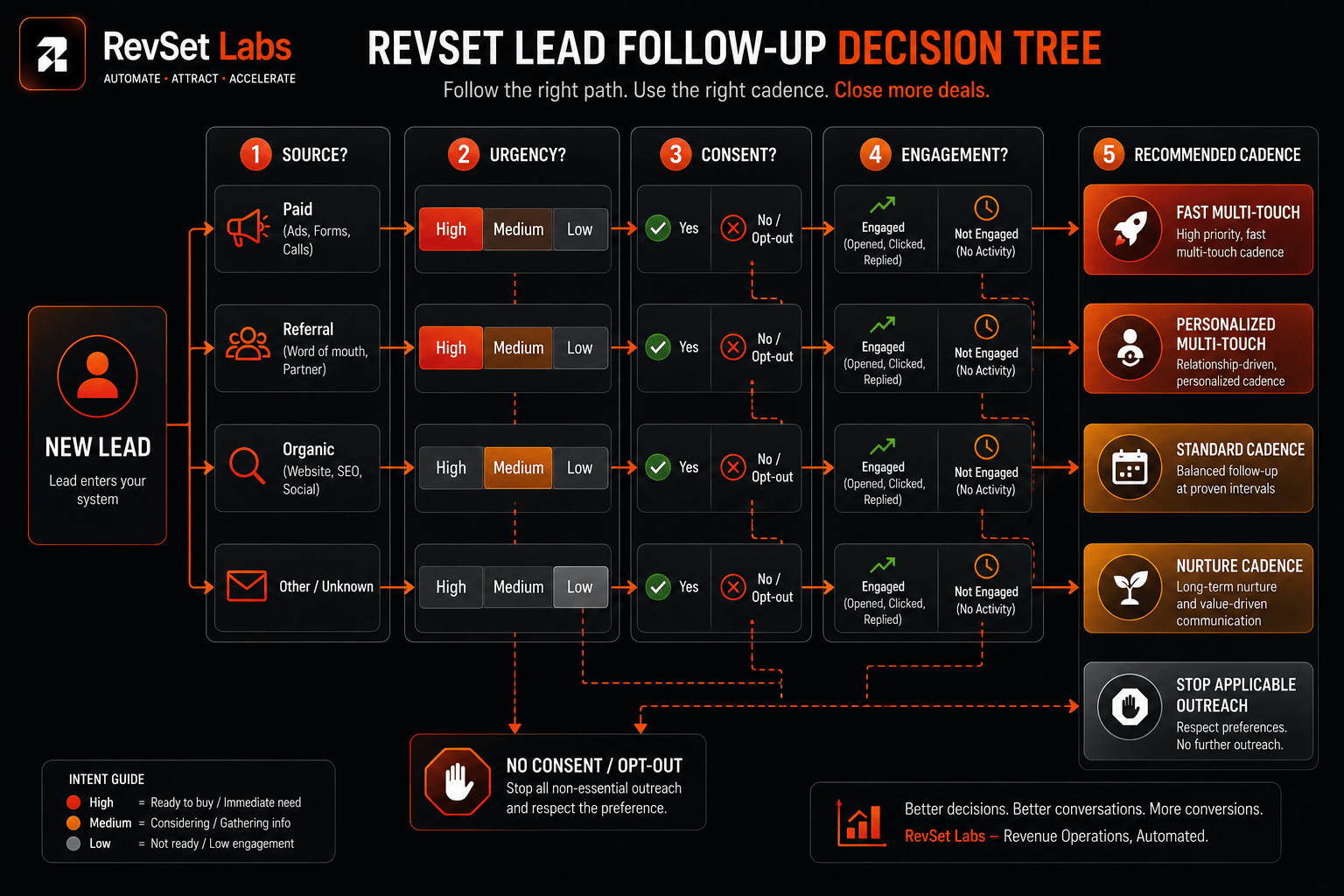
The simplest way to operationalize how many times you should follow up with a lead is to use four questions before a workflow begins.
Question 1: Where Did the Lead Come From?
Paid search/quote request: High priority
Referral: High priority with personalized context
Organic inquiry: Depends on intent
Content download: Nurture first
Cold outbound: Separate outreach framework
Question 2: How Urgent Is the Problem?
Immediate: Same-day intensive follow-up
Near-term: Several attempts across a few days
Long-term: Lower-frequency nurture
Question 3: What Has the Lead Done?
More involvement has been shown by a prospect who read an email, clicked a scheduling link, responded once, or asked for a callback than by someone who filled out a form and then vanished.
Utilize such signals to modify cadence and lead scoring.
Question 4: What Has the Lead Asked You To Do?
The most crucial question is this one.
Follow up tomorrow if they request a callback.
Respect their email request exclusively.
Stop the relevant messages if they choose to opt out.
How Many Follow-Up Emails Should You Send?
Seldom should a high-intent inbound lead just use email.
It could be better to give someone a call rather than send six emails if they have given you their phone number and explicitly asked for a quote.
Every communication in an email series should have a specific goal.
For instance:
Email 1: Verify the question and suggest the next course of action.
Email 2: Respond to a frequently asked query or offer helpful background information.
Email 3: Provide alternatives for scheduling.
Email 4: Respond to a possible complaint.
Email 5: Respectfully end the current sequence.
How many follow-up emails to send is not the only question.
It’s whether each email offers the potential customer a good cause to carry on a discussion.
If “Just following up” appears in every message, the sequence soon becomes monotonous.
How Many Times Should You Call a Lead Before Giving Up?
Several call attempts may be appropriate for inbound leads with strong intent.
According to a recent study by HubSpot on cold calling, 55% of salespeople who frequently cold contact said they made three to five efforts before giving up.
A global inbound-lead rule should not be derived from such data. Inbound response and cold outbound response are two distinct scenarios.
RevSet Labs considers contact opportunities rather than just calls when evaluating an incoming lead.
A sequence might include:
- Call
- SMS
- Second call
- Follow-up email
- Final call
- Nurture
This creates multiple ways for the customer to respond without making the business feel aggressive.
When Should You Stop Active Follow-Up?
Active sales follow-up and long-term lead nurturing should be distinct from one another.
Remove a lead from active follow-up when:
- They decline outright.
- They ask not to be contacted again.
- Their need has disappeared.
- The opportunity is unqualified.
- No engagement results after many well-spaced tries.
- The first purchase window has been surpassed by the sales cycle.
Don’t necessarily remove the lead.
Depending on their choices and relevant communication needs, transition them into a lower-frequency nurturing technique if it is suitable and allowed.
In addition to safeguarding the connection, this keeps salespeople from wasting time pursuing dormant possibilities.
RevSet Labs’ Intelligent Approach to Lead Follow-Up Strategy
RevSet Labs doesn’t think the best way to follow up with a lead is to “keep contacting them until they respond.”
That’s perseverance without passing judgment.
We take a different approach.
Before making a decision, we consider the lead source, urgency, intent, communication preference, prior engagement, and sales cycle stage.
In a matter of hours, a qualified paid lead with a same-day service need can require many contact efforts.
Over the course of many weeks, a B2B prospect assessing a complicated solution can require fewer direct interactions but more helpful information.
A content lead might not be prepared at all for a sales follow-up.
Those variations ought to be automatically identified by the system.
Those variations ought to be automatically identified by the system.
CRM automation is useful in this situation.
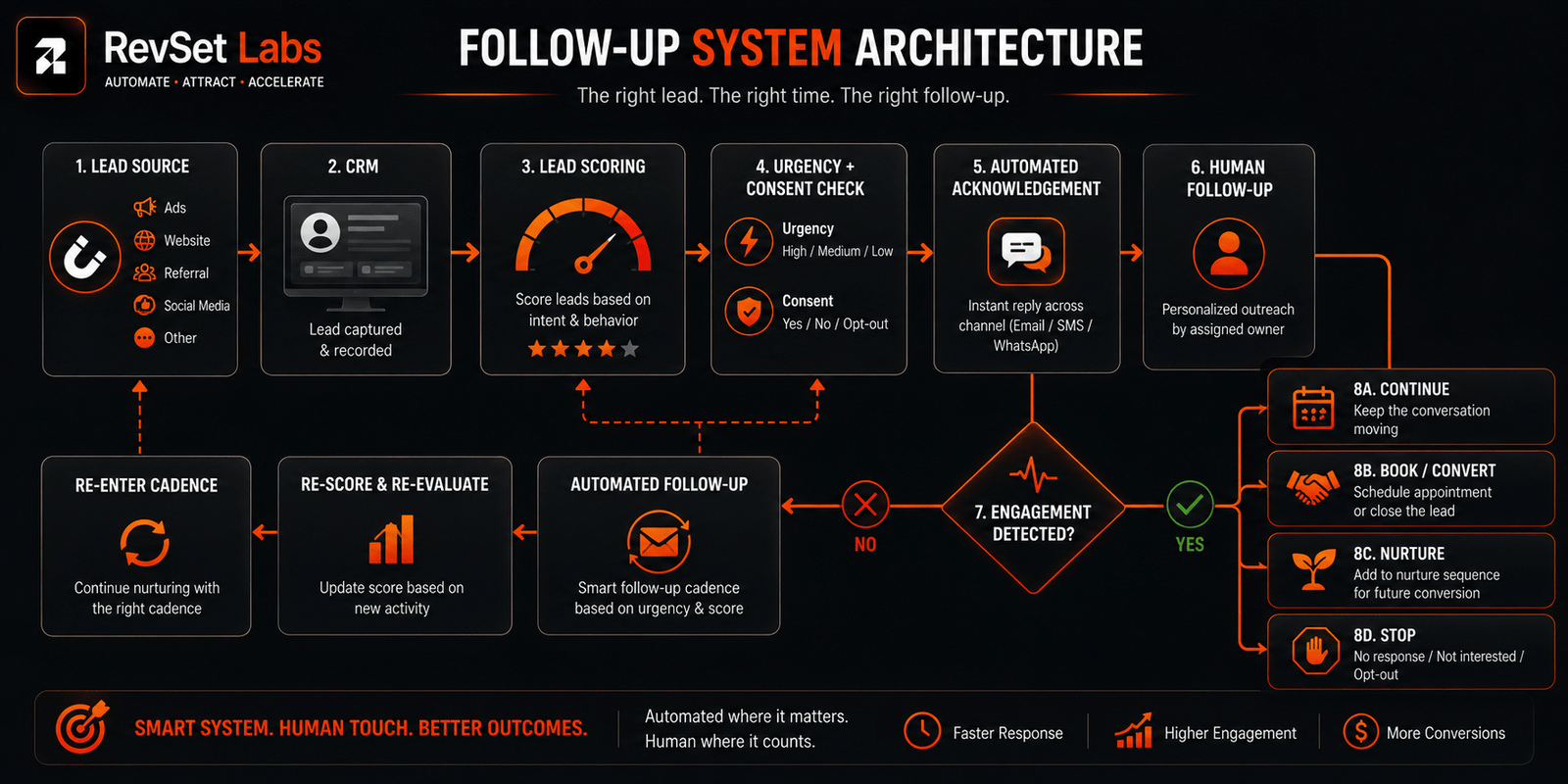
Automation is capable of:
- Initiate prompt acknowledgments.
- Assign leads to the appropriate agent.
- Assign follow-up assignments.
- Based on engagement, modify lead scores.
- Workflows should be stopped after a response.
- Be mindful of your communication preferences.
- Turn dormant leads into active ones.
- When high-intent leads are not followed up on, notify teams.
Automating persistence is not the aim.
The goal is to automate judgment rules while keeping human communication where it matters.
Measure Follow-Up Quality, Not Just Follow-Up Volume
Even after hundreds of follow-up attempts, a sales team’s procedure may still be flawed.
Whether their efforts result in movement is a more pertinent topic.
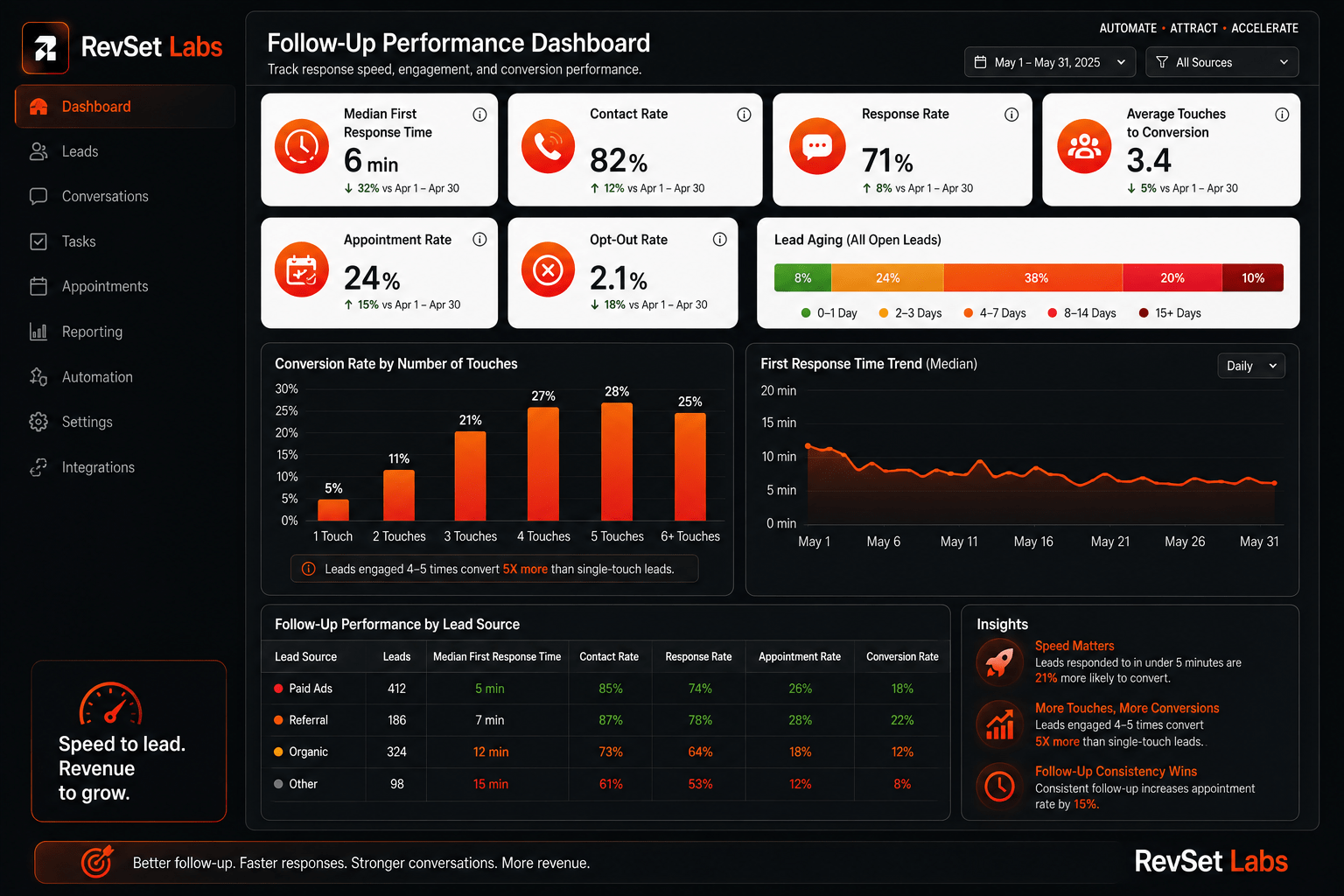
RevSet Labs monitors:
| KPI | What It Tells You |
| Response Rate | Whether prospects are engaging. |
| Contact Rate | Whether outreach is reaching people. |
| Lead-to-Appointment Rate | Whether follow-up creates a next step. |
| Touches to Conversion | How many meaningful interactions typically precede conversion. |
| Time to First Response | Whether the business engages quickly enough. |
| Follow-Up Completion | Whether planned sequences actually happen. |
| Opt-Out Rate | Whether communication frequency or relevance is becoming a problem. |
| Lead Aging | How long opportunities remain without meaningful progress. |
In the end, this data provides a more accurate response than any generic sales piece.
After three touches, you could find that your best leads convert.
Another segment may require six.
A two-week nurturing sequence could improve a third’s conversion.
Generic assumptions should eventually be replaced by your own consumer data.
How RevSet Labs Can Help
The larger issue might not be follow-up effort if your sales staff is often questioning how often you should follow up with a prospect.
It can be the lack of a well-defined system.
Lead collection, CRM workflows, intelligent routing, automated acknowledgements, follow-up sequences, lead scoring, and human handoffs are all integrated into a single revenue operations process by RevSet Labs.
Rather than requiring salesmen to recall each subsequent step, the technology assists in determining:
Who should respond → How quickly → Through which channel → How often → When to stop → When to nurture
As a result, customers receive a more uniform experience, and sales teams have more time to concentrate on discussions that genuinely call for human judgment.
Final Thoughts
There is no one-size-fits-all solution to the question of how often to follow up with a lead.
The preferable course of action is to follow up sufficiently to provide a prospect who is truly interested with appropriate opportunity to interact, then adjust the approach when new information becomes available.
The follow-up cadence should be influenced by the lead source, urgency, intent, consent, prior interaction, and duration of the sales cycle.
A prospect who downloaded an instructional booklet should receive a different response than a sponsored lead who requests an urgent service. A personal context is necessary for a referral. Instead of making daily calls, a long-term B2B possibility could require careful nurturing. Additionally, the sales sequence should always be superseded by an explicit opt-out.
RevSet Labs follow-up is not a measure of a salesperson’s perseverance, but rather an operational system.
The most effective systems promptly collect the lead, route it appropriately, initiate the appropriate response, track engagement, and automatically modify the subsequent action in response to the customer’s actions.
This indicates that no one on your team is questioning, “Should I call this person again?”
The next course of action is already known by the system.
FAQs
How many times should you follow up with a sales lead?
RevSet Labs advises beginning with five to seven meaningful efforts for many high-intent inbound leads; however, the precise number should be determined by urgency, lead source, engagement, and consent. Instead of continuing eternally, the sequence should become less frequent as the opportunity matures.
How many follow-ups before giving up?
An unanswered communication should not be interpreted as an automatic rejection. Before putting a warm inbound lead into nurturing, it makes sense to make a few well-spaced efforts across various channels, as long as the prospect hasn’t requested you to stop.
How often should you follow up with a lead?
While lower-intent leads often require longer time between touches, high-intent leads may warrant many efforts on the first day. As urgency and engagement decrease, a meaningful cadence should become less frequent.
How many follow-up emails should you send?
A global email limit does not exist. As long as each email provides value and respects the recipient’s preferences and relevant communication needs, a sensible sequence may consist of three to five meaningful emails.
How many times should you call a lead before giving up?
Three to five call attempts can be a good place to start for an incoming lead, but calls shouldn’t be mechanically repeated; instead, they should be supplemented with other suitable channels. The ultimate cadence should be determined by the customer’s communication preferences, prior involvement, and urgency.
What is the best follow-up schedule for new leads?
Start right away with high-intent inbound prospects, follow up again that same day, and then make spaced attempts during the next week. Rather than getting repeated sales calls, lower-intent leads should typically go into a lengthier nurturing cycle.
Can you follow up too many times with a lead?
Indeed. Reaching out to a prospect repeatedly without providing anything of value might make the follow-up seem invasive and negatively impact the customer experience. When engagement is still poor, it is best to change up the message, honor communication preferences, and cut back on frequency.
Should follow-up frequency change after a lead responds?
Of course. When a lead answers, the automatic follow-up process should typically stop and the dialog should become more tailored. Instead of following a predetermined sequence, the subsequent contact should represent what the prospect truly requested.
Diagnose Your Follow-Up Gaps With the RevSet Labs
Your follow-up procedure, not your lead volume, may be the issue if qualified leads are entering your CRM but vanishing before your team can convert them.
Use the RevSet Labs Revenue Leak Scorecard to find areas where your current lead follow-up procedure needs improvement and where chances are being missed.
Provide context in your response. Make a purposeful follow-up. When the consumer tells you to halt, do so.