
How to Follow Up After Sending a Quote
It seems like a big accomplishment to send a quotation. Your team produced the scope of work, the prospect requested a price, and now they have the sales quotation.
Then nothing occurs.
The potential customer doesn’t respond. They don’t make calls. They reject the quotation. After a few days, the salesperson sends another email with the simple subject line, “Just following up.”
Many sales possibilities begin to stall at this point.
The quote isn’t always the issue. The potential customer could still be intrigued. They could be weighing their options, examining the scope internally, waiting for a different decision-maker, questioning the cost, or simply not knowing what to do next.
Understanding that a quotation is not the conclusion of the sales process is essential to knowing how to follow up after sending a quote. The buyer’s actual queries frequently start at this time.
RevSet Labs treats quotation follow-up as a revenue operations issue rather than a task for email writers. The purpose is to comprehend what is occurring after the quotation is delivered, determine the buyer’s present position, and provide the prospect a meaningful reason to continue the conversation.
“Did you see my quote?” is not a good way to follow up.
It inquires, “What does this buyer need to make the next decision?”
What Should Happen After You Send a Quote?
Instead of vanishing into someone’s inbox, a quotation ought to initiate a predetermined sales procedure.
This is how the basic trip appears:
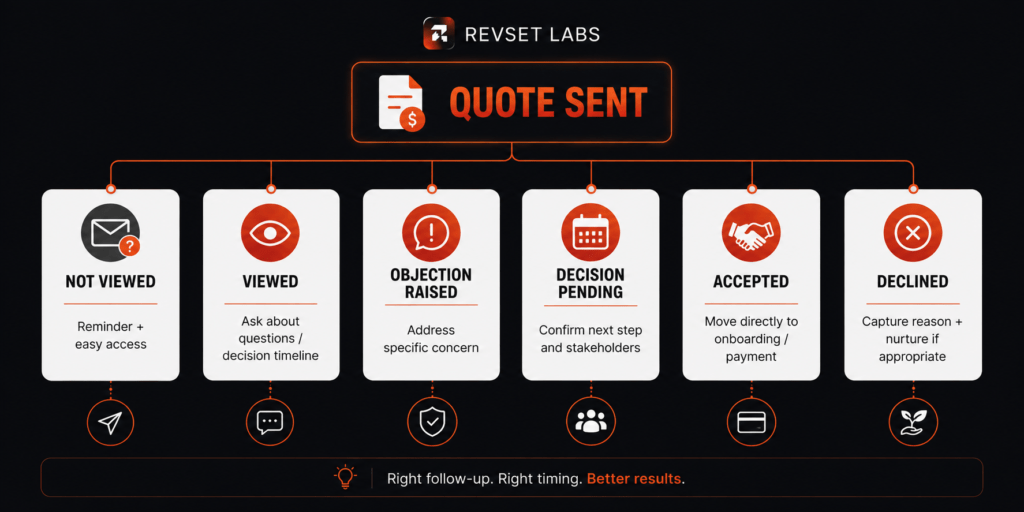
Quote Sent → Quote Viewed → Questions or Objections → Decision → Won / Lost / Nurture
A little different follow-up is needed for each level.
If the prospect hasn’t opened the quote, delivery or attention may be the issue.
There can be doubt or an objection if they have watched it several times without responding.
When they inquire about price, the discussion shifts to value justification or negotiation.
Internal permission or a missing next step might be the only issue if they have confirmed the scope but haven’t signed.
For this reason, it is ineffective to send the identical follow-up email to each prospect.
The follow-up should be determined by the conduct.
How Long Should You Wait to Follow Up After Sending a Quote?
A single universal waiting period does not exist.
The service, purchase urgency, quotation value, choice complexity, and what was decided upon throughout the sales interaction all influence the best time.
A follow-up within one business day is fair for a simple service quote when the client has previously indicated significant interest.
The follow-up may need to be linked to the buyer’s declared decision-making process rather than an arbitrary number of hours for a bigger sales proposal including several stakeholders.
Before providing the quotation, the following is the ideal question to ask:
“When would be a good time for us to review this together?”
The follow-up becomes an agreed-upon next step instead of an interruption thanks to that short query.
According to Gong’s research, sellers who prioritize timely follow-up within one business day and complete open action items see stronger win rates and shorter deal duration. This suggests that timely follow-up and completion of open action items can contribute to faster deal progression.
You should still adjust the precise timing to fit your sales cycle.
A Practical Quote Follow-Up Sequence
| Timing | Purpose | Action |
| Immediately | Confirm delivery | Send the quote with a clear summary and next step. |
| 1 business day | Confirm receipt | Ask whether they received it and whether questions came up. |
| 2–3 business days | Add value | Address likely concerns or clarify scope, pricing, or timing. |
| 5–7 business days | Confirm decision process | Ask what remains before they can decide. |
| Before quote expiration | Create clarity | Mention the expiration date only when it is commercially relevant. |
| After expiration | Re-engage | Ask whether priorities or requirements have changed. |
This is a framework, not a rigid rule.
A $500 service quote and a $50,000 project should not have identical follow-up sequences.
How to Follow Up After Sending a Quote Without Being Pushy
The easiest way to sound pushy is to make the follow-up entirely about yourself.
For instance:
“Just checking if you’ve had a chance to review my quote.”
The paper has already been delivered to the prospect. The email doesn’t clarify anything, respond, or simplify the next step.
A more compelling quotation follow-up email provides the customer with an incentive to reply.
Rather than:
“Any updates?”
Try:
“I wanted to make sure the suggested scope still fits your requirements. If you’d like, I can go over the two topics that are most frequently asked about: implementation timing and cost.
The prospect receives something helpful in the second version.
Additionally, it makes it simple to object.
This is one of the most crucial differences in sales follow-up, in our opinion at RevSet Labs:
RevSet Labs believes this is one of the most important distinctions in sales follow-up:
“Don’t follow up simply because time has passed. Follow up because there is something useful to move forward.”
Quote Follow-Up Should Focus on the Buyer, Not the Quote
A business document is a quote. Making a purchase is a human decision.
The potential customer can be inquiring:
- Is this within our budget?
- Does the scope include everything we discussed?
- Why does this cost more than another provider?
- Can the project start on our preferred date?
- Does my manager need to approve it?
- What happens after I sign?
- Are there additional costs?
- Can we change part of the package?
Frequently, these inquiries have greater significance than the paper itself.
Therefore, the goal of your follow-up after submitting a quotation should be to eliminate any doubt.
This might be delivering a pertinent case study, verifying availability, elucidating a pricing discrepancy, outlining the scope of work, or making a brief review call.
A follow-up that addresses a question the prospect hasn’t yet posed is frequently the most effective.
What to Say in a Quote Follow-Up Email
A professional quotation follow-up email can be short.
A useful structure is:
Context → Value → Question → Next Step
Example
Hello [Name],
I wanted to inquire about the status of the proposal we submitted for [service/project]. I wanted to make sure the proposed scope still represents what you’re looking for because [particular objective] was the top priority based on our talk.
If it would be beneficial, I may go over the cost and schedule with you or modify the scope in response to any queries you may have.
Would it be helpful to have a brief phone conversation on [day/time]?
Best wishes,
[Name]
Take note of what this email omits.
It doesn’t state:
- “I haven’t heard back.”
- “Just bumping this.”
- “Please let me know.”
- “Any update?”
Rather, it provides a useful next step and reminds the customer of the purpose of the quote.
Generic terms like “following up” might perform worse than communications that provide the customer anything substantial or helpful, according to Gong’s examination of over 300,000 follow-up prospecting emails.
The concept applies to quotation follow-up: instead of just telling the prospect that you’re waiting, offer them a cause to participate.
Quote Follow-Up Templates for Different Situations
First Follow-Up After Sending the Quote
Subject: Quick question about [Project/Service]
Hello [Name],
I wanted to confirm that you got the estimate for [service/project].
I think [priority 1] and [priority 2] were the primary priorities based on our discussion. Do you still think the suggested scope is appropriate?
I’d be pleased to answer any queries you may have about scope, cost, or schedule.
Best wishes,
[Name]
Follow-Up When the Quote Was Viewed
Subject: Questions about the [Project] quote?
Hello [Name],
After you got a chance to look over the quote, I wanted to follow up.
Do you have any questions about the scope, cost, or schedule that I should address?
I would be pleased to review it with you over the phone if that would make things simpler.
Best,
[Name]
Here, the key difference is that instead of acting as though the quote hasn’t been examined, the message reacts to buyer behavior.
Quote activity, acceptance status, and expiry risk are becoming more visible on quote platforms and CRM systems, which makes managing this kind of behavior-based follow-up simpler.
Follow-Up When Price May Be the Objection
Subject: About the pricing in the proposal
Hello [Name],
I wanted to make sure that the proposal’s cost matched your original plans.
If the investment is more than anticipated, I’d be pleased to go over the scope with you and see if there’s anything we can change without sacrificing the primary result you want.
Would that be useful?
Best,
[Name]
Don’t give a discount right away.
A value, scope, time, or budget concern might be mistaken for a pricing objection.
First, determine which one you are working with.
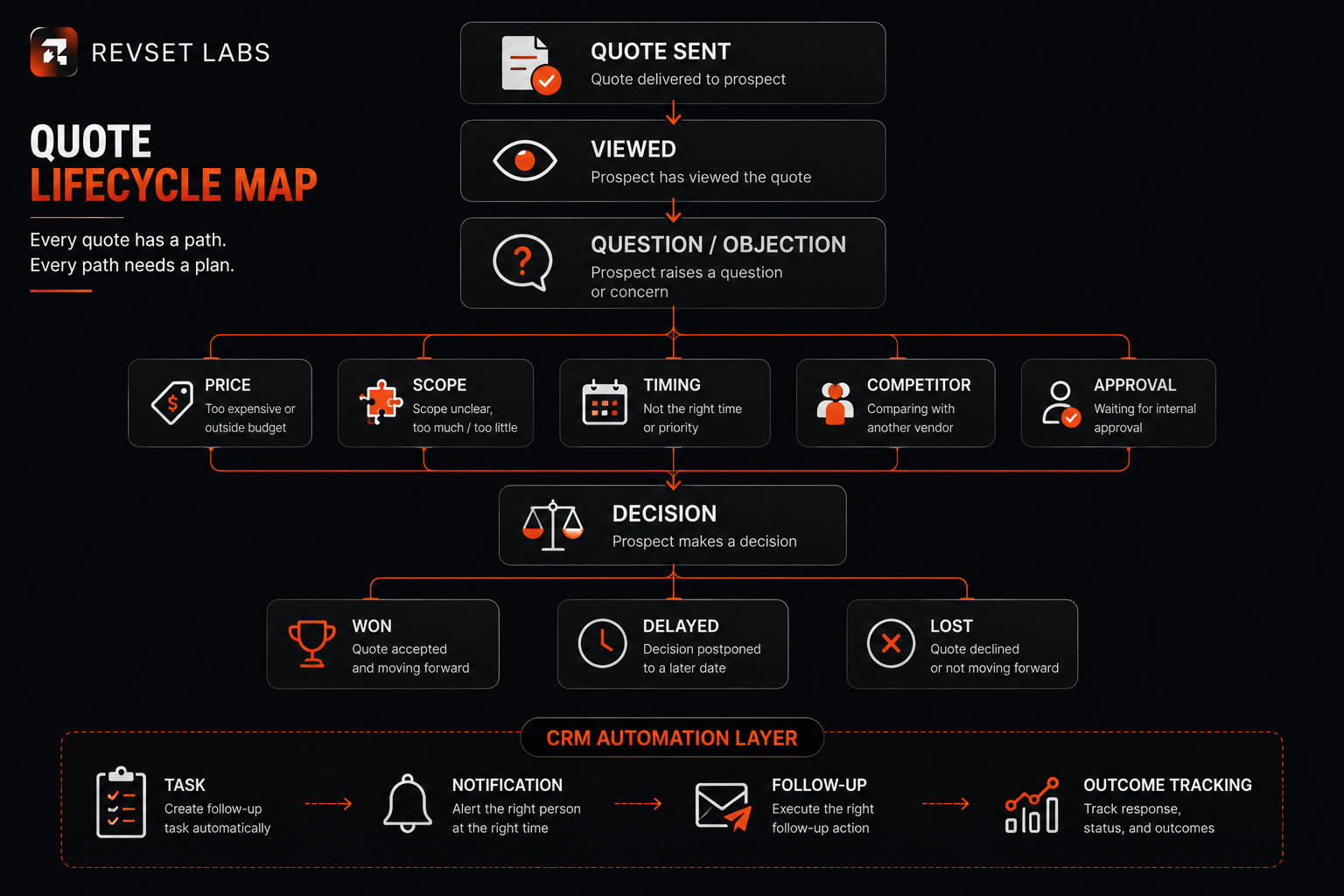
Map the Quote: Sent, Viewed, Objection, Decision
At this point, quotation follow-up transitions from being a set of templates to an operational procedure.
RevSet Labs maps the quote lifecycle inside the CRM, so each stage creates a different action.
Stage 1: Quote Sent
What you know: A business proposition has been sent to the prospect.
Action: Verify delivery, outline the main result, and determine the anticipated review schedule.
CRM trigger: Make a task to follow up.
Stage 2: Quote Viewed
What you know: The buyer has accessed the quote or engaged with it.
Action: Avoid sending another generic message right away. After giving them a fair amount of time to evaluate, inquire about any queries or worries.
CRM trigger: Give the chance for individualized follow-up top priority.
Stage 3: Objection
What you know: The buyer has identified something preventing a decision.
Common objections include:
- Price
- Scope
- Timing
- Internal approval
- Competitor comparison
- Contract terms
- Implementation concerns
Action: Diagnose before responding.
Don’t immediately cut the price if that’s the problem. Find out whether the buyer thinks the investment is not worth it, if the budget is tight, or if the scope is more than necessary.
Stage 4: Decision
The buyer has chosen not to advance, is prepared to move forward, or requires internal permission.
Action: Clearly state what comes next.
For a victory:
Sign → Pay → Schedule → Onboard
Due to a delay:
Confirm blocker → Agree next date → Assign owner
For a loss:
Capture reason → Update CRM → Determine nurture path
In a similar vein, Salesforce literature shows how quote follow-up may be integrated directly into opportunity management rather than relying on individual recall by utilizing automated activities around the “Proposal/Quote Given” step to establish scheduled follow-up tasks.
How to Handle Common Quote Objections
“Your Price Is Too High.”
Don’t justify the pricing right away.
Inquire:
“Compared with what you had budgeted, or with another proposal you’ve received?”
That distinction is important.
A scope revision could be necessary if your pricing truly exceeds their budget.
The topic of results, scope, quality, risk, or service level must be brought up again if the potential customer is comparing you to a less expensive supplier.
“We’re Still Reviewing Other Quotes.”
This isn’t always a negative indication.
It attests to the prospect’s active evaluation of providers.
Inquire:
“Definitely. Are you comparing certain aspects of the offers, such as scope, cost, timeliness, or service level?
A general complaint is transformed into a focused discussion with that question:
“We Need to Think About It.”
Don’t immediately send another reminder.
Inquire:
“Obviously. Can I provide clarification on anything you’re still unsure about?
If they find a problem, fix it.
Determine when it makes sense to get back in touch if they truly need time.
“We Need Approval.”
The decision-maker is now crucial.
Inquire:
“Would it be useful if I provided a summary of the expected outcome, scope, and investment that you can share internally?”
As agreements move forward, Gong’s sales research highlights how crucial it is to involve the appropriate stakeholders and drive specific next steps.
When a Quote Isn’t Moving: Don’t Keep Sending the Same Email
Diagnosing a stopped quotation is necessary.
Check the CRM before sending another follow-up email following the quote.
Inquire:
- Did you open the quote?
- When was the last time you saw it?
- Has the potential customer responded?
- Was a deadline for making a choice set?
- Is there an unanswered objection?
- Is there another decision-maker involved?
- Has the timetable for the prospect changed?
- Is the quotation about to expire?
You may learn more from these questions than just how many emails you’ve sent.
An answer to a statement that has been viewed three times can be very different from one that hasn’t been opened.
Build a Quote Follow-Up Sequence
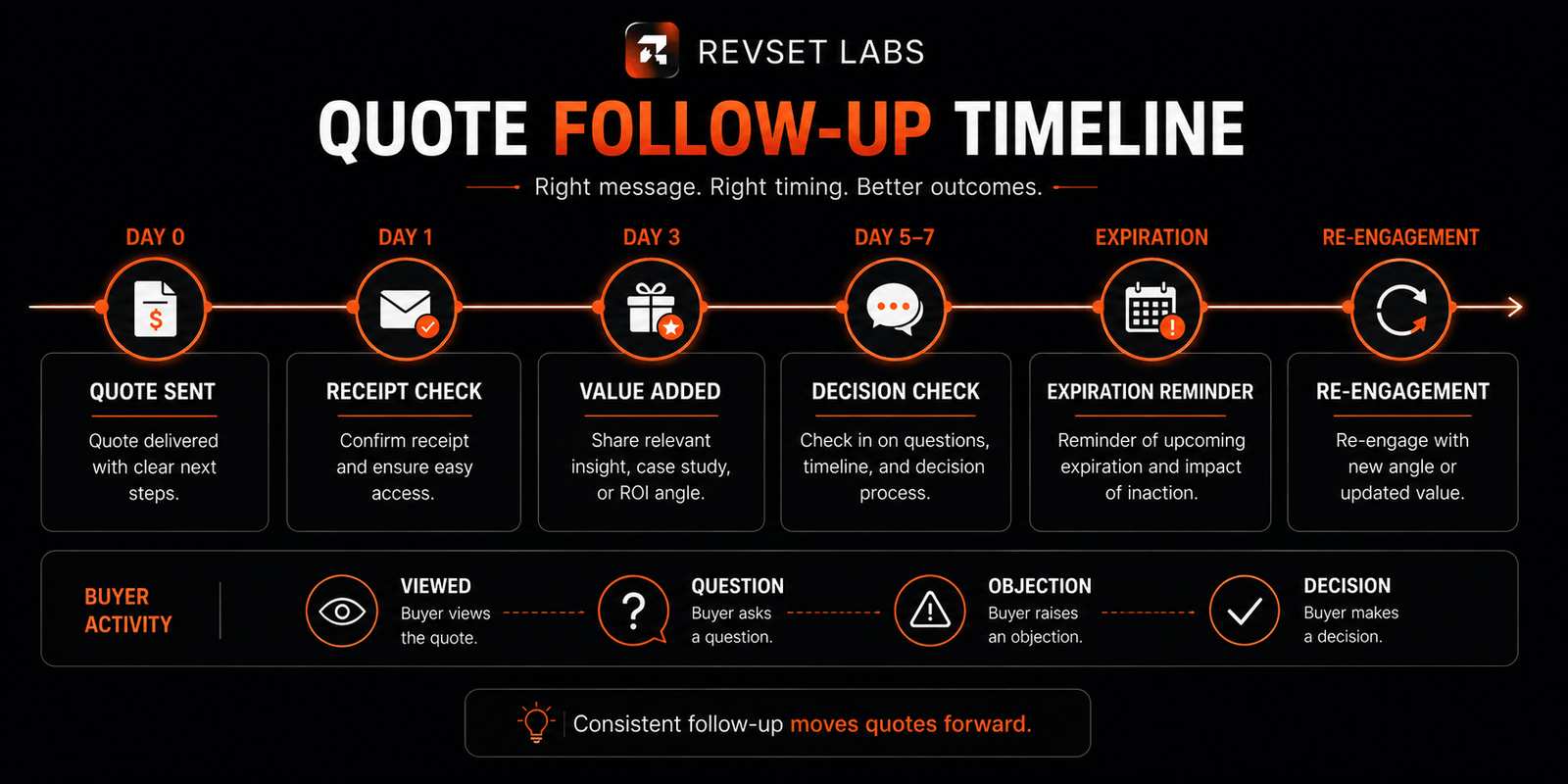
This is an example of a basic sales quotation follow-up sequence:
Day 0: Quote Sent
Provide a succinct explanation and a clear next action along with the quotation.
Day 1: Receipt and Questions
Verify delivery and ask questions.
Day 3: Value-Based Follow-Up
Provide a pertinent explanation, case study, implementation detail, or insight.
Day 5–7: Decision Check
Before the buyer can decide, find out what’s left.
Before Expiration: Timing Check
Describe what occurs after the quote’s actual expiration date.
After Expiration: Re-Engagement
Find out if the project is still ongoing and if anything has changed.
Automating this process should not be done carelessly.
Based on consumer behavior, the CRM should decide what comes next.
The RevSet Labs Approach to Quote Follow-Up
Quote follow-up is viewed by RevSet Labs as a component of a broader revenue operations system.
The process will ultimately break down if salespeople have to manually verify who opened each document, remember when to call, remember every estimate they send, and hunt through inboxes for client inquiries.
It’s not a human issue.
It’s a systemic issue.
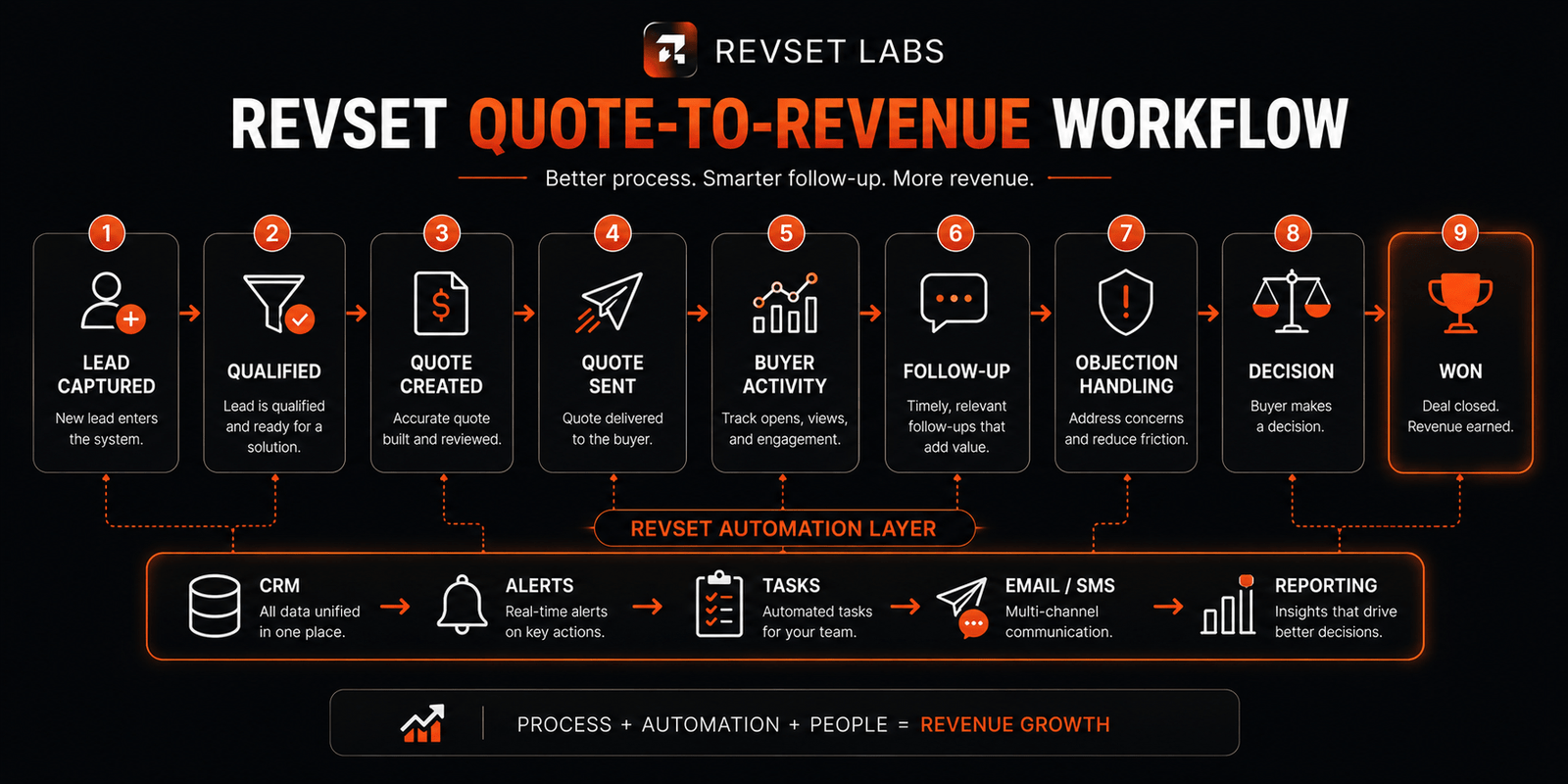
A better setup connects:
Lead → CRM → Quote → Activity → Follow-Up → Objection → Decision → Revenue
When the quotation was sent should be known to the CRM.
The system needs to be able to determine whether action is necessary.
The salesman ought to be aware of the prospect’s prior conversations.
Additionally, active quotations, stalled, expired, won, and lost should be visible to management.
This exposure is progressively supported by contemporary quoting technologies. HubSpot offers quotation activity, expiry details, acceptance rates, and suggested follow-ups according to quote activity and expiration status.
The plan is not the technology.
Knowing what should be done next is the strategy.
Final Thoughts
Finding the ideal email template is not as important as figuring out what is keeping the buyer from making a choice when it comes to knowing how to follow up after providing a quotation.
Occasionally, they have not seen the quotation.
They ask questions from time to time.
There are moments when the cost seems excessive.
Sometimes approval from another decision-maker is required.
Additionally, there are instances when the project is no longer a top priority.
Every circumstance calls for a unique reaction.
The most effective sales teams don’t increase their follow-up emails just because a certain number of days have gone by. To decide on the best course of action, they consider customer behavior, CRM data, past discussions, and known concerns.
This is the distinction between sales process management and sales follow-up.
RevSet Labs assists companies in developing systems that link lead collection, CRM processes, quotation follow-up, automation, routing, and reporting so that opportunities are independent of a person’s memory or a backlog of emails.
More leads might not be the solution if quotations are being supplied yet opportunities later stagnate.
The process of sending a quote, reviewing it, answering questions, making a choice, and generating income may be more efficient.
Examine your quotation pipeline first to determine where opportunities are being stalled. Next, focus the follow-up procedure on those particular issues of contention.
FAQs
How do you follow up after sending a quote?
After verifying that the prospect has received the estimate, find out if they have any concerns regarding the cost, scope, schedule, or next actions. Rather than just requesting an update, a helpful follow-up provides context.
How long should you wait to follow up after sending a quote?
One business day is a sensible beginning point for many service companies, but timeliness should take into account the buyer’s urgency, decision-making process, and predetermined timeframe. Use the review date that was agreed upon rather than a random timetable.
How do you follow up on a quote without being pushy?
By answering a likely query, outlining the scope, providing a brief review call, or verifying the next decision step, you may provide the prospect an incentive to reply. Steer clear of repeated notifications that just state that you’re checking in.
What should I say when following up on a quote?
Make reference to the particular project, make sure the estimate still satisfies the prospect’s requirements, and pose a targeted inquiry regarding any issues, deadlines, or next actions. Make sure the message is clear and helpful.
How do you follow up with a client after sending a quote?
Before reaching out to the customer, review their earlier communication and tailor the follow-up to their objectives. Instead of delivering the same information again, utilise the context of whether the quotation has been seen to ask if anything needs clarification.
Should you follow up if a prospect viewed your quote?
Yes, but don’t assume that just because they’re watching, they’re prepared to purchase. Provide clarity on scope, cost, implementation, or the next step using the activity as justification.
Should you follow up if a prospect viewed your quote?
Find out if the problem is perceived value, comparison with another service, or the overall budget. You may decide whether to examine alternatives, modify scope, or explain value after you have a clear understanding of the problem.
What happens if a quote expires before the customer decides?
Find out if the project is still ongoing by getting in touch with the prospect. Before providing a new quote, ascertain whether pricing, availability, scope, or other parameters need to be revised if the opportunity is still valid.
Turn Quote Follow-Up Into a Revenue System
If quotes are being sent but too many opportunities are going quiet afterward, the problem may not be your sales team; it may be the process behind the follow-up.
RevSet Labs helps you connect lead capture, CRM activity, quote tracking, automated follow-up, objection handling, and sales routing into one system.
Stop letting sent quotes become stalled opportunities. Run your RevSet Labs Revenue Leak Scorecard to identify where your pipeline is losing momentum and what to fix next.