
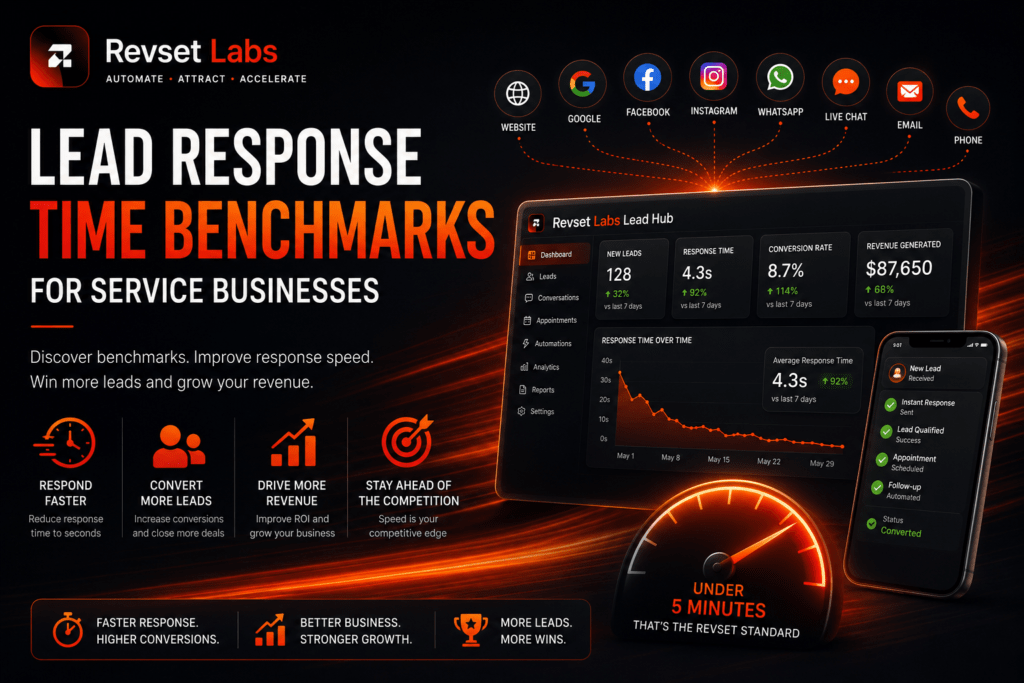
2026 Lead Response Time Benchmarks for Service Businesses
Marketing has the power to raise awareness. Revenue is generated through sales discussions. Minutes are frequently used to quantify the gap between those two results.
Each incoming query signifies a person who is actively seeking a solution. They are assessing providers when their interest is at its peak, whether they are looking for an emergency plumber, seeking a legal consultation, or scheduling a dentist appointment. The speed at which your company reacts can determine whether the discussion proceeds or terminates before it starts.
This does not imply that all businesses should aim for the same response time. For a residential service emergency, a five-minute response could be suitable, but it wouldn’t be essential for a complicated B2B consulting contract. Inquiry urgency, business hours, sales complexity, workforce capacity, and customer expectations all influence the appropriate benchmark.
This guide analyzes response-time standards across service sectors, explains how RevSet Labs suggests monitoring lead response time, and offers a useful framework for choosing goals that work for your company.
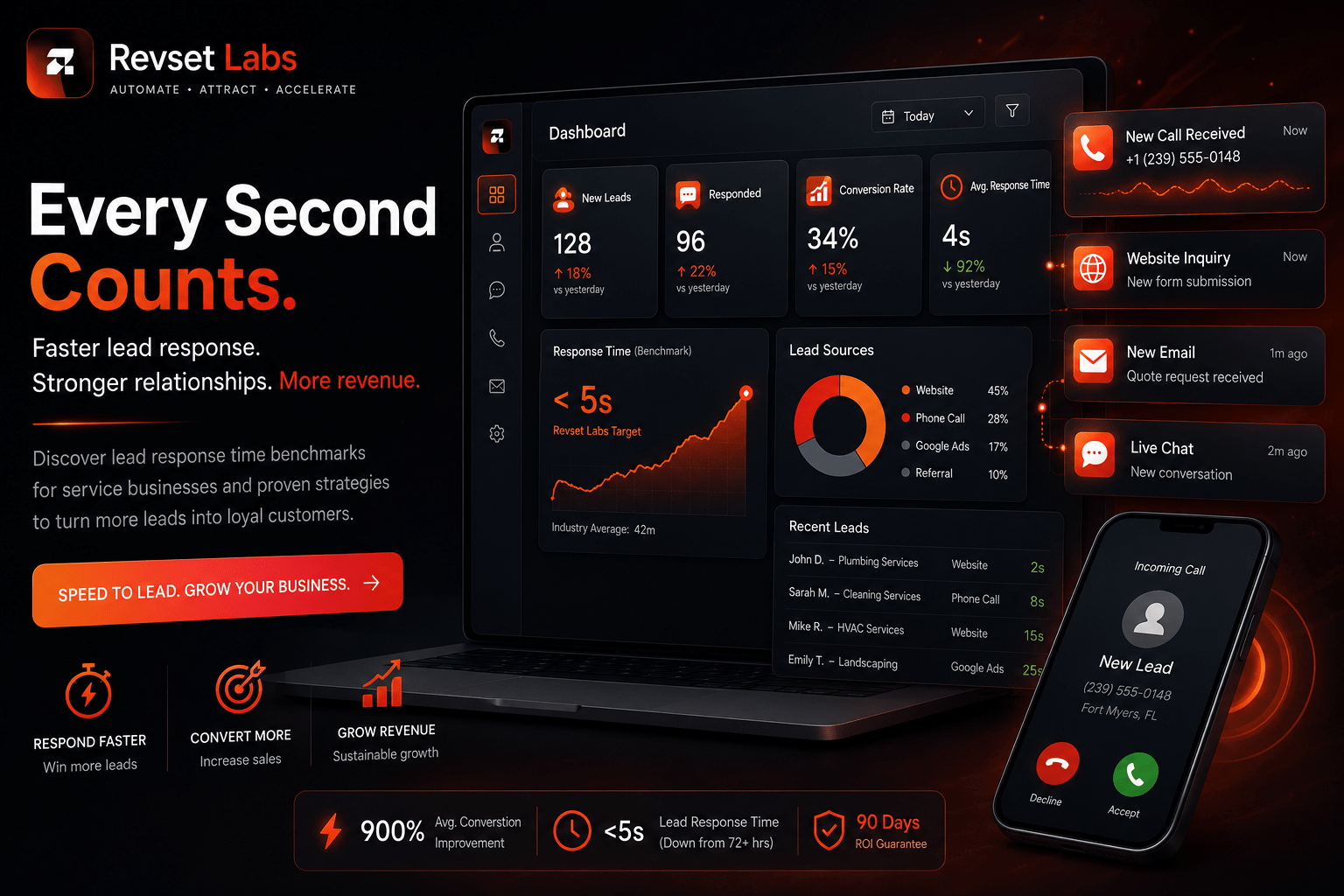
What Is Lead Response Time?
The time it takes a sales and marketing team to get in touch with a prospect once they have shown interest is known as the lead response time. The potential customer can express their interest by requesting a demo, completing a form, or downloading a gated file. It begins when the lead makes contact and concludes when a member of your team responds.
Although it’s a straightforward measure, it may reveal a lot about how your sales process operates. Reacting quickly demonstrates your attention to detail. A delayed lead response time? They start to question whether they ought to search elsewhere.
The formula is simple on paper:
Lead Response Time= Lead Processing Time + Representative Response Time
According to RevSet Labs, a meaningful response is one that actively advances the discussion. This can entail giving the prospect a call, answering their particular query, verifying their availability, setting up an appointment, or starting a tailored conversation.
Why Lead Response Time Matters More Than Ever
The well-known “five-minute rule” is a major topic of controversy when it comes to reaction time. While reacting promptly is usually advantageous. The speed at which businesses respond to leads has a direct impact on sales outcomes. Here’s why:
Conversion rates are 100 times higher with a 5-minute response time than with a 30-minute wait. Contacting prospects within five minutes results in 21 times greater qualifying rates than waiting only thirty minutes, research from the Harvard Business Review and Lead Response Management Study.
More than 30% of leads are never contacted. Sales representatives frequently give up too quickly, making an average of 1.3 call tries before moving on and losing crucial conversion opportunities, found by Forbes study.
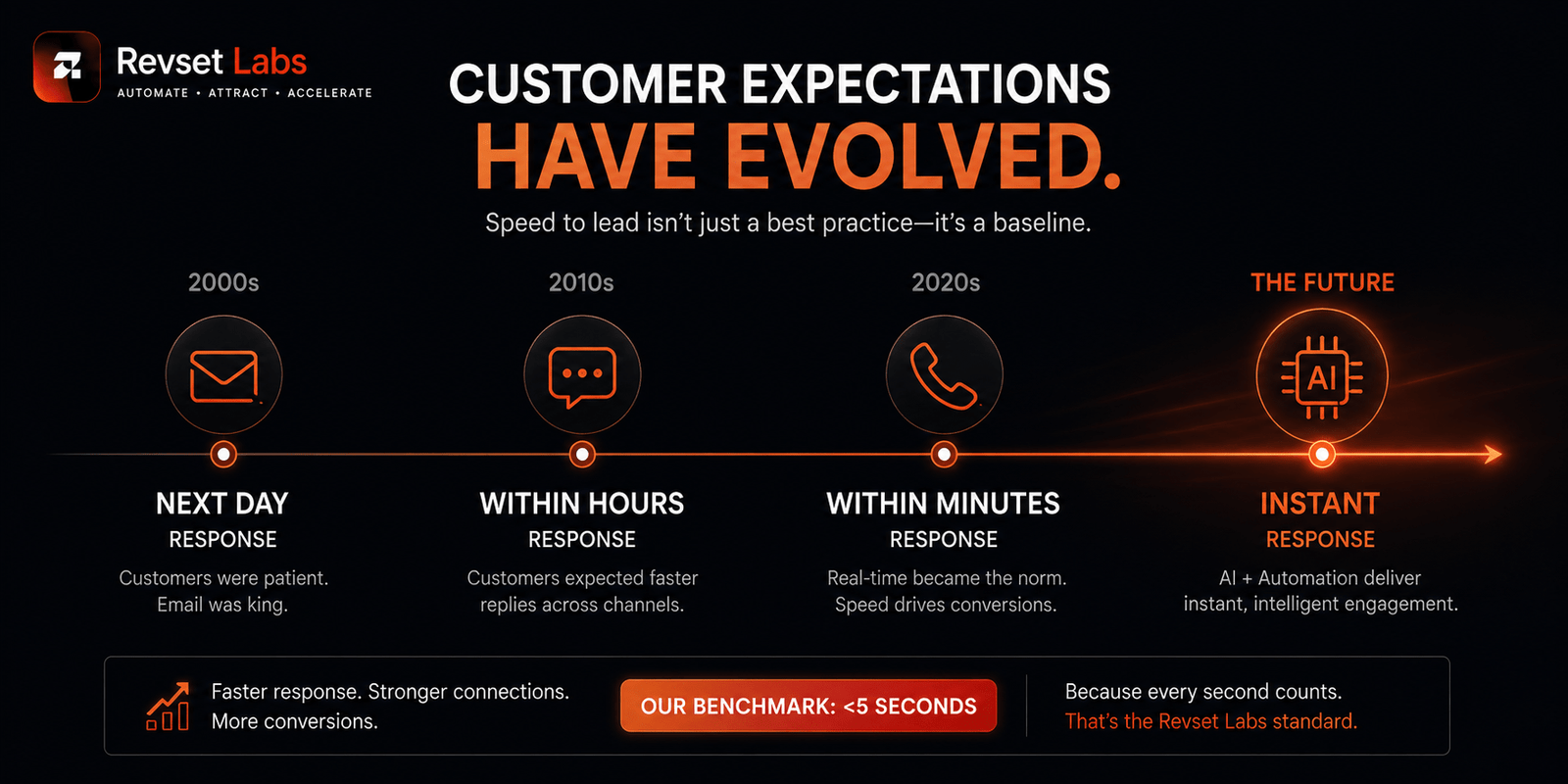
Customer Expectations Have Changed
Consumers today are used to instant communication.
They get:
- Delivery on the same day
- Order confirmations in real time
- Live chat assistance
- AI helpers
- Tracking in real time
- Reminders for appointments
- Updates that happen automatically
Every industry now has different expectations as a result of these experiences.
Consumers now evaluate your response to all the great digital experiences they’ve had elsewhere rather than just your competition.
The RevSet Benchmark Model
Adopting response-time objectives without taking into account how clients actually purchase their services is one of the greatest mistakes companies make.
A B2B consulting firm offering six-month transformation projects should not be held to the same standards as a domestic plumbing company dealing with burst-pipe emergencies. Similarly, a law company managing urgent legal cases has different client expectations than a dentistry facility scheduling regular visits.
RevSet Labs employs an operational benchmark approach based on five criteria that consistently affect customer expectations and conversion prospects rather than suggesting a single “ideal” response time.
These factors assist companies in setting response goals that are practical, quantifiable, and consistent with company objectives.
Inquiry Urgency
The most important factor should always be urgency.
Usually do people evaluate many providers over the course of several days when they submit an emergency service request. They need help right now.
Examples consist of:
- Plumbing emergencies
- HVAC malfunctions
- Electrical malfunctions
- Water-related harm
- Lockout services
Every extra minute for these questions raises the possibility that the client may get in touch with a different supplier.
In contrast, the evaluation cycle is usually lengthier for someone seeking information on a long-term consulting engagement, accounting service, or marketing plan. Slightly longer reaction windows often have a smaller business impact, even if timeliness is still important.
At RevSet Labs, we recommend that the greater the urgency, the shorter the acceptable human response time.
Lead Source
Not every lead has the same degree of intent to buy.
Compared to someone simply interacting with a social media post, someone who completes a “Request a Quote” form after browsing many service sites has shown much greater purchase intent.
Typical sources of leads include:
- Google Lookup
- Profile on Google Business
- Natural traffic to websites
- Sponsored advertising
- Referral partners
- Real-time conversation
- Social media
- Current client recommendations
Instead of aggregating all inquiries into a single average, businesses should divide response-time statistics by channel.
Business Hours
By assessing each request in the same way, many service companies inadvertently exaggerate their response-time figures.
If the business is closed, a query made on Tuesday at 10:00 AM should not be assessed with the same standards as one received on Saturday at 11:30 PM.
Rather, RevSet suggests dividing:
- Inquiries during business hours
- After-hours questions
- Weekend questions
- Holiday-related questions
A far more realistic picture of operational performance is produced by this differentiation.
Customers demand assurance that their question has been received, even if your team is unavailable.
While preparing the query for human follow-up once business restarts, an automated acknowledgment, appointment calendar, or AI-powered assistant may comfort prospects right away.
At RevSet Labs, measuring business-hours performance separately from after-hours performance rather than combining both into a single KPI.
Sales Complexity
Not every client needs the same kind of answer.
Setting up a site inspection can be necessary for a roofing estimate.
Medical data may be gathered during a cosmetic dentistry consultation.
Technical research and several stakeholders may be necessary for a managed IT services proposal.
Compared to transactional services, complex purchasing paths inherently call for more deliberate talks.
Slow answers are not justified by this, but it does affect what constitutes “good performance.”
For instance:
- Plumbing emergency: Quick communication
- Making an appointment for a roofing inspection
- Legal advice: Preliminary qualification
- Marketing firm: Call for discovery
- Enterprise software: Qualification for sales
Instead of just responding fast, businesses should optimize for significant advancement.
Team Capacity
Additionally, operational realities must be reflected in benchmarks.
Sales, customer service, scheduling, and operations are all handled concurrently by a small number of employees in many small organizations.
Instead of improving customer experiences, setting unreasonable goals that staff members are unable to regularly meet results in inaccurate reporting.
Instead of aiming for unachievable standards, companies can set quantifiable goals that become better over time and use automation to get rid of tedious administrative tasks.
Automation should not take the place of real customer engagements, but rather lessen operational friction.
Consistency is the goal.
Reliable five-minute replies are significantly more beneficial to customers than erratic performance spanning from one minute to many hours.
RevSet Operational Response Targets (2026)
Compared to long-term consulting contracts, emergency home services usually demand for quicker replies.
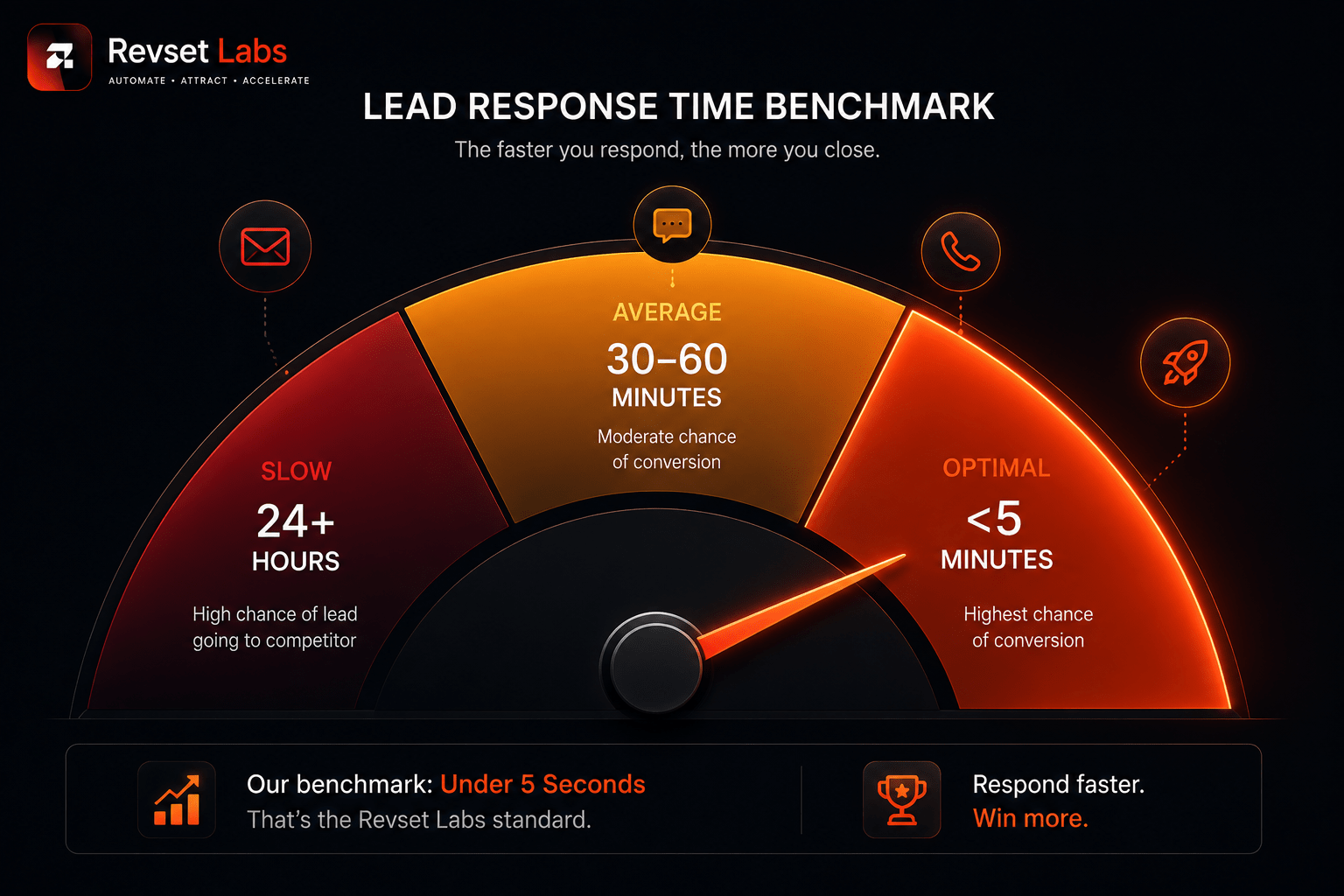
Nonetheless, the benchmarks listed below offer a helpful foundation for assessing your performance.
| Response Time | Performance Level | Customer Impact |
| Under 1 minute | Exceptional | Immediate engagement, strongest chance of conversion |
| 1-5 minutes | Excellent | Highly competitive, builds trust quickly |
| 5-15 minutes | Very Good | Strong opportunity to secure the lead |
| 15-30 minutes | Acceptable | Customer may begin comparing competitors |
| 30-60 minutes | Average | Increased risk of losing the inquiry |
| 1-4 hours | Poor | Many prospects contact another provider |
| More than 24 hours | Critical | Most opportunities are lost |
Instead of focusing on being “good enough,” RevSet Labs try to react within the first five minutes whenever it is feasible from an operational standpoint.
Industry Response Benchmarks
Some industries depend on rapid communication more than others.
| Industry | Recommended First Response |
| Plumbing | Under 5 minutes |
| HVAC | Under 5 minutes |
| Roofing | Under 10 minutes |
| Electrical Services | Under 5 minutes |
| Real Estate | Under 5 minutes |
| Dental Clinics | Under 10 minutes |
| Law Firms | Under 15 minutes |
| Insurance Agencies | Under 15 minutes |
| Marketing Agencies | Under 30 minutes |
| IT Services | Under 15 minutes |
For high-urgency companies where every minute affects revenue, we at RevSet Labs advise near-instant lead response. Quick follow-up is still crucial for attracting and keeping prospects over lengthier sales cycles.
How to Measure Lead Response Time Correctly
Because they respond to all inquiries before the end of the day, many companies think they are responsive. Unfortunately, for many service businesses, “same-day response” is no longer a useful standard.
The true question is not whether your staff responds, but rather how frequently, how fast, and how those reactions result in profitable outcomes.
Organizations that boast an average response time of 20 minutes have been known to lose qualified leads. After analyzing the data, we discovered that inconsistency rather than the average was the issue. While some questions were answered in less than two minutes, others were left unanswered for several hours because they came in via a different channel or after work hours.
For this reason, precise measurement is just as important as actual reaction time.
RevSet Labs works on:
- Instead of using the average response time as your main KPI, use the median.
- To find sluggish outliers, follow the 90th percentile.
- Distinct performance during business hours and after hours
- Divide response times by lead source and channel.
- Analyze response attempts and real conversations independently.
The KPIs Every Service Business Should Track
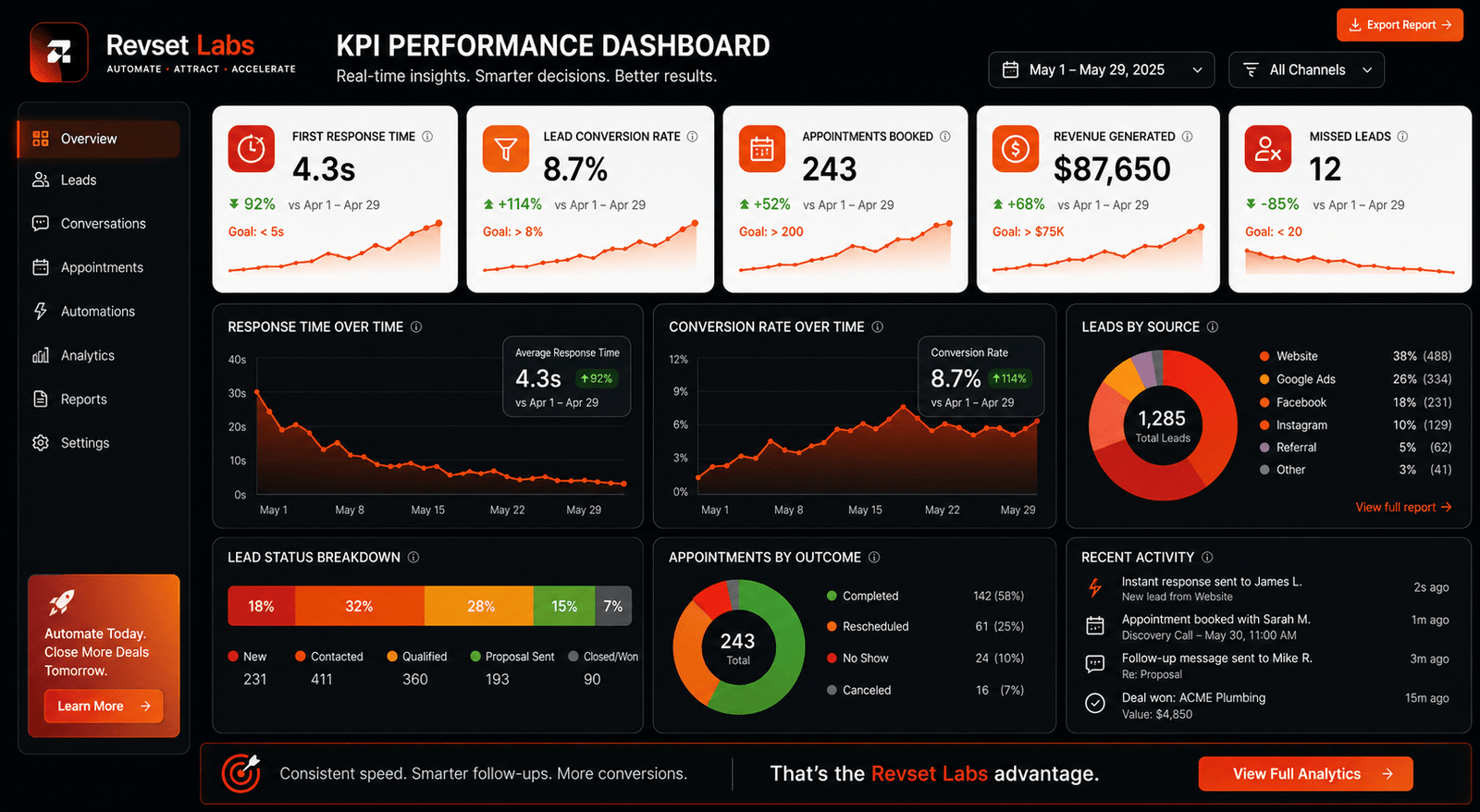
Measurement is the first step towards improving lead response time. It is hard to determine whether your team is getting more productive or whether opportunities are being missed without monitoring the appropriate data.
RevSet Labs concentrates on a core set of Key Success Indicators (KPIs) that have a direct impact on sales success rather than keeping an eye on dozens of data.
| KPI | What It Measures | Recommended Target |
| First Response Time | Time taken to make first meaningful contact | Under 5 minutes |
| Lead Response Rate | Percentage of leads contacted | 100% |
| Lead-to-Appointment Rate | Leads converted into scheduled appointments | 40–60% (varies by industry) |
| Appointment-to-Customer Rate | Appointments converted into paying customers | Continuously improving |
| Missed Call Rate | Calls that were never answered or returned | Under 5% |
| Follow-Up Completion Rate | Leads receiving complete follow-up sequences | Above 95% |
| Average Time to Book | Time from inquiry to confirmed appointment | Under 24 hours |
To see patterns, evaluate team performance, and find process bottlenecks before they impact revenue, review these KPIs on a weekly or monthly basis.
Practical Ways to Improve Lead Response Performance
The quickest reaction isn’t necessarily the best one.
The objective is to create a repeatable system that records all inquiries, intelligently directs them, and enables your team to reply consistently without adding to the administrative burden.
These enhancements have the most operational impact on service businesses.
Centralize Every Inquiry
In a single CRM, record internet forms, phone conversations, live chat, social media messages, recommendations, and paid advertising leads. There are fewer opportunities lost when all inquiries go through the same process.
Send Immediate Acknowledgements
Clients shouldn’t be unsure if their question was answered. While preparing the lead for significant human follow-up, automated confirmations minimize ambiguity.
Prioritize High-Intent Leads
Not every question should be handled the same way. To help your team concentrate on the prospects that are most likely to convert, create routing rules based on urgency, service type, geography, or lead source.
Implement Missed-Call Text Back
Numerous clients contact several suppliers. An instant text message acknowledging the call and outlining the next steps, in the event that it is not answered, keeps the discussion going and minimizes missed chances.
Review Response Performance Every Week
Assumptions are seldom the source of operational gains. Regularly check response-time reports, booking rates, unanswered questions, and follow-up completion. Large process modifications performed once a year are frequently not as effective in the long run as little tweaks made weekly.
How Revset Labs Helps You Improve Lead Response Time
At RevSet Labs, we think that creating systems that function more intelligently is a better way to improve lead response than asking your staff to put in more effort.
By integrating CRM optimization, intelligent lead routing, AI-powered automation, and structured follow-up into a single linked speed-to-lead solution, we assist service firms in removing operational bottlenecks. Your team can prioritize high-intent prospects, reply regularly, and keep visibility across the whole customer experience without depending on manual procedures.
Whether you’re handling complicated B2B sales, appointment-based enterprises, or emergency service calls, our strategy focuses on developing long-term growth-promoting operational changes.
FAQs
1. What is a good lead response time?
No single standard is applicable to all businesses. For the majority of support questions during business hours, RevSet Labs typically advises issuing an automatic acknowledgement within one minute and providing the first substantive human response within five to fifteen minutes. While sophisticated B2B transactions can accommodate longer windows, emergency services should aim for even quicker response times.
2. Is responding within five minutes a universal benchmark?
No. Although many service firms view replying within five minutes as a significant operational goal, this is not a common industry norm. Customer expectations, workforce capacity, business hours, inquiry urgency, and the intricacy of your sales process are some of the variables that determine the appropriate benchmark.
3. Which industries benefit most from faster response times?
Faster lead response is usually most beneficial to industries like plumbing, HVAC, electrical services, roofing, legal services, healthcare, real estate, and insurance where clients frequently want quick help.
4. How often should businesses review response time metrics?
The majority of service companies should track response times on a weekly basis and evaluate more general performance indicators, such revenue and conversion rates, on a monthly basis. Frequent evaluations aid in spotting patterns and areas that might want improvement.
Final Thoughts
It takes more than just the quickest answer your team can provide to determine the appropriate lead response standard. It’s the quickest, reliable answer your company can provide without compromising service quality, customization, or relevance.
Rarely do companies that surpass rivals do so because they respond a minute quicker than everyone else. Every inquiry follows a dependable procedure, from capture and routing to follow-up and booking, which is why they are successful. This operational consistency boosts sales effectiveness, enhances customer satisfaction, and increases the return on marketing spend.
Responsiveness affects customer engagement, according to ongoing research, but companies shouldn’t consider any one response-time goal as a guarantee of improved outcomes. Instead, assess performance continuously, utilize benchmarks as a foundation, and improve your procedures using actual operational data.
In the end, lead response time is more than just a customer service statistic; it’s a quantifiable measure of how well your marketing, sales, and operations collaborate.
Ready to Stop Losing Qualified Leads?
A rival has the chance to initiate the discussion with each delayed answer.
Enhancing response performance is frequently one of the quickest ways to raise the value of current marketing initiatives, whether you’re investing in SEO, paid advertising, referrals, or other lead generating methods.
Use the RevSet Labs Revenue Leak Scorecard to find chances to enhance conversions without raising your marketing spend, measure your response performance, and find hidden holes in your lead management process.