
HighLevel’s API is what lets you turn the GoHighLevel platform into a true automation hub instead of a closed SaaS box. If you’re a founder, marketer, or technical operator, understanding how the API is structured—and how to use it safely—is the difference between fragile one-off zaps and reliable, scalable integrations.

In this guide, Revset Labs (an AI automation and marketing agency) turns the official HighLevel API docs into a practical playbook. You’ll see what the API can do, how authentication really works, what the rate limits mean in practice, and how to avoid common integration pitfalls.
Along the way, you’ll also see where GoHighLevel itself fits into the picture and when it makes sense to bring in a partner like Revset Labs to architect or maintain your automations.
What the HighLevel API Actually Does for You
HighLevel’s API is a REST API that lets you programmatically interact with most of the objects you see inside your GoHighLevel account, including:
- Contacts & leads – create, update, and enrich contact records from other tools
- Conversations & messaging – sync messages, trigger follow-ups, and unify communication logs
- Workflows & automations – start or update automations based on events in other systems
- Calendars & bookings – create appointments, move bookings, and sync calendar status
- Payments & invoices – send payment links, log transactions, or trigger billing workflows
- Webhooks & events – listen for HighLevel events and push them into your data stack
If you’ve ever wished HighLevel could “just talk” to your internal tools, your data warehouse, or your clients’ legacy systems, the API is how you make that happen.
The official documentation lives here:
- HighLevel Developer Docs (V2): https://marketplace.gohighlevel.com/docs/
- HighLevel API overview (help center): https://help.gohighlevel.com/support/solutions/articles/48001060529-highlevel-api
If you don’t yet have a GoHighLevel account to experiment with, you can spin one up here:
- Start your free GoHighLevel trial: https://www.gohighlevel.com/?fp_ref=getfreetrail
Understanding API Versions: V1 vs V2
HighLevel currently has two generations of API endpoints:
-
V1 – end-of-support
- Legacy endpoints that may still power older integrations.
- Existing connections can continue to function, but there is no ongoing support.
- You should avoid building anything new on V1.
-
V2 – the actively supported API
- Lives in the HighLevel Developer Marketplace docs.
- Gains new endpoints, security improvements, and better tooling over time.
- Uses modern patterns for authentication and rate limiting.
What this means in practice:
- If you’re maintaining an existing V1 integration, plan a migration path to V2 as soon as feasible.
- If you’re starting any new project, treat V2 as the only option.
At Revset Labs, whenever we inherit a GoHighLevel account, one of the first things we audit is “Are we still relying on V1 anywhere?” If the answer is yes, we map out a phased migration to V2 so the client isn’t stuck on unsupported endpoints.
Where to Find and How to Use the Official Docs
HighLevel has multiple documentation entry points, and it’s easy to get lost if you’ve bookmarked older URLs.
- Primary docs: [Removed link]
- Support-portal overview: [Removed link]
- Developer landing page: [Removed link]
When you’re building a real integration, use the support-portal page as an orientation layer, but treat the Developer Marketplace docs as your source of truth for:
- Exact endpoint URLs
- Required and optional fields
- Authentication requirements
- Error codes and examples
If you’d rather not spend hours reverse-engineering edge cases from documentation, Revset Labs can help you design an integration that matches your specific workflows and data model.
Authentication Options: Private Tokens vs OAuth 2.0
HighLevel supports two primary approaches to authentication:
Private Integration Tokens
Best for internal, single-account, or agency-owned tools, for example:
- An internal dashboard your team uses to monitor client performance
- A one-off data sync from HighLevel to your warehouse
- A script that cleans or enriches contacts overnight
Key traits:
- The token belongs to a single Location or Agency.
- Great when you fully control both sides of the integration.
- Simpler to implement than a full OAuth flow.
OAuth 2.0
Best for public or Marketplace apps where multiple GoHighLevel users will authorize your application, for example:
- A SaaS product that needs to connect to each customer’s GoHighLevel account
- A multi-tenant reporting platform
- A public integration listed in the HighLevel Marketplace
Key traits:
- Users explicitly authorize your application to access their account.
- Tokens can be refreshed and scoped.
- Required for Marketplace apps and most multi-account scenarios.
Rule of thumb:
- If you’re building for your own agency only, you’ll likely use a Private Integration Token.
- If you’re building something your customers will connect to, you’ll almost certainly use OAuth 2.0.
If you want a done-for-you implementation of either approach, Revset Labs can architect the flow and handle token management so your team can focus on product logic instead of auth edge cases.
API Access by Plan: What You Actually Get
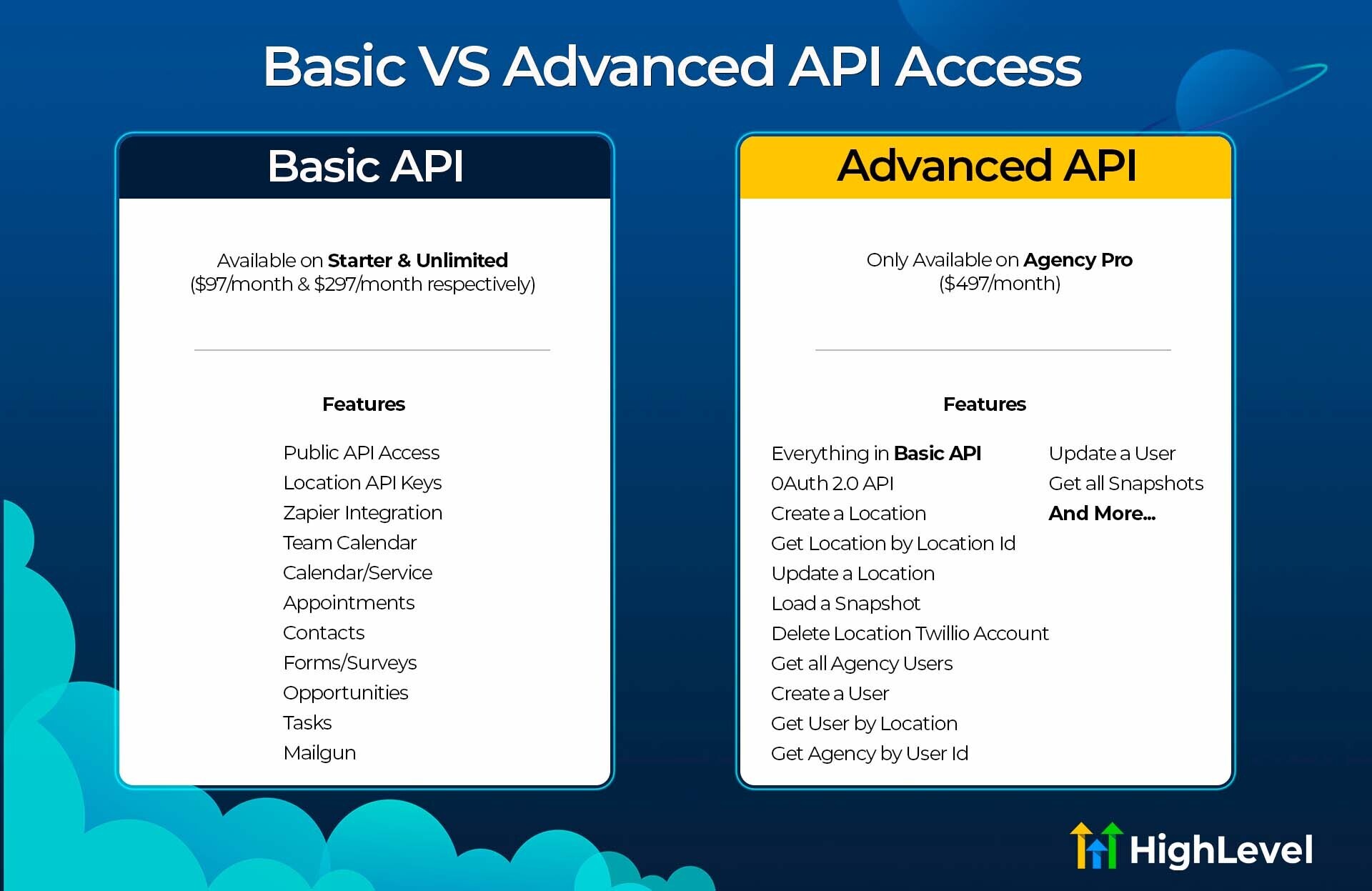
API access isn’t identical across all HighLevel plans. At a high level:
-
Starter & Unlimited plans
- Access to core APIs for working with a single Location.
- Ideal for getting started with one-off integrations and basic workflows.
-
Agency Pro plans
- Adds advanced API access, including OAuth 2.0 endpoints and agency-level tokens.
- Better suited for multi-location setups, Marketplace apps, or complex reporting.
From a growth perspective, this means:
- If you’re experimenting or building an internal integration, you can usually start with Starter/Unlimited.
- If you want to productize an integration or build something multi-tenant, plan on Agency Pro.
In addition to the future endpoints that will be released in our OAuth 2.0 API (which is only available in our Advanced API access), this tier unlocks the use of Agency API Keys, where lower plan levels only access Location API Keys.
If you’re still evaluating whether GoHighLevel is the right platform for your stack, you can test-drive it here while you explore the API surface area:
- Try GoHighLevel for free: [Removed link]
Rate Limits: How to Stay Reliable at Scale
HighLevel uses rate limits on its public V2 APIs to protect performance and stability. The two most important limits are:
-
Burst limit:
- Up to 100 requests per 10 seconds, per client (Marketplace app) per resource (Location or Company).
-
Daily limit:
- Up to 200,000 requests per day, per client per resource.
You’ll see rate limit information in response headers such as:
X-RateLimit-Limit-Daily– your daily limitX-RateLimit-Daily-Remaining– how many requests you have left todayX-RateLimit-Interval-Milliseconds– the time window for the burst limitX-RateLimit-Max– maximum requests in that time window
Practical design tips
To avoid unpleasant surprises in production, design your integration with these principles:
- Batch whenever possible – avoid firing one request per row when you can send data in chunks.
- Back off automatically – when you approach limits, slow down or temporarily queue work.
- Use idempotency patterns – design your requests so retries don’t create duplicates.
- Monitor headers – log rate limit headers so you can spot trends before they bite you.
Revset Labs often pairs API usage with background workers or queues so that marketing teams can run big campaigns without worrying about hidden API ceilings.
Typical Integration Patterns with the HighLevel API
Here are some of the most common and valuable ways teams use the HighLevel API in real projects:
1. Lead capture and enrichment
- Capture leads from custom landing pages or third-party tools.
- Send them into GoHighLevel as Contacts, tagged with source and campaign.
- Enrich those records with firmographic data or CRM info from other systems.
2. Cross-platform messaging
- Sync conversations between GoHighLevel and support tools or CRMs.
- Trigger HighLevel workflows when specific events happen in external apps.
- Keep SMS, email, and chat activity centrally logged.
3. Revenue and billing automations
- Connect payment processors or billing tools so that successful payments update HighLevel opportunities.
- Trigger post-purchase sequences or onboarding workflows automatically.
4. Central reporting and analytics
- Export contact, deal, and conversation data to a warehouse.
- Join GoHighLevel data with ad platforms, billing, and product analytics for a true full-funnel view.
If you’d rather skip the plumbing and focus on strategy, Revset Labs can spec, build, and maintain these integrations for you—using the HighLevel API as the backbone.
Support, Community, and How to Get Help
Because the API is powerful, the support model is intentionally focused on platform stability rather than custom coding help.
Here’s how support is structured:
-
Platform support (HighLevel Support)
- Ensures the platform and APIs are generally functioning.
- Does not provide hands-on coding, setup audits, or custom debugging for your integration.
-
Developer support portal
- Best path if you’ve double-checked your implementation and suspect a platform bug.
- Submit issues here: [Removed link]
-
Developer community (Slack)
- Active community of builders discussing patterns, workarounds, and ideas.
- Join here: [Removed link]
-
Developer Council Calls
- Monthly calls (usually the second-to-last Friday) where the HighLevel team shares updates and answers higher-level questions.
- Events calendar: [Removed link]
If you want more strategic or hands-on implementation help than the official channels provide, that’s exactly where an agency like Revset Labs fits in—we translate your business goals into a resilient technical design on top of GoHighLevel.
HighLevel API FAQs (Plain-Language Answers)
What is the HighLevel API used for?
The HighLevel API lets you send data into GoHighLevel, pull data out, and keep it in sync with the rest of your stack. You can create and update contacts, manage conversations, trigger workflows, sync bookings, and much more—without manual exports or CSV uploads.
Does HighLevel still support API V1?
V1 has reached end-of-support. Existing integrations can keep running for now, but they won’t receive fixes or improvements. All new work should target V2.
Which authentication method should I choose?
- Use Private Integration Tokens if you’re building for one account or for internal use.
- Use OAuth 2.0 if many different customers will connect their GoHighLevel accounts to your app.
What are the current HighLevel API rate limits?
For public V2 APIs using OAuth, the typical limits are:
- Up to 100 requests per 10 seconds per resource.
- Up to 200,000 requests per day per resource.
Always check the response headers in your environment, as limits may evolve over time.
Can HighLevel Support help me debug my integration?
Support can confirm whether the platform and APIs are up, but they won’t write or debug your code. For deep debugging, your options are:
- Working with your own developers or internal team.
- Collaborating with the HighLevel developer community.
- Partnering with a specialist team like Revset Labs to design, implement, and maintain your integration.
Turning API Power into Real Growth
The HighLevel API gives you the building blocks to automate more of your funnel, unify customer data, and create experiences that generic tools can’t match. But like any powerful tool, it pays to design things carefully.
Here’s a practical next step:
- If you’re still evaluating GoHighLevel, start a free trial and click around the API docs in parallel: [Removed link]
- If you already have an account and a clear use case, sketch the data flows you want between GoHighLevel and your other systems.
- When you’re ready for an expert build-out, bring in Revset Labs to architect and implement a solution that respects rate limits, handles auth the right way, and actually moves revenue—not just data.
When you combine a powerful platform like GoHighLevel with a well-designed API integration, you get compounding leverage: every new automation makes the next experiment easier, faster, and more profitable.