
Most marketers look at open and click‑through rates to judge whether their email strategy is working. But if your messages quietly land in the spam folder, your best copy and offers never even get a chance.

That’s where email deliverability comes in. It’s the discipline of making sure your emails reliably hit the inbox instead of disappearing into filters.
In this guide, you’ll learn how mailbox providers decide where to place your messages, what really drives sender reputation, and the practical steps to improve deliverability—especially if you’re sending from a platform like GoHighLevel.
What Is Email Deliverability (and Why It Matters)?
Email deliverability is the percentage of messages that successfully reach a subscriber’s inbox instead of being filtered to spam or blocked altogether.
It’s not the same as:
- Delivery rate – whether the receiving server accepted your email at all.
- Open rate – how many people opened the email after it landed.
- Click‑through rate – who interacted with your links.
Deliverability sits before all of those metrics. If your deliverability is poor, every other KPI is artificially low because people never see your message.
For businesses running campaigns, workflows, and transactional notifications inside GoHighLevel, good deliverability means:
- More leads actually get your nurture sequences.
- More customers see important billing, booking, and account emails.
- Less time chasing “I didn’t get the email” support requests.
If you’re just getting started, you can start a free GoHighLevel trial and implement the best practices in this article from day one.
How Mailbox Providers Decide Inbox vs Spam
Every major mailbox provider (Gmail, Outlook, Yahoo, iCloud, and others) is constantly asking three questions about your emails:
- Is this message safe?
- Is this message wanted by most subscribers?
- Is this message wanted by this particular subscriber?
If the answer to all three is “yes,” you land in the inbox. If any answer is “no,” you get filtered, throttled, or sent to spam.
Behind the scenes, providers look at signals like:
- Whether your domain is properly authenticated with SPF, DKIM, and DMARC.
- Your sender reputation based on historical behavior.
- How subscribers interact with your emails (opens, clicks, replies, spam complaints).
- The overall content and structure of your message.
Platforms like GoHighLevel handle the heavy lifting on infrastructure, but mailbox providers ultimately judge your domain and sending behavior. That’s what we’ll optimize next.
Sender Reputation: Your Email Credit Score
Your sender reputation is like a credit score for your domain and sending IPs. Mailbox providers maintain this score privately and update it in real time based on what they see you doing.
Positive signals that strengthen reputation:
- Consistently authenticated emails (valid SPF, DKIM, DMARC).
- High engagement: opens, clicks, and replies.
- Low hard‑bounce rates.
- Very few spam complaints.
- Stable send volumes over time.
Negative signals that damage reputation:
- Sudden spikes in send volume to cold or purchased lists.
- A lot of invalid addresses, bounces, or role accounts (info@, sales@, etc.).
- Frequent “Mark as spam” clicks.
- Using brand‑new or disposable domains just to send bulk mail.
Inside GoHighLevel, you can protect sender reputation by:
- Sending from a domain you actually own and use.
- Authenticating that domain with SPF, DKIM, and DMARC before you send a single campaign.
- Starting with your most engaged contacts and gradually ramping up volume.
When your infrastructure is ready, activate or upgrade your GoHighLevel account so your emails ride on a stable, deliverability‑friendly platform instead of a patchwork of tools.
Subscriber Engagement: The Strongest Deliverability Signal
Mailbox providers care most about how real people react to your messages. Engagement data tells them whether you’re a valued sender or just more noise.
High engagement looks like:
- People opening most of what you send.
- Regular clicks on your calls‑to‑action.
- Replies and forwards.
- Users dragging messages out of the spam folder into the inbox.
Low engagement looks like:
- Messages ignored or deleted without being opened.
- “Mark as spam” clicks.
- Large portions of your list that haven’t engaged in months.
You can’t fake engagement, but you can design your list, cadence, and content to encourage it.
1. List Health: Only Email People Who Want to Hear From You
A clean, permission‑based list is the foundation of good deliverability.
- Use explicit opt‑in. Only email contacts who have clearly requested messages from you. Avoid purchased or scraped lists entirely.
- Secure your forms. In GoHighLevel, pair forms with double opt‑in and tools like reCAPTCHA to stop bots and fake signups.
- Regularly prune unengaged contacts. If someone hasn’t opened or clicked in several months (the exact window depends on your send frequency), move them to a re‑engagement sequence or suppress them.
- Segment by engagement. Keep your most engaged subscribers at the core of your sends, and treat cold segments cautiously.
Healthy list = higher average engagement = better reputation.
2. Consistent Sending: Train Mailbox Providers to Expect You
Spiky, unpredictable sending patterns look risky to spam filters. Instead:
- Warm up new domains. Start with small, highly engaged segments and gradually increase volume.
- Pick a realistic cadence. For most brands, that means at least 1–4 campaigns per month plus essential automations.
- Avoid “email blasts.” Don’t go from zero to tens of thousands of sends overnight.
- Use GoHighLevel workflows. Let automations drip messages over time instead of blasting everyone on the same day.
Consistency signals that you’re a stable, trustworthy sender.
3. Content That Looks and Feels Legitimate
Even with perfect infrastructure and list hygiene, poor content can still trigger filters or user complaints.
- Write like a human, not a spam bot. Avoid ALL CAPS, extreme urgency, and shady promises.
- Keep a balanced layout. Use a healthy mix of text and images so the email still makes sense if images are blocked.
- Skip link shorteners. Many are associated with phishing. Link directly to your domain or trusted tools.
- Set clear expectations. Remind people why they’re receiving the email and what they’ll gain by reading.
- Invite real interaction. Ask subscribers to reply with a quick answer (“Reply with ‘YES’ if you want the checklist”) or click a simple poll.
GoHighLevel’s email builder makes it easy to create clean, mobile‑friendly templates. Combine that with clear copy and you’ll avoid most common content pitfalls.
If you’d rather have an expert set this up, Revset Labs—an AI automation and marketing agency—can design and implement deliverability‑friendly templates and automations for you inside GoHighLevel so you don’t have to guess.
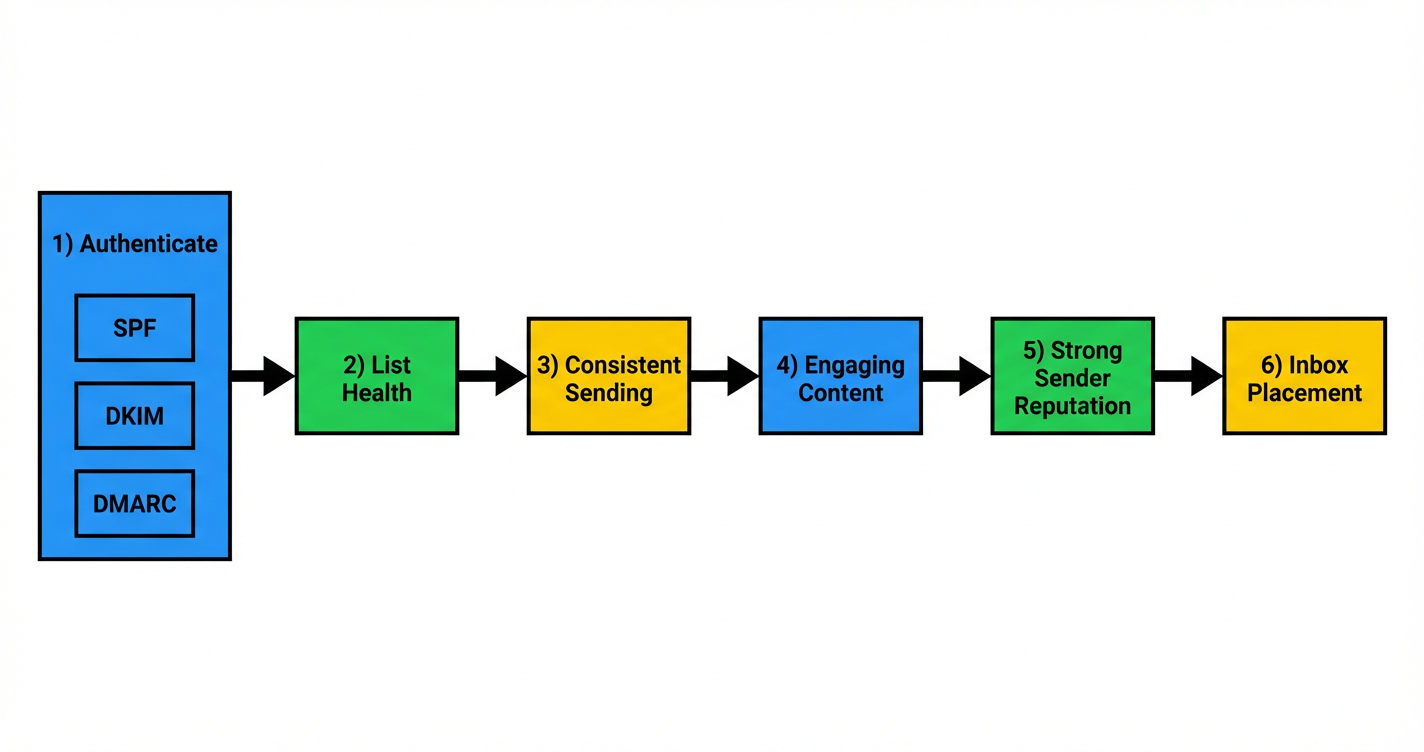
A Simple Email Deliverability Action Plan
To pull everything together, use this checklist as your starting point:
-
Authenticate your sending domain.
Set up SPF, DKIM, and DMARC records with your DNS provider and verify them inside GoHighLevel before sending any bulk email. -
Clean your existing list.
Remove hard bounces, role accounts, and clearly unengaged subscribers. Consider running older lists through a reputable email verification tool. -
Define a consistent sending schedule.
Decide how often each segment should hear from you (for example, weekly for active leads, monthly for customers) and build GoHighLevel campaigns and workflows around that cadence. -
Standardize on trustworthy templates.
Create a small library of tested templates that follow best practices: clear branding, scannable structure, balanced text‑to‑image ratio, and plain‑language copy. -
Monitor performance and adjust.
Watch open rates, click‑through rates, spam complaints, and bounce rates. If engagement slips, tighten your segments and refresh your content. -
Scale carefully.
As you see strong engagement and low complaints, gradually add more recipients and new automations rather than jumping straight to your full database.
When you’re ready to centralize everything—CRM, funnels, automations, and deliverability monitoring—run your campaigns through GoHighLevel instead of juggling separate tools.
Email Deliverability FAQs
What tools can I use to monitor my email deliverability?
Start with the analytics you already have: open rate, click‑through rate, bounce rate, and spam complaint data from GoHighLevel. If these drift in the wrong direction, your deliverability is likely slipping.
For deeper insight, you can layer in dedicated tools such as:
- Inbox placement and spam‑testing tools.
- Reputation monitors from providers like Mailgun or SendGrid (if you’re sending through them).
- DNS monitoring to make sure SPF, DKIM, and DMARC stay correctly configured.
The goal isn’t to collect more data for its own sake—it’s to spot problems early so you can correct them before mailbox providers lose trust.
How can I recover if my emails are going to spam or I’ve been blacklisted?
Recovery takes time, but it’s absolutely possible:
-
Identify the cause.
Check for authentication failures, high bounce rates, spam complaints, or a sudden jump in volume. -
Fix the underlying issues.
Correct your DNS records, clean your list, and stop emailing segments that never engage. -
Pause risky sending.
Temporarily stop broad campaigns and focus only on your most engaged subscribers. -
Gradually rebuild reputation.
Send highly relevant, high‑value messages to small, engaged segments and expand as metrics improve.
If you’ve been listed on a specific blacklist, follow their remediation process. Revset Labs can help you diagnose the problem, clean up your data, and rebuild a healthier sending strategy using GoHighLevel.
What role does engagement play in email deliverability?
Engagement is one of the strongest signals mailbox providers use. High engagement tells them:
- People recognize and trust your brand.
- Your content is valuable enough to open and click.
- Your messages deserve priority placement in the inbox.
Low engagement suggests the opposite. Over time, that can push even legitimate senders into the spam folder.
Design your strategy so that every message has a clear purpose, delivers real value, and makes it easy for subscribers to take a next step—whether that’s clicking through, replying, or confirming a preference.
Email deliverability isn’t a one‑time project. It’s an ongoing practice of protecting your reputation, respecting your subscribers, and sending messages people genuinely want. With the right setup in GoHighLevel—and, if you choose, a partner like Revset Labs helping behind the scenes—you can keep your campaigns landing exactly where they belong: the inbox.