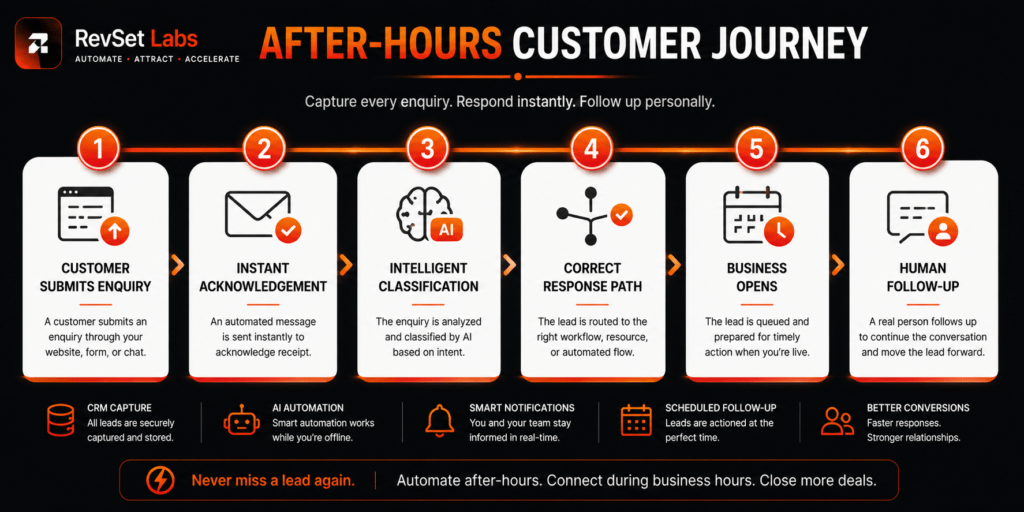
How to Build an After-Hours Lead Response System
Customer inquiries continue beyond 5:00 PM, even though the workweek for many service organizations ends at that time.
At night, a homeowner discovers a leaky pipe. A business owner requests an after-hours demo. On Sundays, someone who wants legal counsel fills out a form. These potential customers anticipate responses right away, not during business hours.
However, many companies still wait until the next working day to respond to inquiries made after hours.
Risk is created by that delay. Prospects may have moved on or chosen a different choice by the time you reply, as they continue to investigate rivals and the urgency wanes.
One of the most neglected operational gaps in service companies, according to RevSet Labs, is after-hours lead handling. Businesses spend a lot of money generating inquiries through content marketing, paid advertising, SEO, and referrals, but many lack a formal procedure for handling inquiries that come in after office hours.
Staffing your sales crew around-the-clock is not the goal.
The goal is to create a system that recognizes each inquiry, assesses its urgency, directs it correctly, and guarantees that no suitable opportunity is overlooked.
In this article, learn how to build an after-hours lead response system that keeps customer momentum alive with timely, consistent engagement beyond business hours. Discover how to balance automation with human follow-up to deliver a seamless experience, whether enquiries arrive on a Tuesday morning or a Sunday night.
Why After-Hours Leads Matter?
Because workers aren’t accessible to react right away, many organizations inadvertently perceive inquiries sent after hours as lower importance.
That’s not how customers view it.
From their point of view, contacting your company marks the start of their purchasing process rather than the start of your workday.
Whether a request is made at 11:00 AM or 11:00 PM, the customer wants assurance that the company will respond to them and be able to assist them in moving forward.
According to Twilio research, consumers are demanding more easy, fast communication across the platforms of their choice. A better customer experience may be achieved by establishing clear expectations and reacting regularly, even when firms might not offer round-the-clock human support.
Unnecessary ambiguity results from waiting till the following morning without acknowledgment.
Naturally, customers start asking themselves questions like:
- Did my inquiry get through?
- Does anyone keep an eye on requests?
- How much time will I have to wait?
- Should I get in touch with a different supplier instead?
Silence rarely answers those questions positively.
Rather, it makes room for rivals who react more quickly or just communicate more effectively.
But with RevSet Labs, we’ve found that a lot of missed chances aren’t brought on by poor marketing or low-quality leads in the service companies we engage with.
Uncertainty is the root of them.
Consumers don’t usually anticipate receiving a call right away at midnight.
They do, however, anticipate confirmation that their inquiry has been received, that its significance has been acknowledged, and that the following steps are well-defined.
Whether purchasing enthusiasm persists or starts to wane is sometimes determined by that tiny difference.
The Cost of Waiting Until Morning
It’s simple to think that answering the following business day is “good enough.”
Sometimes it is. Often it isn’t.
Customer expectations and urgency determine the impact.
For instance, even before speaking with someone, a homeowner experiencing a late-night water leak will probably get in touch with the first contractor who recognizes their request and establishes expectations.
A company owner who requests a CRM consultation on a weekend might not require a call right away, but they do anticipate a timeframe, a clear next step, and confirmation.
The benefit in both situations is clarity rather than merely speed.
Consumers are curious about:
- Their enquiry was received.
- What happens next?
- When will they hear back?
- That they don’t need to follow up again.
Until business hours restart, these little cues are frequently sufficient to uphold confidence and preserve the opportunity.
This is precisely where RevSet Labs usually intervenes. Using CRM processes, intelligent routing, and structured after-hours messaging, we assist companies in designing and implementing the solutions that automatically provide this clarity. Inquiries are immediately recognized, categorized by urgency, and put into a predetermined follow-up procedure rather than depending on human responses or hoping someone checks an inbox. This ensures that no lead is left unclear or ignored overnight.
The Most Common After-Hours Response Mistakes
Many organizations already have some form of after-hours process.
The problem is that those processes often focus on administration rather than customer experience.
Every Enquiry Receives the Same Automated Email
Customers may be reassured that the form was successful by a generic confirmation message, but it seldom explains what occurs next.
A person downloading a marketing book shouldn’t get the same reaction as someone requesting emergency plumbing.
Expectations vary depending on the type of inquiry.
No One Owns the Lead Until Morning
Many inquiries remain in a shared inbox until staff members start working.
Opportunities go unnoticed for hours when ownership is unclear.
Even if the human reaction takes longer, an efficient after-hours system allocates responsibilities right away.
Urgent Requests Are Not Identified
It is more likely that truly urgent consumers would encounter needless delays if all inquiries are treated similarly.
Instead, before directing requests into the proper process, companies should categorize them according to customer intent, service type, and urgency.
Customers Receive No Timeline
Giving clients clear expectations is one of the easiest ways to eliminate confusion.
For example:
“We appreciate you reaching out to us. After reviewing your request, our staff will get in touch with you by tomorrow at 9:00 AM. Please contact our emergency help line if this is an emergency.”
Confidence is produced by having clear expectations.
Customers are motivated to continue looking by uncertainty.
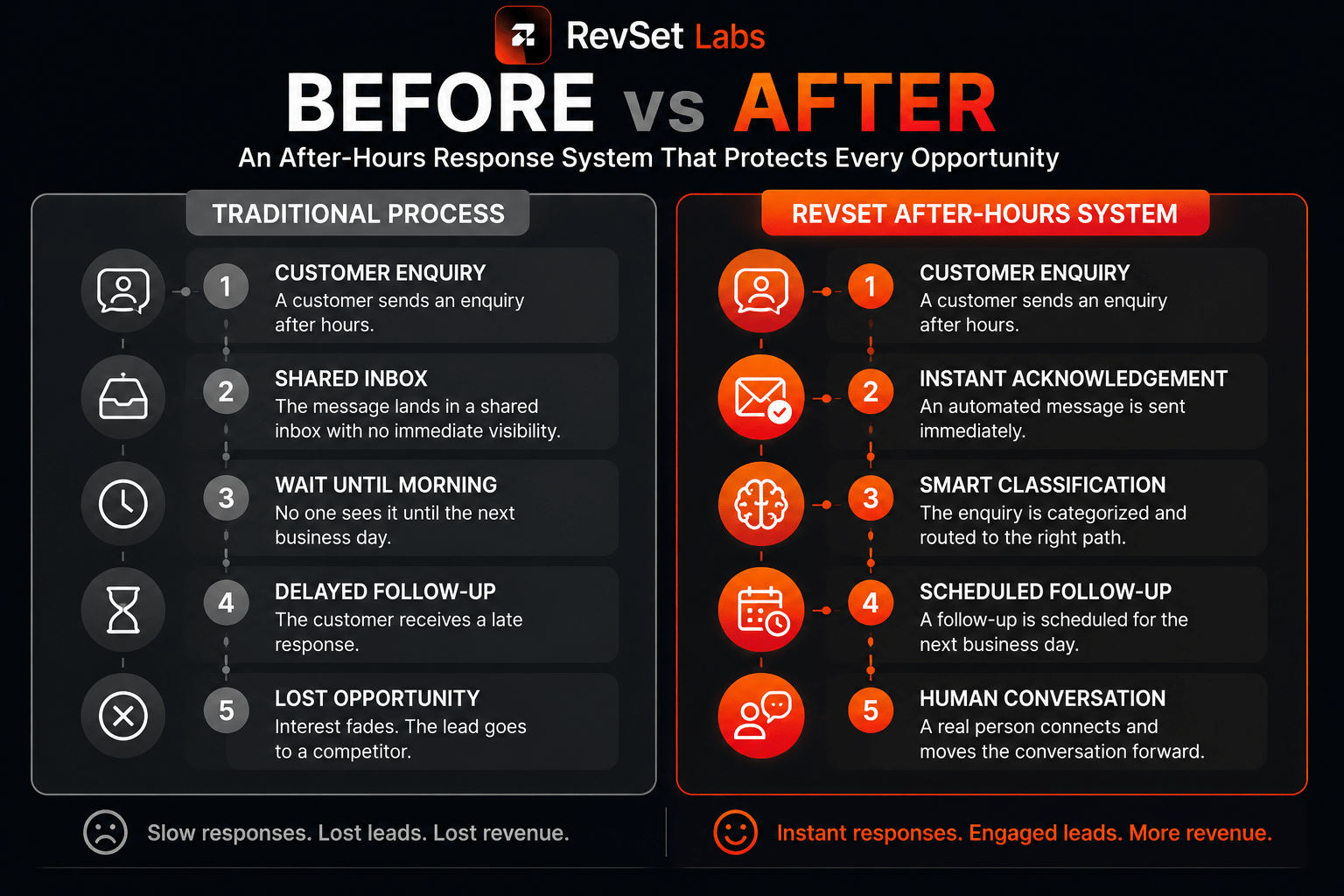
No Follow-Up Process Exists
Getting an inquiry is only the first step.
After-hours inquiries can quickly turn into Monday morning backlogs rather than qualifying opportunities in the absence of reminders, job assignments, and organized follow-up.
Instead of depending on memory or human tracking, an efficient system makes sure that every inquiry enters a predetermined process.
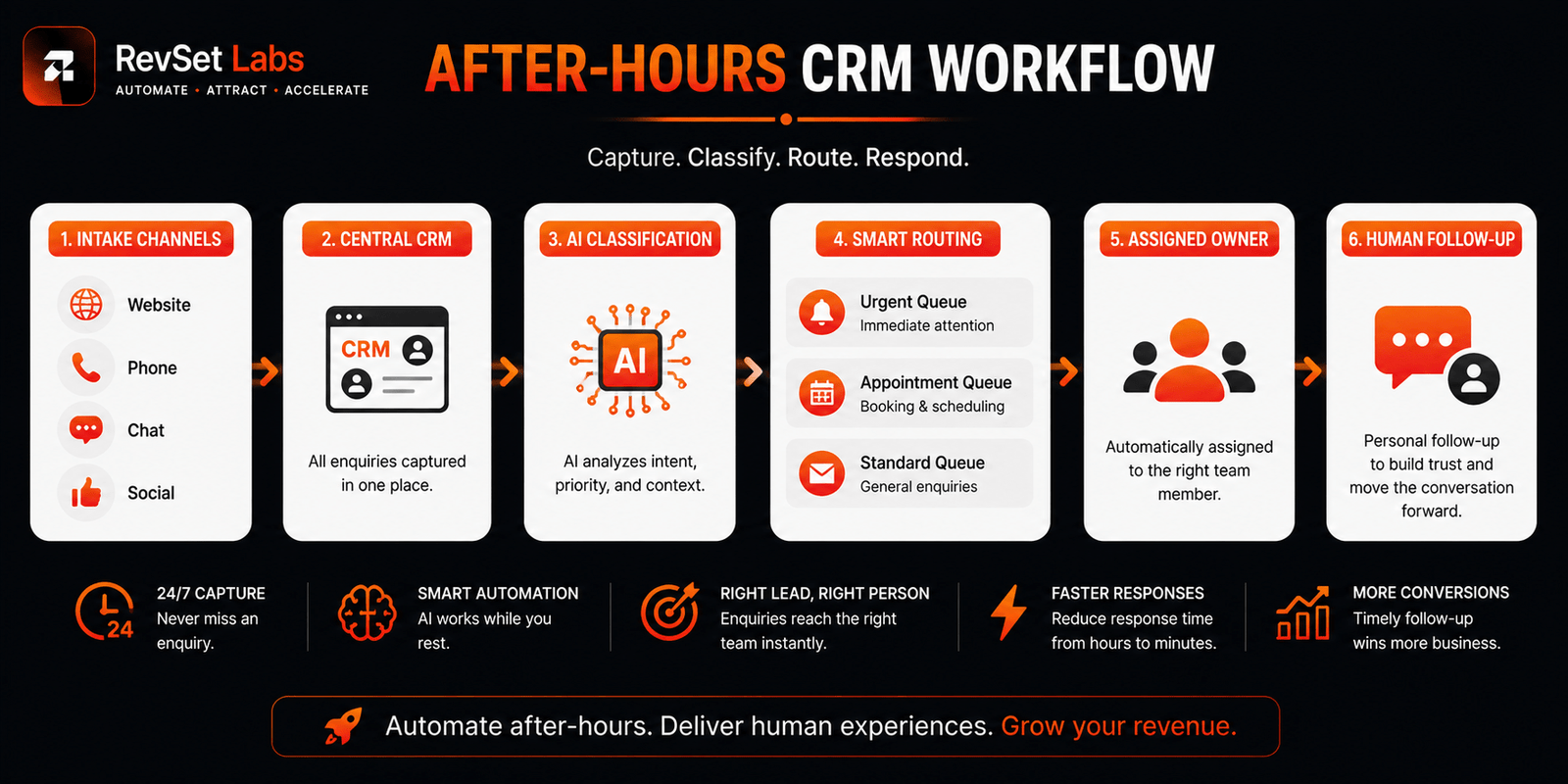
The RevSet Labs After-Hours Response Framework
Many companies believe that automation is the first step in developing an after-hours response system.
We at RevSet Labs have a distinct perspective.
Automation is just one aspect of the answer. Businesses must specify how various kinds of inquiries should be handled before choosing software or developing procedures. Automation just speeds up uncertainty in the absence of clear decision rules.
After each inquiry is received, an efficient after-hours lead response system should promptly respond to the following five questions:
- Is this an urgent inquiry?
- Is this a brand-new or current client?
- Can the issue wait until business hours?
- Who is responsible for the next action?
- What information is now necessary for the customer?
Every inquiry follows a predictable course rather than relying on who happens to check the inbox first when these queries are addressed consistently.
Step 1: Capture Every Enquiry in One Place
Visibility is the top priority.
Whether an inquiry originates via your website, Google Business Profile, Facebook Messenger, live chat, email, or a missed phone call is irrelevant. Opportunities will unavoidably be lost if those channels function independently.
Before implementing any automation, we at RevSet Labs advise directing all inquiries into a single CRM.
A centralized system provides a single viewing location for your team:
- Lead source
- Time obtained
- Customer information
- Requested service
- Level of priority
- Owner assigned
- Status of follow-up
This establishes accountability as soon as the inquiry is received.
One of the major operational advantages we notice isn’t faster replies; it’s decreasing uncertainty inside the business. One RevSet Labs customer, a multi-location service provider, noticed that when every enquiry entered a centralized system, teams no longer spent time asking, “Did someone already respond?” or “Who owns this lead?”
Step 2: Classify the Enquiry Automatically
Not every inquiry should follow the same procedure.
A consumer obtaining a brochure or downloading a price guide should not be in the same line as someone reporting a busted water pipe.
Rather, categorize inquiries according to their purpose and urgency.
Example Categories
Emergency Requests Examples:
- Plumbing leaks
- Electrical hazards
- HVAC failures
- Water damage
- Locksmith emergencies
High-Priority Sales Enquiries Examples:
- Quote requests
- Consultation bookings
- Demo requests
- Existing customer upgrades
Standard Enquiries Examples:
- General questions
- Pricing information
- Service availability
- Appointment requests
Low-Priority Requests Examples:
- Career enquiries
- Partnership opportunities
- Vendor outreach
- Marketing submissions
Once classified, each category should trigger its own workflow rather than following one generic process.
Step 3: Match the Response to Customer Expectations
Consumers don’t anticipate receiving the same response to every inquiry.
They do anticipate communication that takes into account how urgent their issue is.
For example:
A plumbing emergency client needs to know that assistance is on hand.
A request for legal advice requires confirmation that it has been received and that a representative will get in touch with them within business hours.
A calendar link and a precise response timeframe can be all that is required for a software demo request.
Thus, the answer should promptly address three questions:
- Your inquiry has been received.
- What follows is as follows.
- When will you hear from us?
That degree of clarity preserves purchasing momentum while lowering uncertainty.
Step 4: Build Different Workflows for Different Scenarios
Creating a single after-hours procedure for each client is a frequent error.
Rather, design processes according to the demands of the client.
Scenario 1: Emergency Service Request
Goal:
Reduce ambiguity instantly.
Recommended actions:
- Instant acknowledgement
- Emergency contact instructions
- Notify on-call technician (if appropriate)
- Record activities in CRM
- Schedule follow-up if immediate dispatch isn’t available
Scenario 2: Appointment-Based Business
Goal:
Continue the reservation procedure.
Recommended actions:
- Verify receipt of the inquiry
- Provide online scheduling
- Provide directions for preparation.
- Assign the owner of the appointment
- Inform employees before the start of operations.
Scenario 3: Professional Services
Goal:
Continue your purchasing momentum.
Recommended actions:
- Individualized recognition
- Describe the anticipated response time
- Distribute pertinent resources
- When applicable, provide calendar booking
- Automatically assign a consultant
Scenario 4: Existing Customer Support
Goal:
While controlling expectations, offer assurance.
Recommended actions:
- Verify receipt
- Set priorities according to the service agreement.
- Raise serious concerns
- Standard requests in a queue
- Inform the owner of the account
One general automated message is not as good for customers as several workflows.
Step 5: Define Ownership Before Business Opens
A query shouldn’t stay unassigned until staff begins work.
Ownership should be established automatically.
Every lead should include:
- Assigned employee
- Backup owner
- Level of priority
- Follow-up deadline
- CRM task
- Internal notification
This prevents Monday morning confusion and reduces the likelihood of qualified opportunities sitting untouched.
Leads were being immediately collected and recognized in a recent RevSet Labs installation for a multi-location home services provider, but conversions remained low because of a lack of ownership. Intent decreased as a result of after-hours inquiries not being allocated to a responsible team member until the following day.
In order to automatically categorize urgency and send each lead to an on-call owner with clear next actions, we changed the process. Without raising ad spending, this resulted in a discernible rise in after-hours reservations and a decrease in missed follow-ups.
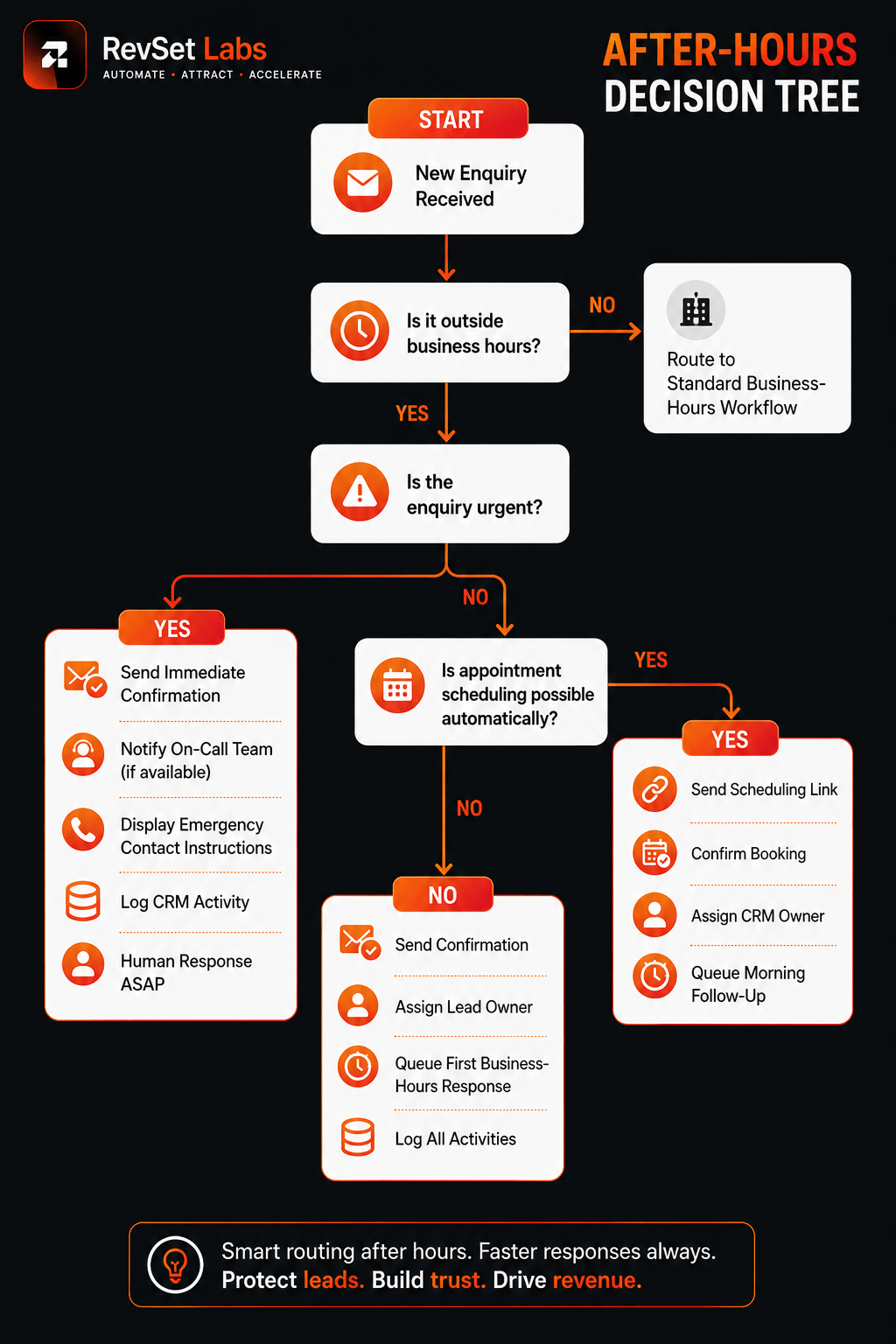
Decision Tree for Nights, Weekends & Urgent Enquiries
Instead of depending solely on human judgment, every after-hours inquiry should follow a predetermined decision path.
The following framework illustrates how RevSet Labs recommends routing enquiries outside normal business hours.
Implementing Your After-Lead Response System
Adding extra software is not the goal of developing an after-hours lead response system.
After-Hours Lead Response involves developing a repeatable procedure that guarantees each inquiry gets the appropriate answer, reaches the appropriate person, and proceeds through the customer journey even when your office is closed.
At RevSet Labs, we’ve discovered that the most prosperous companies don’t use a single solution. Rather, they integrate intelligent routing, unambiguous ownership, organized follow-up, and CRM automation into a single, integrated operational system.
The procedure is aided by technology.
The result is determined by the method.
Use Automation to Remove Delays, Not Conversations
Automation should eliminate repetitive administrative tasks, so your team can focus on meaningful customer interactions.
Additionally, industry guidelines recommend that automation be used to increase operational efficiency rather than to replace client connections. Salesforce advises automating monotonous lead management tasks so that sales teams may focus less on administrative tasks and more on having meaningful discussions with customers.
RevSet Labs frequently witnesses companies approaching automation with the worry that technology would completely replace human interaction or depersonalize their customer experience.
In practice, the opposite is true.
Automation, when used properly, preserves human interaction rather than eliminating it. After-Hours Lead Response guarantees that your staff has the time, context, and mental space to have more meaningful, individualized interactions from the very first engagement by managing routine administrative tasks in the background.
Your team begins each day with clarity, organization, and total visibility over what needs to be addressed rather than responding to haphazard incoming inquiries.
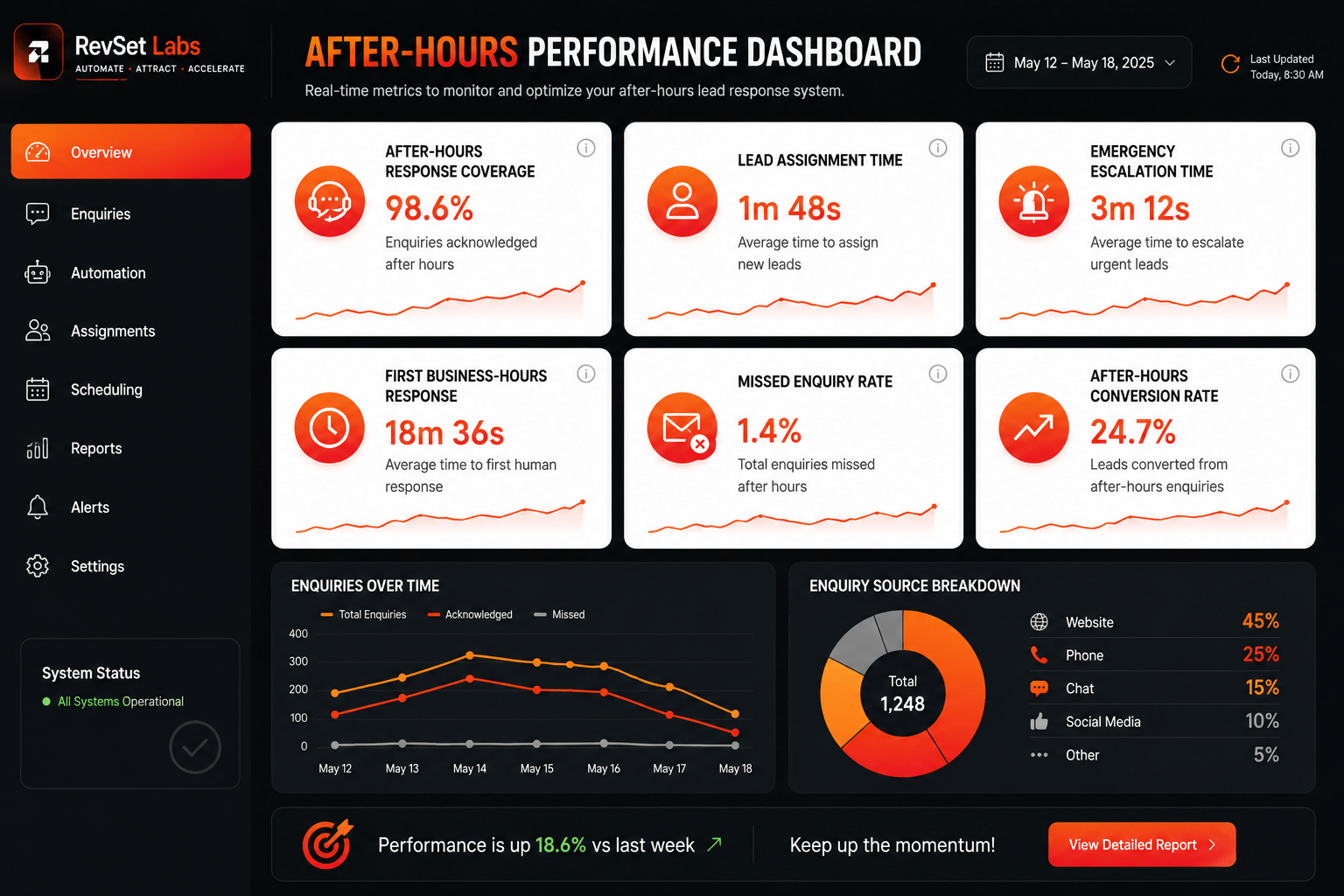
KPIs That Measure After-Hours Performance
Many businesses only monitor response time. While important, response time alone doesn’t reveal whether the system is actually working. RevSet Labs measures operational performance using several complementary KPIs.
| KPI | Measures |
| After-Hours Response Coverage | Percentage of after-hours enquiries receiving an immediate acknowledgement. |
| First Business-Hours Response Time | Measures how quickly meaningful human engagement begins after reopening. |
| Lead Assignment Time | Indicates how efficiently ownership is established. |
| Emergency Escalation Time | Measures response speed for urgent enquiries requiring immediate action. |
| Lead-to-Appointment Rate | Evaluates whether after-hours enquiries continue progressing through the sales process. |
| Missed Enquiry Rate | Identifies opportunities that never received follow-up. |
| After-Hours Conversion Rate | Compares the performance of after-hours enquiries against business-hours enquiries. |
These metrics provide a more complete picture than response time alone and help identify where improvements are needed.
RevSet Labs Perspective
Working with service companies has taught us many important truths, one of which is that clients demand confidence rather than perfection.
When a consumer submits an inquiry at 10:00 PM, they are aware that they might not get a response from a professional right away. They don’t want to be unsure of whether their request has been accepted or what will happen next.
It’s not always the case that companies with round-the-clock sales teams convert more after-hours inquiries.
They are the ones with well-defined operational processes that automatically allocate responsibility, prioritize the most important things, address every inquiry, and start meaningful discussions as soon as business resumes.
For this reason, we advise companies to consider alternatives to autoresponders.
A single automation is insufficient for an efficient after-hours lead response system. From the time an inquiry is received until a member of your team takes over, it is a synchronized operational structure that safeguards buying momentum.
FAQs
1. What is an after-hours lead response system?
An organized procedure for handling client inquiries received beyond regular business hours is known as an after-hours lead response system. The system recognizes the inquiry, determines its urgency, assigns ownership, and plans the necessary follow-up rather than waiting until the following working day. This keeps eligible chances from being missed and preserves client confidence.
2. Why is an after-hours lead response system important?
Because they have more time to look for alternatives, customers frequently send inquiries on the weekends, holidays, and in the nights. Businesses run the danger of losing purchasing momentum as prospects continue to compare rivals if they don’t have a clear response procedure. Until a team member can carry on the discussion, an efficient after-hours mechanism helps sustain participation.
3. Should every after-hours enquiry receive an immediate phone call?
Not always. The sort of service being asked and the urgency of the inquiry determine the suitable answer. While appointment requests or consultation inquiries may frequently be handled with an acknowledgement message, a clear response timetable, and a planned follow-up during office hours, emergency inquiries may necessitate rapid escalation.
4. Can automation replace an after-hours sales team?
Automation can increase productivity, but it shouldn’t take the place of human knowledge. When it comes to creating CRM tasks, scheduling appointments, routing leads, and recognizing inquiries, automated processes function well. However, seasoned team members are still best suited to manage relationship-building, technical help, and intricate sales interactions.
5. How can I identify urgent enquiries after business hours?
Business should establish precise qualifying standards according to the services they offer. While ordinary inquiries, price requests, or appointment reservations may often wait until the next business day, emergency repairs, safety concerns, or clients with key service agreements may need to be escalated right away. Every inquiry is guaranteed to follow the proper process thanks to a decision tree and pre-established routing rules.
6. What tools are needed to build an after-hours lead response system?
With a CRM, marketing automation platform, online scheduling tool, communication software, and internal notification system, the majority of organizations can create a successful after-hours procedure. While technology plays a significant role, long-term success also depends on well-defined workflows, ownership, and follow-up procedures.
7. What is the biggest mistake businesses make with after-hours enquiries?
Treating every inquiry in the same way is one of the most frequent errors. The urgency, motive, and expectations of customers vary. A bad customer experience is frequently produced when the same automatic response is sent to each inquiry. Inquiries should be categorized and routed via a structured system based on their business effect and importance.
8. How often should an after-hours lead response system be reviewed?
As customer expectations and business operations change, an after-hours response system should be routinely assessed to make sure procedures continue to be successful. To find bottlenecks, enhance response consistency, and maximize lead conversion, RevSet Labs track key performance indicators every week, testing automation and routing rules every month, and carrying out a more comprehensive operational review every quarter.
Final Thoughts
Being accessible around-the-clock is not the goal of an after-hours lead response system.
It’s about making sure that every customer inquiry is handled, according to a defined procedure, and proceeds even when your office is closed.
Companies frequently believe that inadequate lead volume or bad marketing are to blame for missed chances. Operational gaps sometimes have a far greater impact in practice. Long before a sales interaction starts, a customer’s momentum might be halted by an unanswered question, an unassigned lead, or an unclear follow-up procedure.
Instead of seeing after-hours response as a stand-alone automation project, RevSet Labs advise companies to consider it as a component of their entire revenue operations strategy. The goal is to establish a dependable procedure that seizes every chance, lowers uncertainty, and provides your team with a better foundation for the upcoming workday.
Over time, purchase intent is safeguarded by consistency rather than continual availability.
How RevSet Labs Improves After-Hours Lead Response Systems
At RevSet Labs assisted companies in the trades, professional services, and home services sectors in changing the way they respond to after-hours inquiries, frequently retrieving leads that were previously completely overlooked.
In recent client installations, automatic acknowledgement and intelligent routing have reduced after-hours response times from many hours (or the next business day) to less than two to three minutes. In one instance, a service company used CRM-based assignment criteria and organized follow-up procedures to recover more than 18% of previously unreached after-hours leads.
Our strategy integrates response monitoring, intelligent lead routing, AI-powered automation, CRM optimization, and organized follow-up into a single, interconnected operational framework. Businesses get a process that records every inquiry, categorizes urgency, assigns ownership automatically, and keeps opportunities moving ahead rather than depending on shared inboxes, human assignment, or disjointed communication channels.
We don’t think every company need a sales force that works around the clock.
Every company, in our opinion, requires a system that assures no legitimate inquiry is missed, removes needless delays, and instills trust in consumers.
Build an After-Hours System Before You Buy More Leads
A faulty follow-up procedure cannot be fixed by increasing traffic.
Consider what happens to the inquiries you already receive after business hours before boosting your advertising budget or spending more money on lead creation.
Without needing more marketing expenditure, an organized after-hours lead response system may enhance consumer satisfaction, safeguard purchasing momentum, and boost conversion prospects.
The RevSet Labs Revenue Leak Scorecard may be used to assess your present processes, find operational holes in your lead management process, and find useful possibilities to enhance conversion performance and response consistency.