

Turn HighLevel websites into a repeatable revenue stream instead of one-off custom builds. This guide walks you through how to package, price, and sell HighLevel websites as a scalable offer—without turning your agency into a custom development shop.
What You’re Actually Selling With a HighLevel Website
Most agencies pitch “a new website.” That sounds like a time-consuming, custom project—and prospects immediately start worrying about scope creep, timelines, and cost.
With HighLevel, you’re not just selling a website. You’re selling:
- A conversion-focused marketing system (pages, funnels, forms, calendars, automations).
- A faster way to launch new campaigns without developers.
- A platform the client can grow into—email, SMS, pipelines, workflows, reporting, and more.
Position your offer as a revenue system built on GoHighLevel rather than a one-off web build. That’s what justifies recurring revenue and keeps you out of the custom-dev trap.
If you don’t already have a GoHighLevel account, you can start a free GoHighLevel trial here and follow along as you package your website offer.
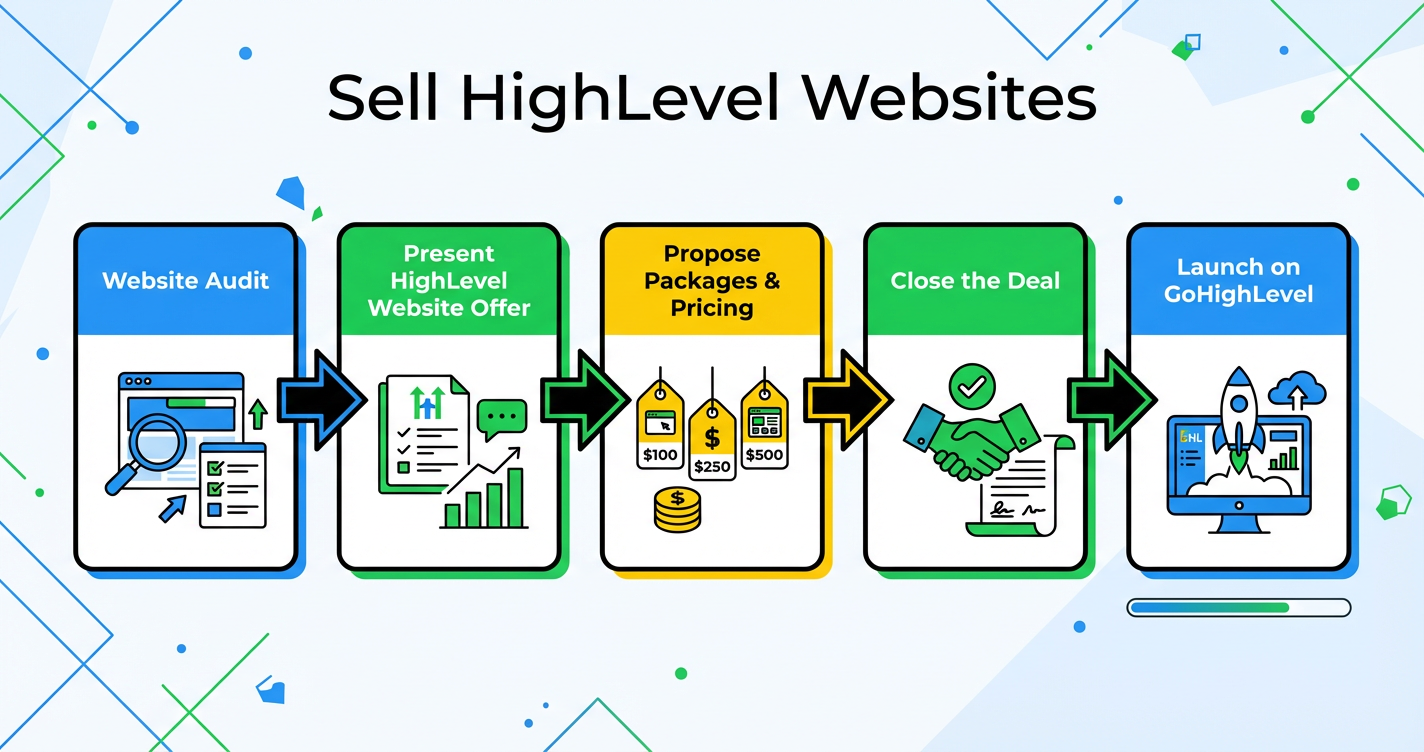
Step 1: Run a Strategic Website Audit
Before you pitch anything, you need context. A structured audit lets you uncover gaps you can fix with a HighLevel website and funnel.
Use questions like these in your discovery or audit call:
- What’s the primary goal of your website right now? (Leads, bookings, purchases, applications?)
- How are you capturing leads today? Forms, chat, calls, calendars, or none of the above?
- What happens after someone becomes a lead? Is there a follow-up sequence, or do leads sit in an inbox?
- Which traffic sources matter most to you? Organic, paid, social, referrals, offline?
- How are you tracking performance today? Do you know your conversion rate from visitor → lead → customer?
As you ask these questions, highlight problems that a HighLevel site can solve:
- No clear call-to-action on key pages.
- Leads disappearing in email instead of entering a pipeline.
- No automated email/SMS follow-up.
- No online booking or payment options.
Finish the audit by summarizing the gap:
“Right now your website is basically a brochure. A HighLevel website would turn it into a lead and revenue engine that captures, nurtures, and tracks every opportunity for you.”
This sets the stage for your offer and makes the prospect want a more systemized solution.
Step 2: Present Your HighLevel Website Offer
Next, present a clear, productized offer instead of a technical feature list.
Anchor your pitch around outcomes:
- Higher conversion rates with dedicated landing pages and funnels.
- Fewer no-shows thanks to integrated calendars, reminders, and confirmations.
- Faster follow-up via automated email and SMS sequences.
- Clearer reporting so they can see which campaigns and pages are printing revenue.
A simple way to explain the stack is:
- Front-end: A modern, branded website or funnel hosted on GoHighLevel.
- Back-end: Pipelines, automations, and tracking attached to every form and call-to-action.
- Support layer: Your agency’s strategy, optimization, and ongoing improvements.
You can even reference GoHighLevel’s own documentation as proof of concept—for example, the original guide on how to sell HighLevel websites.
Right after showing this value stack, invite a decision:
“If we built this for you, using GoHighLevel under the hood, would that solve the issues we uncovered in the audit?”
When they say yes, you transition into packages and pricing.
If you don’t have a GoHighLevel account yet, now is a great moment to spin up your free trial so you can demo live pages and funnels during your call.
Step 3: Package and Price Your HighLevel Websites
You want clear, tiered packages instead of custom quotes for every prospect. Keep your scope tight and predictable so you can deliver consistently.
A simple starting framework:
-
Launch Package
- 1–3 core pages (Home, Services, Contact/Booking) or a single funnel.
- Basic on-page SEO and mobile optimization.
- Lead capture forms connected to a HighLevel pipeline.
- Simple email/SMS follow-up sequence.
- One round of design revisions.
-
Growth Package
- Everything in Launch.
- Additional pages or funnels for specific offers.
- A/B-tested lead capture sections.
- Multi-step nurturing sequences (e.g. education + offer + deadline).
- Monthly optimization and reporting.
-
Scale Package
- Everything in Growth.
- Advanced automations (win-back, reactivation, missed-call text back, etc.).
- Integrated online payments, subscriptions, or memberships.
- Quarterly strategy workshops.
Pricing will depend on your niche and positioning, but a common pattern is:
- Build fee: A one-time project fee for initial strategy, build, and launch.
- Platform + service retainer: A monthly fee that covers GoHighLevel plus your ongoing optimization and support.
Important: your build fee should reflect a repeatable process, not bespoke dev work. You are re-using proven HighLevel templates and workflows, then customizing copy and branding.
For deeper inspiration on packaging the tech side, you can later link to guides like “Getting Started: Launch a Website From a Template in GoHighLevel” or “Getting Started: Migrate a WordPress Site to GoHighLevel” once those posts are live on your site.
Step 4: Close the Deal Without Becoming a Dev Shop
When it’s time to close, keep the focus on business outcomes and your productized process—not technical edge cases.
A simple close script:
“Based on everything we covered, the [Package Name] is the best fit to hit your lead and revenue goals. The build fee is $X, then $Y/month for hosting, automations, and ongoing optimization on GoHighLevel. Are you ready to get this in motion?”
If they hesitate, come back to:
- The cost of leads slipping through the cracks today.
- The value of having a single system that captures, nurtures, and tracks.
- The fact that you’re not just launching a site—you’re setting up a growth platform.
Avoid custom promises like “Yes, we can build anything you want.” Instead, stay inside the boundaries of your packages:
- Offer add-ons (extra pages, integrations, custom workflows) as separate line items.
- Use a simple change-order process if they want to expand scope.
Because HighLevel gives you reusable templates, snapshots, and automations, you can confidently promise results without writing custom code for every project.
Step 5: Launch the Website on GoHighLevel
Once the client signs, your delivery process should be straightforward and repeatable.
A simple launch checklist:
- Clone your proven HighLevel snapshot or website template.
- Update branding (logo, colors, fonts, images, copy).
- Wire up forms, calendars, and CTAs to the correct pipeline and workflows.
- Configure email/SMS sequences and notification settings.
- Set up basic analytics and goal tracking.
- Run a full QA pass on mobile and desktop.
- Soft launch to a small segment, then roll out fully.
From here, you can plug into other HighLevel-powered systems:
- Reactivation campaigns and nurture sequences.
- Payment links and recurring subscriptions.
- Online courses or membership areas.
You can even reference your own implementation guides—such as launching a website from a template or migrating a WordPress site into GoHighLevel—to standardize your team’s process.
Whenever you want to test new funnels or offers, you already have the infrastructure in place. That’s the value of selling HighLevel websites instead of static builds.
If you’d like a guided setup, you can start your own GoHighLevel trial through this partner link, then follow this checklist as you launch your first client site.
How Revset Labs Can Help You Productize HighLevel Websites
Revset Labs is an AI automation and marketing agency that helps teams turn GoHighLevel into a predictable revenue engine.
For agencies and consultants, we can help you:
- Design and document your HighLevel website packages.
- Build reusable snapshots for different niches.
- Wire in automations, follow-up sequences, and reporting.
- Optimize funnels based on real conversion data.
Instead of figuring all of this out from scratch, you get a scalable offer you can roll out across multiple clients.
If you’d rather focus on sales conversations while someone else builds the systems, Revset Labs can help you implement the exact kind of HighLevel website offer described in this article.
Your Next Steps
If you’re serious about selling HighLevel websites without becoming a custom dev shop:
- Use the audit questions above on your next sales call.
- Turn your delivery process into 2–3 clear packages.
- Standardize your launch checklist inside GoHighLevel.
- Layer on automations and reporting so clients can see the ROI.
When you’re ready to move, you can:
- Start a free GoHighLevel trial with our partner link and build your first productized website offer.
- Talk to Revset Labs about done-with-you or done-for-you implementation so you can scale this offer faster.