
Texas raised the bar on SMS compliance with Senate Bill 140 (often called the Texas “mini‑TCPA”). If you text Texas residents about offers, discounts, events, or promotions, those messages can now be treated like phone solicitations—with new rules around registration, bonding, and disclosures.

GoHighLevel’s Texas SMS Safeguard – One‑Toggle Block for SB 140 gives you a simple, technical safety net: flip a switch and automatically block non‑exempt marketing SMS to Texas numbers from your account while you get your compliance house in order.
This guide walks you through what SB 140 changes, how Texas SMS Safeguard works inside GoHighLevel, and the practical steps you should take so your SMS strategy stays both effective and compliant.
If you’re not yet on GoHighLevel and need an all‑in‑one CRM, funnel, and SMS platform that actually ships compliance features like this, you can start a free GoHighLevel trial here.
What Changed Under Texas SB 140 for SMS Marketing
Texas SB 140 expands the definition of “telephone solicitation” to explicitly include SMS and MMS marketing messages sent to Texas residents.
In practice, that means:
- Many marketing texts are now regulated like traditional telemarketing calls.
- Businesses may need to register with the Texas Secretary of State, pay an annual fee, and post a security bond before sending marketing texts to Texas residents.
- You must be able to show prior express written consent (PEWC) for automated marketing texts.
- Messages must include clear identification, promotional disclosure, and opt‑out instructions (for example, “Reply STOP to unsubscribe”).
- You’re expected to respect quiet hours when sending solicitations to Texas residents.
SB 140 doesn’t ban SMS marketing—but it does turn “casual” SMS campaigns into something that needs a structured compliance plan.
What Is the Texas SMS Safeguard One‑Toggle Block in GoHighLevel?
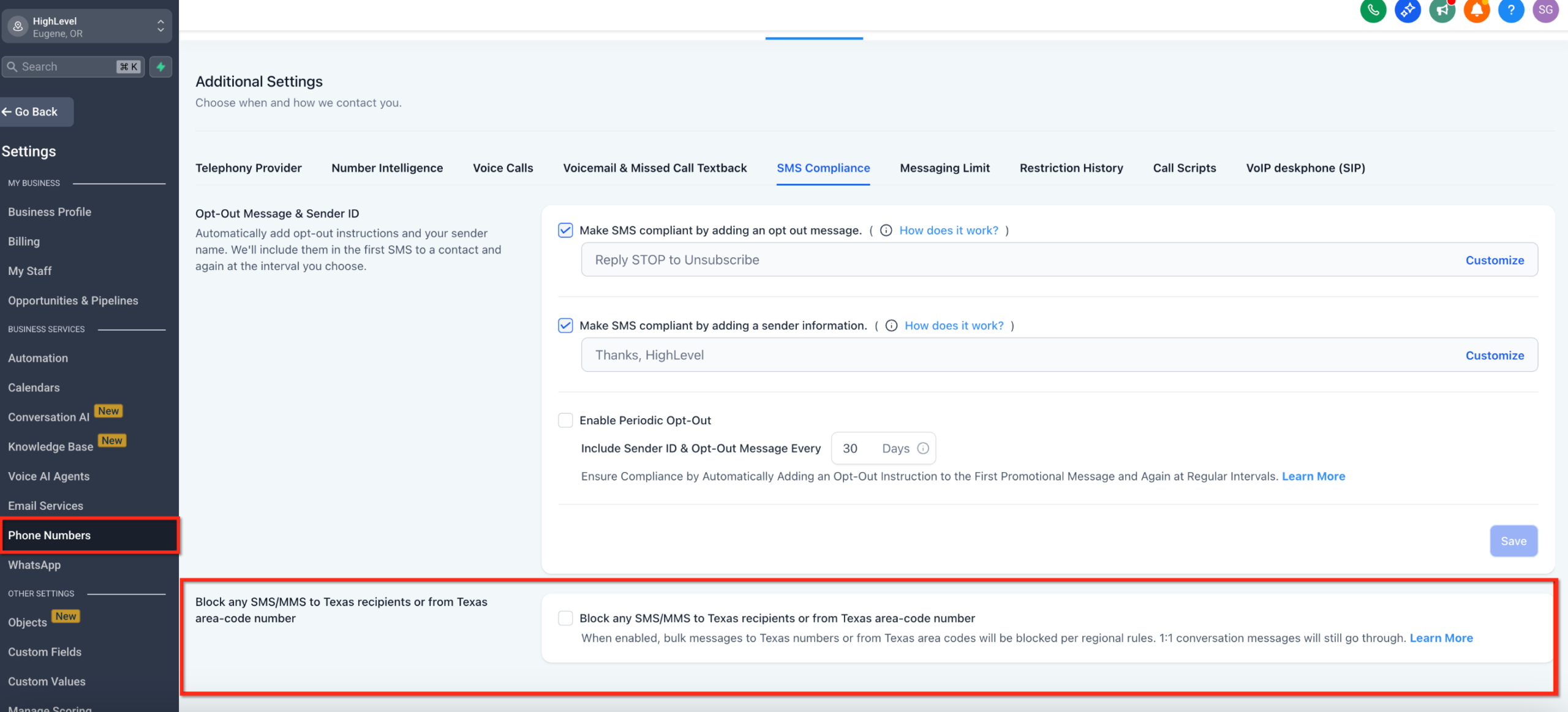
Texas SMS Safeguard is a GoHighLevel feature that helps you technically enforce a safer posture under SB 140.
When you enable the one‑toggle block:
- GoHighLevel will block outbound marketing SMS to contacts whose phone numbers are identified as Texas numbers (for example, via area code or other carrier data), unless they fall under an exemption.
- Your existing workflows, campaigns, and bulk sends will fail fast for those Texas recipients instead of silently going out and creating risk.
- You can keep running your broader SMS strategy while you figure out registration, bonding, exemptions, and consent for Texas contacts.
Think of it as a circuit breaker for Texas marketing SMS. You stay in control of your strategy, but you give your team a hard guardrail while legal and compliance details are being finalized.
If you’re evaluating tools and want this kind of built‑in compliance support from day one, consider trying GoHighLevel with this free trial link.
Who the Texas SMS Safeguard Applies To
SB 140 is aimed at businesses sending marketing or solicitation texts to Texas residents—including:
- Local businesses running promotions (“20% off this weekend, reply YES to claim”).
- Agencies sending SMS campaigns on behalf of clients.
- SaaS and membership businesses with promo sequences that hit Texas area codes.
Importantly:
- It doesn’t matter where your business is located—what matters is that the consumer is in Texas.
- Conversational, one‑to‑one replies that aren’t solicitations are generally treated differently from automated marketing blasts, but you should still speak with counsel about your specific use cases.
Texas SMS Safeguard in GoHighLevel focuses on campaign‑style and automated sends where compliance risk is highest, not every possible human‑typed message.
Key Benefits of Using Texas SMS Safeguard in Your Account
Turning on Texas SMS Safeguard gives you several advantages:
- Immediate risk reduction – You can pause outbound Texas marketing SMS with a single toggle while you work through registration, bonding, and consent updates.
- Technical enforcement, not just policy – Instead of relying on team memory (“don’t text Texas”), the platform enforces the rule for you.
- Cleaner audit trail – You can show that you took active steps to block potentially non‑compliant SMS campaigns to Texas numbers.
- Protection for agencies – If you manage multiple client sub‑accounts, you can reduce the chance that a single client’s campaign creates exposure for your whole book of business.
- More focused compliance work – With the safeguard on, you can concentrate on fixing data, consent, and legal gaps without worrying about campaigns slipping through in the meantime.
For many businesses, this toggle is the difference between “hoping” they’re compliant and being able to prove they’re doing something concrete.
Texas SB 140 Exemptions: Are You Covered?
SB 140, like other telemarketing and mini‑TCPA style laws, includes narrow exemptions. Depending on the final rulemaking and interpretation, exemptions may include (examples, not legal advice):
- Certain non‑profit or charitable organizations.
- Political or public safety messaging.
- Some contacts where there is a pre‑existing business relationship and the content is not promotional.
- Purely transactional updates, such as appointment reminders, password resets, or order confirmations.
You should not assume you’re exempt just because you “know” your customers or your messages feel helpful. Whether an exemption applies is a legal question, and the safest path is to:
- Map out every type of SMS you send.
- Label each one as marketing, mixed, or transactional.
- Ask your attorney or compliance advisor which buckets qualify for exemptions under SB 140.
GoHighLevel will not determine your exemption status for you—it simply gives you tools to enforce the decisions you make.
If You’re Not Exempt: What Changes for Your SMS Strategy?
If your SMS campaigns don’t clearly fit into an exemption, you’ll likely need to:
- Register with the Texas Secretary of State and, if required, post the applicable security bond.
- Tighten consent flows to capture clear prior express written consent specifically for marketing texts.
- Update templates to include sender identification and opt‑out instructions.
- Respect quiet hours for Texas time zones.
- Segment Texas contacts so you can treat them differently if needed.
Texas SMS Safeguard in GoHighLevel then becomes your enforcement layer: you can keep the block on for non‑exempt marketing campaigns until everything above is implemented and verified.
If you’d rather not design all of this alone, Revset Labs can help you re‑architect funnels and automations so they’re both profitable and compliant. We specialize in AI‑powered marketing systems on top of GoHighLevel.
Legal and Business Risks of Ignoring SB 140
Choosing to “wait and see” on SB 140 can create serious downside:
- Regulatory penalties – Fines and enforcement actions for unregistered or non‑compliant solicitations.
- Class‑action exposure – TCPA‑style laws are often enforced via lawsuits from consumers or law firms.
- Carrier filtering and deliverability issues – Carriers are increasingly aggressive about blocking or throttling traffic they consider risky.
- Brand damage – Being known as the brand that “spammed Texans” is hard to undo.
Texas SMS Safeguard doesn’t make you lawsuit‑proof, but it does demonstrate that you are taking concrete steps to reduce outbound risk while you work through the rest of your compliance program.
What Existing GoHighLevel Customers Should Do Right Now
If you already run SMS in GoHighLevel, here’s a practical playbook:
-
Confirm your exposure
Pull a quick report or list of contacts with Texas area codes or Texas addresses. Estimate how much of your SMS volume touches Texas. -
Inventory your campaigns and workflows
List every automation, campaign, and bulk send that could be hitting those contacts—especially:
- Promo blasts
- Flash sales
- Nurture sequences
- Re‑activation campaigns
-
Turn on Texas SMS Safeguard (see setup section below)
This acts as your immediate guardrail while you review legal obligations. -
Clean up consent and data
Make sure forms, funnels, and lead sources are collecting clear SMS marketing consent and storing it against the contact record. -
Update copy and quiet‑hour logic
Refresh your messaging to include brand identification and opt‑out language, and adjust send times to respect Texas quiet hours. -
Decide what can be re‑enabled
Once you’ve registered (if required) and tightened consent, work with counsel to determine which campaigns can resume for Texas contacts.
If you’d like a partner to audit your current GoHighLevel setup and rebuild it for SB 140 era compliance, Revset Labs can handle the strategy, funnels, and automations end‑to‑end.
What HighLevel Handles vs. What Stays Your Responsibility
Texas SMS Safeguard is powerful, but it’s not a replacement for a compliance program.
GoHighLevel helps you by:
- Providing a one‑toggle block for outbound marketing SMS to Texas numbers.
- Giving you tools to segment contacts, manage DNC status, and add opt‑out language.
- Supplying a documented feature you can reference when explaining your technical controls to stakeholders.
You are still responsible for:
- Determining whether you must register and post a bond under SB 140.
- Deciding whether each campaign is marketing, mixed, or transactional.
- Maintaining evidence of consent for marketing SMS.
- Getting proper legal advice tailored to your business.
Use GoHighLevel as your execution and enforcement layer, not as your legal department.
How to Turn On Texas SMS Safeguard One‑Toggle Block in GoHighLevel
Exact menu labels may evolve over time, but the high‑level setup process is straightforward:
-
Log in to your GoHighLevel account.
Decide whether you want to enable the safeguard at the agency level, the sub‑account level, or both. -
Open your settings.
Navigate to the area where you manage phone/SMS or compliance settings for the relevant account. -
Locate “Texas SMS Safeguard” or “SB 140 One‑Toggle Block.”
This is typically grouped with other SMS and compliance tools. -
Review the description and scope.
Confirm which types of messages and which contacts will be blocked when the toggle is on. -
Enable the toggle.
Turn the safeguard On. Save your changes. -
Test with a small segment.
Attempt to send a test marketing campaign including Texas contacts and confirm that those messages are blocked as expected, while non‑Texas contacts still receive texts. -
Document the change.
Capture a quick internal note or SOP so your team knows the safeguard is on and which campaigns it affects.
If you’re building a new GoHighLevel instance from scratch, you can bake this into your standard onboarding checklist. When you start a free GoHighLevel trial through our link, you’ll be working in the same environment Revset Labs optimizes for clients every day.
Frequently Asked Questions
Does Texas SB 140 apply to transactional SMS like appointment reminders?
SB 140 is primarily focused on marketing and solicitation messages. Purely transactional texts—such as appointment reminders, password resets, and order confirmations—are often treated differently. However, if you add promotional language (“Reply YES to get 20% off your next visit”), you may move that message into marketing territory. Always confirm with your legal counsel how the law applies to your specific use cases.
Can I keep sending marketing texts to non‑Texas contacts while Texas SMS Safeguard is on?
Yes. The safeguard is designed to target Texas recipients, not your entire list. With the one‑toggle block enabled, campaigns can continue to reach non‑Texas contacts while Texas numbers are blocked from receiving marketing SMS until you decide it’s appropriate to re‑enable them.
Does turning on Texas SMS Safeguard handle registration and bonding for me?
No. Texas SMS Safeguard is a technical control, not a legal filing service. It does not register your business with the state, post a bond, or manage your legal obligations. You still need to complete any required registrations, maintain proof of consent, and align your messaging with legal guidance.
Resources and Further Reading
If you want to go deeper into SB 140 and SMS compliance, these resources are helpful starting points:
- Texas “Mini‑TCPA” Overview – Jackson Walker
- Navigating Texas SB 140 – Richt Firm
- Complying with the Texas Business & Commerce Code for SMS – Omnisend
- Texas Messaging Compliance Update – Postscript
- Enhanced SMS Compliance Features – GoHighLevel
- Official Texas SMS Safeguard – One‑Toggle Block for SB 140 Article – GoHighLevel Help Center
How Revset Labs Can Help
Revset Labs is an AI Automation and Marketing Agency that builds high‑ROI, compliance‑aware systems on top of GoHighLevel.
If you want to:
- Audit your existing SMS and funnel strategy for SB 140 exposure,
- Rebuild campaigns so they’re both profitable and compliant,
- Or launch a new GoHighLevel instance that “just works” out of the box,
our team can help you design, implement, and optimize everything—so you can focus on growth while staying on the right side of evolving regulations.
And if you’re starting from scratch, you can sign up for GoHighLevel here and then bring Revset Labs in to handle the heavy lifting.